Calculating BJT Voltage and Current Gain for Given Circuit

Click For Summary
SUMMARY

The discussion centers on calculating voltage gain (Av) and current gain (Ai) for a BJT amplifier circuit. The voltage gain formula Av = -gm * rce * Rc * Rl / (Rc * Rl + rce * (Rc + Rl)) is confirmed to match textbook solutions. The current gain Ai is defined as Iout/Iin, where Iout is the total collector current, which includes contributions from both Rc and Rl. The definition of Iout varies based on circuit configuration, emphasizing the need for clarity in problem statements regarding current definitions.

PREREQUISITES
  • Understanding of BJT amplifier configurations (common base, common collector, common emitter)
  • Familiarity with small-signal parameters (gm, rce, rpi)
  • Knowledge of circuit analysis techniques (parallel and series combinations of resistors)
  • Ability to interpret and apply formulas for voltage and current gain in transistor circuits
NEXT STEPS
  • Study the derivation and application of the voltage gain formula for BJT amplifiers
  • Learn about the impact of load resistance on current gain in BJT circuits
  • Explore the differences in current gain definitions across various BJT amplifier configurations
  • Investigate the effects of circuit modifications on Iout and overall amplifier performance
USEFUL FOR

Electrical engineering students, circuit designers, and anyone involved in analyzing or designing BJT amplifier circuits will benefit from this discussion.

etf
Messages
179
Reaction score
2
Hi!
Here is my task:
Calculate voltage gain Av and current gain Ai for circuit on scheme .
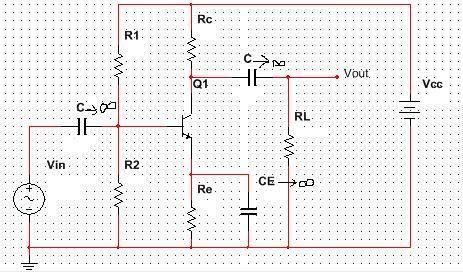
scheme.JPG

I don't know how to calculate Ai. I got that Av=-gm*rce*Rc*Rl/(Rc*Rl+rce*(Rc+Rl)) and it matches with solution given in my textbook.
I know that Ai=Iout/Iin but which current is Iout? Ai should be gm*rce/((rce+Rc*Rl/(Rc+Rl))*(1/R1+1/R2+1/rpi)).
 
Physics news on Phys.org
Iout is the current through the load, RL.
 
  • Like
Likes 1 person
It seemed to me also that Iout is current through Rl but when I calculate Iout/Iin it doesn't match with solution in textbook :(
 
The current that corresponds to gm*rce/((rce+Rc*Rl/(Rc+Rl))*(1/R1+1/R2+1/rpi)) is the total collector current; the sum of the currents in Rc and RL.
 
  • Like
Likes 1 person
etf said:
It seemed to me also that Iout is current through Rl but when I calculate Iout/Iin it doesn't match with solution in textbook :(
Well, the current through RL definitely should be Iout.

However, you could imagine an additional load in parallel with RL, with Iout going into that additional load. But this is just equivalent to making RL smaller.
 
@The Electrician
Does Iout depend of circuit configuration or it is always Ic? What would be Iout for this circuit:
dilema.JPG

?
 
I would say that what Iout is, depends on the intention of the problem originator.

Iout for the circuit in post #1 is the sum of the currents in Rc and RL because that's what gives the answer from your book.

Iout for the circuit you show in post #6 could be the total current out of the emitter of Q1, or it could be the current only in a load connected to Vout.
 
Here is current gain for circuit in my previous post:
Ai=(1+gm*R3pi)*rce/(R12E+rce), where R12E=R1||R2||RE, R3pi=R3||rpi.
Really tricky for me...
 
What is the definition of current gain you have used? Is it the total emitter current, or something else?
 
  • #10
etf said:
Here is current gain for circuit in my previous post:
Ai=(1+gm*R3pi)*rce/(R12E+rce), where R12E=R1||R2||RE, R3pi=R3||rpi.
Really tricky for me...

If I take Iout to be the sum of the currents in R1, R2 and RE then I get your result. Is that what you used for Iout?
 
  • #11
The Electrician said:
What is the definition of current gain you have used? Is it the total emitter current, or something else?
We did in class basic BJT amplifier configurations (common base, common collector and common emittor) and Iout is differently defined for every configuration. Maybe my task is incomplete, it should be emphasized what Iout is I think.
Thanks for help guys!
 

Similar threads

  • · Replies 14 ·
Replies
14
Views
4K
Replies
8
Views
4K
  • · Replies 8 ·
Replies
8
Views
2K
  • · Replies 2 ·
Replies
2
Views
4K
Replies
8
Views
2K
  • · Replies 6 ·
Replies
6
Views
2K
  • · Replies 7 ·
Replies
7
Views
6K
  • · Replies 23 ·
Replies
23
Views
4K
  • · Replies 2 ·
Replies
2
Views
3K
  • · Replies 4 ·
Replies
4
Views
2K