Calculating buckling strength of steel pipe for non-axial load

Click For Summary

Discussion Overview

The discussion focuses on calculating the buckling strength of a steel pipe subjected to non-axial loads, specifically in the context of a chaotic pendulum design. Participants explore the necessary calculations and considerations for determining the force a pipe can withstand before buckling occurs, including factors such as bending stress and material properties.

Discussion Character

  • Technical explanation
  • Debate/contested
  • Mathematical reasoning

Main Points Raised

  • One participant seeks guidance on calculating the buckling strength of a pipe used in a pendulum setup, mentioning a specific load of 2800N.
  • Another participant suggests ensuring the ratio of pipe diameter to wall thickness does not exceed 40 to avoid flexural buckling and recommends calculating the moment of inertia and bending moment.
  • A question is raised about the variable 'c' in the bending stress formula, which is clarified as half the outside diameter of the pipe.
  • Concerns are expressed regarding the type of piping material, with a recommendation to limit maximum bending stress to ensure a safety factor.
  • One participant emphasizes that the stress in question is bending stress rather than buckling, suggesting a reference to relevant structural specifications.
  • Another participant counters that flexural buckling is indeed relevant, referencing the initial post and the thread title.
  • A further comment notes that in steel structural engineering, buckling is often discussed in the context of Euler's formula rather than stress failure criteria.

Areas of Agreement / Disagreement

Participants express differing views on the relevance of bending stress versus buckling in this context. While some agree on the importance of both aspects, others emphasize one over the other, indicating that the discussion remains unresolved regarding the primary focus of the calculations.

Contextual Notes

Participants have not specified the assumptions regarding the type of steel or the exact conditions under which the pipe will be loaded, which may affect the calculations and recommendations provided.

sudnak
Messages
3
Reaction score
0
Hello All,

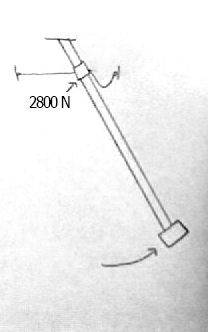
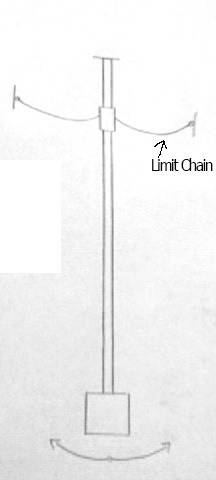
I am in the process of creating a 33' tall chaotic pendulum, and cannot find any calculations for the buckling strength of pipe. The pendulum swings from side to side, but is stopped as it goes too far one way or another by a limiting cable attached to a sleeve over the pendulum. So, essentially I have a pipe supported on one end and free on the other, and there will be a force applied to the end of the pipe. I need to know how to calculate the amount of force that different size pipes can take before they buckle. The force from the load, calculated at the fixed end of the pipe, is about 2800N. See picture for details. So, what formulas can I use to find this? Would I calculate section modulus and moment of inertia? Thanks for all the help!
pend force 1.jpg


pend force 2.jpg
 
Engineering news on Phys.org
sudnak: Ensure d2/t does not exceed 40, and then your steel pipe will not flexurally buckle, where d2 = pipe outside diameter (OD), and t = pipe wall thickness.

Yes, compute moment of inertia (I). Also compute bending moment (M) on the pipe at the cable. Then compute sigma = M*c/I. Ensure sigma does not exceed 170 MPa.

Because you have the cable tensile force, you can compute bending moment M, but you will need the distance from the pivot to the cable attach point, the distance from the pivot to the mass, the mass of the mass, and the angle between a vertical line and the pipe when the cable tensile force is 2800 N.
 
Last edited:
What is c in your M*c/I?
 
c = OD/2, where OD is outside diameter of the pipe.
 
You haven't specified the type of piping material or grade you are using. For ordinary pipe material, the maximum tensile strength is lower than that for ordinary steel (30 ksi for Grade A pipe v 36 ksi for ASTM A-36 steel). I would limit the max. bending stress to 120-125 MPa (18 ksi) to give yourself a reasonable factor of safety.
 
Awesome, thank you so much for the recommendations, I cannot tell you how much it helps!
 
Hi, i have some annotations:
- In this case, the kind of stress is bending, not buckling.
- I recommend you to consult the "Specification for Structural Steel Buildings (ANSI/AISC 360-10)": http://www.aisc.org/WorkArea/showcontent.aspx?id=26516 (go to F.8 chapter).
 
Last edited by a moderator:
mauchitoq: No, sudnak is correctly referring to flexural buckling, as well as bending stress. This was covered in post 2. Recheck, e.g., the subject title of the thread.
 
Last edited:
nvn: it's true. But in steel structural engineering, buckling usually is about the behavior explained with Euler formula, and not with the stress failure criteria.
 

Similar threads

Replies
2
Views
2K
  • · Replies 1 ·
Replies
1
Views
8K
  • · Replies 1 ·
Replies
1
Views
3K
Replies
6
Views
10K
Replies
3
Views
2K
  • · Replies 1 ·
Replies
1
Views
7K
Replies
1
Views
3K
Replies
5
Views
2K
  • · Replies 5 ·
Replies
5
Views
2K
Replies
2
Views
2K