Calculating Deceleration Using Calculus

Click For Summary

Homework Help Overview

The discussion revolves around calculating the deceleration required to stop an object, specifically a car traveling at 50 mph, over a distance of 40 feet. The subject area includes concepts from physics and calculus, particularly relating to motion and acceleration.

Discussion Character

  • Exploratory, Conceptual clarification, Mathematical reasoning

Approaches and Questions Raised

  • The original poster expresses confusion about how to approach the problem and seeks interpretation. One participant suggests using calculus by integrating a second-order differential equation to find deceleration. Another participant notes the necessity of calculus for solving such problems, contrasting it with simpler algebraic methods for constant velocity.

Discussion Status

The discussion is ongoing, with participants exploring different levels of understanding regarding calculus and its application to the problem. Some guidance has been offered regarding the use of calculus, but there is no consensus on how to proceed given the original poster's self-identified lack of knowledge in the subject.

Contextual Notes

There is an indication that the original poster may need to acquire a foundational understanding of calculus to tackle the problem effectively. The discussion also highlights the difference between constant velocity and variable speed scenarios, emphasizing the role of calculus in the latter.

shableep
Messages
2
Reaction score
0
A friend of mine lead me to this math example when I asked him what math would be involved in finding the deceleration necessary to stop an already accelerated object over a certain distance. For example, a car going 50mph that must stop in 40ft.

This was the example...
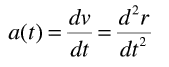
time-dependant-acceleration.gif


...and I have no idea where to start. Could anyone help me interpret this? And... sorry about bugging you guys with my general lack of physics understanding.
 
Physics news on Phys.org
Do you know calculus? If you want to stop with a constant deceleration a start with

[itex]x''(t) = -a[/itex] and integrate twice to get position as a function of a and t. Set the initial velocity to 50mph (in feet per second2), initial position x = 0 and require the velocity is 0 when x = 40. Solve for a.
 
Thanks, LCKurtz. And no, I don't know calculus =( And while I'm sure this is probably infinitely useful, I unfortunately don't know what it is to integrate twice. It's looking like I might be in over my head and I should look into some good calculus books.

Thanks again for the help.
 
Well, yes you will need calculus to solve that kind of problem, although some non-calculus physics books may give you the formulas without deriving them. You can do constant velocity problems with algebra using d = rt, but variable speed requires calculus. Early editions of calculus books are available cheap. You don't need the latest ones.
 

Similar threads

  • · Replies 46 ·
2
Replies
46
Views
12K
Replies
8
Views
6K
Replies
2
Views
2K
  • · Replies 20 ·
Replies
20
Views
2K
Replies
4
Views
1K
Replies
3
Views
2K
  • · Replies 17 ·
Replies
17
Views
4K
Replies
5
Views
5K
  • · Replies 2 ·
Replies
2
Views
1K
  • · Replies 9 ·
Replies
9
Views
2K