Calculating distance (from magnet) to an arbitrary point in 3D space

  • Context: Undergrad 
  • Thread starter Thread starter egoodchild
  • Start date Start date
  • Tags Tags
    3d Magnet Point Space
Click For Summary

Discussion Overview

The discussion revolves around calculating the distance from a permanent magnet to an arbitrary point in 3D space based on the magnetic field strength measured at that point. Participants explore the mathematical relationships involved, particularly using the magnetic dipole model, while addressing challenges related to the uniqueness of the solution.

Discussion Character

  • Technical explanation
  • Mathematical reasoning
  • Debate/contested

Main Points Raised

  • One participant seeks assistance in deriving an equation to calculate the distance 'r' from the center of a magnet to an arbitrary point using known values of magnetic field strength (B) and magnetic moment (m).
  • Another participant suggests taking the magnitude of both sides of the magnetic dipole equation to solve for 'r', indicating that the only vector component involves calculating the magnitude of a specific vector expression.
  • A participant expresses difficulty in solving scalar equations, indicating a lack of confidence in their mathematical skills.
  • Concerns are raised about the non-uniqueness of the relationship between B and r, with one participant noting that multiple locations can yield the same magnitude of B, suggesting that the relationship is not one-to-one.
  • Another participant agrees that there are multiple distances corresponding to the same magnitude of B, emphasizing that the field does not exhibit spherical symmetry.
  • One participant argues that for their specific application, the B-field is mostly spherical, suggesting that while the relationship may not be unique, it is still achievable under constrained conditions.

Areas of Agreement / Disagreement

Participants generally agree that the relationship between the magnetic field strength and distance is not one-to-one, leading to multiple possible distances for the same field strength. However, there is some contention regarding the nature of the B-field's symmetry and its implications for the calculations.

Contextual Notes

Participants note limitations regarding the uniqueness of the solution and the implications of the magnetic field's shape and symmetry on the calculations. The discussion does not resolve these complexities.

egoodchild
Messages
4
Reaction score
0
TL;DR
Looking to learn how to calculate the distance from the center of a magnetic dipole to an arbitrary point in 3D space assuming we know the B-field at that arbitrary point as well as the characteristics of the dipole in question.
So I'm looking for some advice on a problem that I am trying to solve for a project. I'm an engineer but my background in vector mathematics is very minimal so I'm looking for some assistance.

Lets assume we have a permanent magnet. We know the characteristics of this magnet, such as it's dimensions and residual flux density, etc. Now let's say we pick some arbitrary point away from this magnet in 3D space and we define the distance from that point to the center of the magnet as 'r'. Additionally we measure the B-field at this arbitrary point and know the field strength in all 3 dimensions.

I would like to be able to calculate the distance 'r' from the center of magnet to the arbitrary point in meters.

Now from what I have gathered so far I think the way to do this is by using the equation for a magnetic dipole:
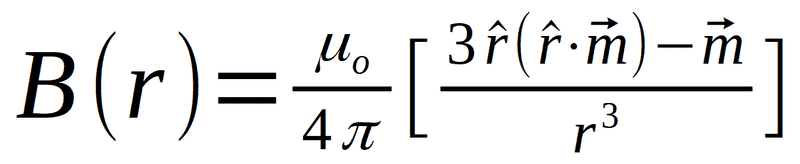
image.png

Above image from K&J Magnetics

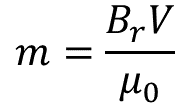
Where m is:
1650323973325.png


B is known, m is known and we are looking to calculate 'r'.

Now where I get a bit lost is finding the reciprocal of this equation in vector form. As mentioned my end goal is an equation that has an input of B and output of r.

Any help on how to derive this or a resource to take a look at to help would be great.

Thanks in advance!
 
Physics news on Phys.org
You don't need to get a reciprocal in vector form. Just take the magnitude of both sides. Then you have
$$\|B\| =B = \frac{\mu_0}{4\pi} \frac{\|3\hat r(\hat r\cdot \vec m) - \vec m\|}{r^3}
=\frac{\mu_0}{4\pi} \frac{\|(3 m \cos\theta)\hat r - \vec m\|}{r^3}
$$
where ##\theta## is the angle between ##\hat r## (the unit direction vector pointing at the point you're interested in) and ##\vec m##.

The symbols ##\|...\|## indicate taking the magnitude of a vector.

This is a scalar equation that you can solve for ##r## in the usual way. The only vector bit is working out the vector ##(3 m \cos\theta)\hat r - \vec m## and getting its magnitude. You can do that with a diagram, or by calculation if you have the components.
 
Thanks so much for the reply! Solving a scaler equation in the usual way is where I'm stuck. I don't know how to go about solving a scaler equation. This level of math is not by strongest subject.
 
But you may have the same magnitude of B at different distances. The relationship does not have to be one-to-one. The field does not have spherical symmetry, does it?
 
You are correct, there are going to be multiple locations where B (and r) will have the same absolute magnitude. For my application this is fine, I'm only interested in knowing the total distance my arbitrary point is away from center of the magnet.
 
No, B will have the same magnitude for different values of r, not for the same r. So you cannot tell just from the magnitude of B what is the distance. There is no unique answer. It's not just the positon being undetermined but the distance itself. Look at a map of lines of equal B for a magnet. You will see that they are not circles (spheres).
 
For my application, size/shape of magnet my B-field is mostly spherical. This can be seen in a magnetics simulation:
1650491385204.png

The contours of the field do change direction as you move around a circle from the origin at a fixed radius, however the absolute value of B will be mostly constant. This can be observed above as the color contour being circular in nature.

So from a basic perspective, I know what I'm trying to achieve is possible (although be it only in constrained conditions).
 

Similar threads

  • · Replies 6 ·
Replies
6
Views
2K
  • · Replies 16 ·
Replies
16
Views
2K
  • · Replies 8 ·
Replies
8
Views
1K
  • · Replies 28 ·
Replies
28
Views
3K
  • · Replies 12 ·
Replies
12
Views
2K
  • · Replies 4 ·
Replies
4
Views
2K
  • · Replies 1 ·
Replies
1
Views
1K
  • · Replies 27 ·
Replies
27
Views
3K
  • · Replies 9 ·
Replies
9
Views
4K
  • · Replies 2 ·
Replies
2
Views
3K