Calculating Equivalent Capacitance for C1, C2 & C3

Click For Summary
To determine the values of C1, C2, and C3 that make the terminal pairs equivalent, the discussion focuses on calculating the equivalent capacitance for both circuits. The series capacitance of 2f and 1f is calculated as 2/3, while the parallel capacitance with 1/2f results in a total of 7/6. The next step involves setting up three simultaneous equations to ensure that the capacitances from the left and right circuits match at the terminals. The left circuit's capacitance to ground is also calculated as 2/3, while the right circuit's capacitance to ground totals 2. Clarification is sought on how to proceed with solving these equations for C1, C2, and C3.
magnifik
Messages
350
Reaction score
0
for what values of C1, C2, and C3 make the terminal pairs equivalent?
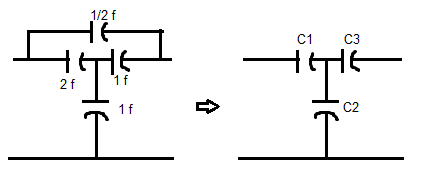
vhz6ll.png


i know the 2f and 1f capacitance are in series:
(1*2)/(1+2) = 2/3

and i know the 1/2 f is parallel to the preceding capacitors:
2/3 + 1/2 = 7/6

but i am unsure where to go from here...
any help would be appreciated. thx.
 
Physics news on Phys.org
magnifik said:
for what values of C1, C2, and C3 make the terminal pairs equivalent?

vhz6ll.png


i know the 2f and 1f capacitance are in series:
(1*2)/(1+2) = 2/3

and i know the 1/2 f is parallel to the preceding capacitors:
2/3 + 1/2 = 7/6

but i am unsure where to go from here...
any help would be appreciated. thx.

I believe you will need to solve 3 simultaneous equations (no big deal). The capacitances have to be equal for the two circuits, as seen at the left and right ports, and across the top leg.

So if you call the bottom rail Ground, then you have to find C1, C2, C3, so that you match the left circuit's capacitances:

C(left to ground)
C(right to ground)
C(left to right)

You've already found the C(left to right) that needs to be matched. Calculate the other two capacitances for the left circuit, and then write the equations for the capacitances of the right circuit, and solve for the values of C1, C2, C3.
 
from what you said...

C(left to ground) = 1*2/(1+2) = 2/3
C(right to ground) = 1+1 = 2
C(left to right) = 7/6

i'm a little confused on what you're saying should be the last step
 

Similar threads

  • · Replies 4 ·
Replies
4
Views
5K
  • · Replies 22 ·
Replies
22
Views
5K
  • · Replies 27 ·
Replies
27
Views
5K
  • · Replies 11 ·
Replies
11
Views
3K
  • · Replies 3 ·
Replies
3
Views
2K
Replies
8
Views
2K
  • · Replies 21 ·
Replies
21
Views
3K
  • · Replies 2 ·
Replies
2
Views
1K
  • · Replies 11 ·
Replies
11
Views
2K
  • · Replies 29 ·
Replies
29
Views
4K