Calculating HP from speedometer video

  • Thread starter Thread starter bwilson4web
  • Start date Start date
  • Tags Tags
    Video
Click For Summary
SUMMARY

The discussion centers on the horsepower (HP) calculations for the 2016 Toyota Prius during maximum acceleration, as documented in a video by Jason from Jalopnik. The calculations reveal that the initial horsepower is significantly low, peaking at 90-100 HP after a few seconds. Factors influencing this include the Prius's electronic continuously variable transmission (eCVT) and potential limitations of the electric motor and drivetrain. The participants suggest that control laws may limit torque to prevent tire spin and improve fuel economy, with further testing planned to analyze traction force.

PREREQUISITES
  • Understanding of kinetic energy calculations in automotive contexts
  • Familiarity with electronic continuously variable transmission (eCVT) technology
  • Knowledge of horsepower and torque dynamics in electric vehicles
  • Basic principles of vehicle aerodynamics and drag coefficients
NEXT STEPS
  • Research the mechanics of electronic continuously variable transmissions (eCVT)
  • Learn about the relationship between torque and horsepower in electric motors
  • Investigate the impact of vehicle weight and drag on acceleration performance
  • Explore methods for measuring traction force in hybrid vehicles
USEFUL FOR

Automotive engineers, hybrid vehicle enthusiasts, and anyone interested in the performance dynamics of electric and hybrid drivetrains.

bwilson4web
Messages
11
Reaction score
0
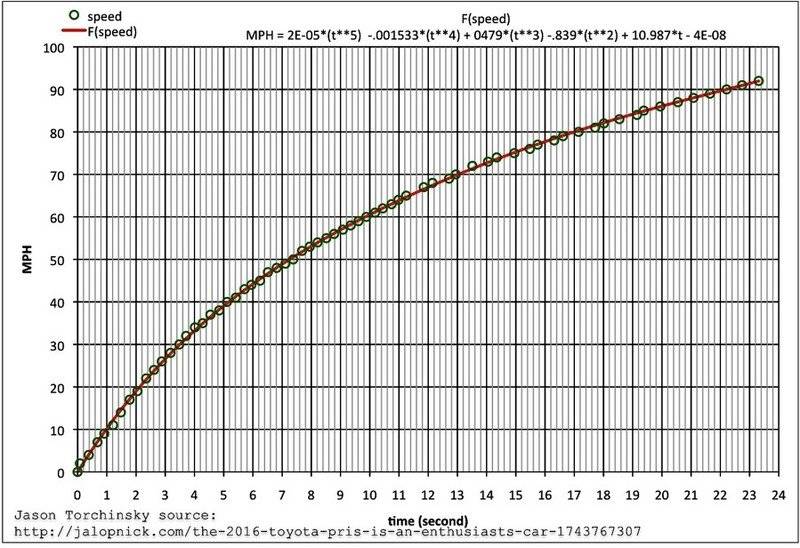
Recently, Toyota held a 'press drive' day for their 2016 Prius and Jason of Jalopnick had the good sense to make a video of the speedometer during a maximum acceleration. I downloaded the video and coded the timestamps of each speed change to generate this curve:
2016_metrics_200.jpg

This confirmed the 0-60 is ~9.8 seconds like the current model. But we also knew the curb weight, gasoline level, and Jason's weight.

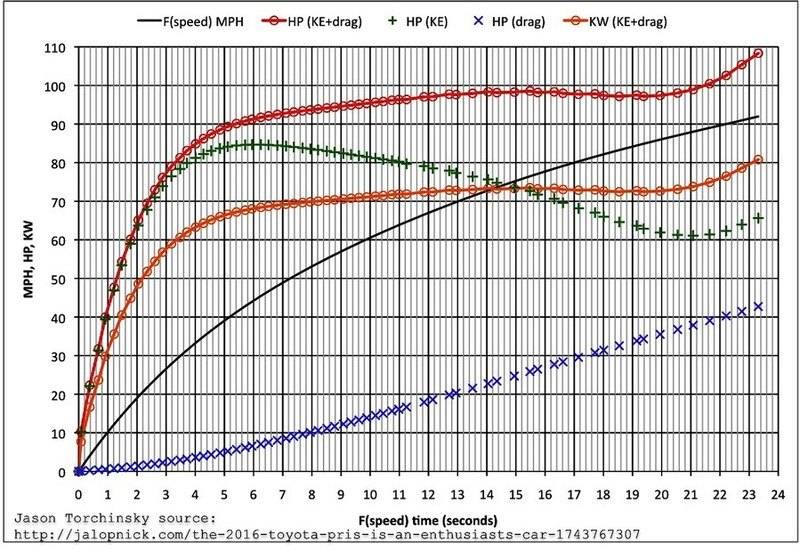
So three of us independently calculated the power required with similar results and this is mine:
2016_metrics_210.jpg

  • HP (KE) - the horsepower calculated by the kinetic energy change of the accelerating car.
  • HP (drag) - the previous model roll-down coefficients with the velocity squared term (aerodynamic drag) scaled by the improved coefficient of drag change, .24 / .25.
What has me puzzled is the low, initial acceleration horsepower:
  • 40 hp @ 1 second
  • 65 hp @ 2 seconds
  • 77 hp @ 3 seconds
  • 85 hp @ 4 seconds
  • levels off at 90-100 hp
Now the Prius uses an electronic, constant velocity transmission, effectively an infinite ratio eCVT. My first thought was the low, early horsepower was to avoid breaking traction and uselessly spinning the tires. Someone else speculated it was a limitation of the Prius engine and eCVT. So my question is how to resolve this?

I am planning to do a pull-test with our current model, Prius and measure how much traction force it asserts. My thinking is the control laws should limit the zero speed, torque to a finite limit. This is probably in the same order of magnitude as the new Prius since both are rated at the same 0-60 times.
The only other approach would be to set a torque limit and see what it does for the early acceleration curve.

Thoughts?

Bob Wilson, Huntsville AL

ps. Toyota changed the control laws so the engine speed is proportional to the speed. It would make sense that this avoids a useless engine wind-up if so little power is actually needed to the wheels.
 
Physics news on Phys.org
Breaking traction would only be an issue for a second or less.

My suspicion is that if you add torque to the graph, you'll find the torque is constant. That would be a limitation of the electric motor (high torque+low rpm = overheating) and/or a choice by the engineers to improve fuel economy.
 
The low early horsepower is likely a limitation of the drivetrain. Even with a CVT, the gear ratios are not infinitely variable, and at close to zero speed, the available power will be limited by the fact that the drive motor is also spinning at near zero speed (where it cannot make peak power). Once the car is moving fast enough that the drive motor is able to spin at the correct speed to make maximum power, the CVT changes ratios continuously to hold the drive motor at this speed, and thus the power levels off. If you looked at the tachometer, I would bet that from 0-5 seconds in your graph, the drive motor is accelerating, and from 5 seconds onwards, the motor RPM would be held constant while the gear ratio changed. This isn't really a problem for the car because at low speed, you do not need much power for adequate acceleration, and by the time you reach a speed where having the additional power is important (30 or 40 mph, in this case), the motor is spinning fast enough to provide that power.
 
I know very little about the prius but I heard that the gas motor isn't used at low speeds - so at what point does it cut in? Is it used at low speed when max acceleration is called for?
 
If the gas motor is not used at low speeds, then the power is probably limited by the batteries maximum discharge rate, not the electric motor's maximum rating.
 

Similar threads

  • · Replies 17 ·
Replies
17
Views
3K
  • · Replies 35 ·
2
Replies
35
Views
2K
  • · Replies 26 ·
Replies
26
Views
7K
  • · Replies 21 ·
Replies
21
Views
10K
  • · Replies 7 ·
Replies
7
Views
5K
  • · Replies 8 ·
Replies
8
Views
5K
  • · Replies 7 ·
Replies
7
Views
5K
Replies
9
Views
5K
  • · Replies 3 ·
Replies
3
Views
4K
  • · Replies 18 ·
Replies
18
Views
35K