Calculating Iout & Output Resistance of BJT-MOSFET Circuit

Click For Summary

Discussion Overview

The discussion revolves around calculating the output current (Iout) as a function of Vc2 and determining the output resistance of a BJT-MOSFET circuit. The context includes theoretical calculations and circuit analysis, specifically focusing on the behavior of the circuit under certain conditions.

Discussion Character

  • Technical explanation
  • Debate/contested

Main Points Raised

  • One participant requests to calculate Iout as a function of Vc2 and the output resistance for specific conditions, noting the neglect of the Early effect.
  • Another participant defines VDD as a positive DC supply voltage and suggests that VA might be a typo for VDD.
  • Some participants clarify that VA refers to the Early voltage and is distinct from VDD.
  • A participant mentions that VDD typically serves as the biasing voltage source for the amplifier to operate in the active region, contrasting it with the use of VCC in their experience.
  • There is a suggestion that the actual value of VDD may not significantly impact the circuit's behavior due to the presence of a current source in series.
  • Another participant notes that in practical applications, the current source is often represented as a transistor network for simplification in analysis.

Areas of Agreement / Disagreement

Participants express differing views on the interpretation of VDD and VA, with no consensus reached on whether VDD is synonymous with VA. The discussion remains unresolved regarding the implications of these definitions on the circuit analysis.

Contextual Notes

There are assumptions regarding the definitions of VDD and VA, and the discussion does not clarify the impact of these definitions on the calculations requested. The role of the current source in the circuit is also noted but not fully explored.

etf
Messages
179
Reaction score
2
Hi!
Here is my task:
a) Calculate and sketch Iout=f(Vc2), for 0<Vc2<1.5V. (neglect Early effect)
b) calculate output resistance for Vc2=Vc1.
BJT's Q1 and Q2 are in forward active mode, have identical characteristics and same temperature. MOSFET M3 is in saturation. Iin=10μA, Vt=25mV, Vc1=1.25V, VA=50V.
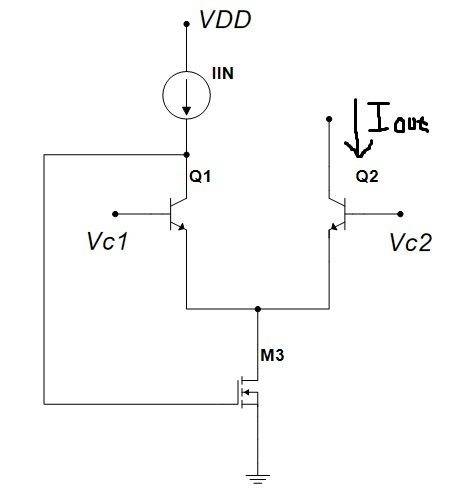
vdd.jpg


My question is, what does VDD represent? There are few examples in my book where VDD is connected to some current source like this...
 
Physics news on Phys.org
VDD will be a +ve DC supply voltage. Your text refers to VA =50V. My guess is this is a typo and VDD is meant to be VA?
 
I don't think so. VA is Early voltage.
 
Generally with questions like this VDD is the biasing voltage source that puts the amplifer into the active region. My prof always used VCC for it :)
 
  • Like
Likes   Reactions: 1 person
etf said:
I don't think so. VA is Early voltage.

I think you're right.

The actual value of VDD isn't really important in this circuit as there is a current source in series.
 
  • Like
Likes   Reactions: 1 person
In real life that current source will be a transistor network. It it frequently represented as a current source to simplify analysis.
 
  • Like
Likes   Reactions: 1 person

Similar threads

  • · Replies 2 ·
Replies
2
Views
2K
  • · Replies 2 ·
Replies
2
Views
4K
Replies
0
Views
2K
  • · Replies 1 ·
Replies
1
Views
2K
  • · Replies 15 ·
Replies
15
Views
9K
  • · Replies 10 ·
Replies
10
Views
3K
  • · Replies 2 ·
Replies
2
Views
3K
  • · Replies 16 ·
Replies
16
Views
3K
  • · Replies 5 ·
Replies
5
Views
3K
Replies
2
Views
2K