SUMMARY
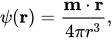
The discussion focuses on calculating Jupiter's magnetic dipole moment using a dipole approximation, where Jupiter's magnetic field strength is approximately 14 G at its poles. The initial calculations for the magnetic dipole moment (T) were incorrect due to unit errors and the use of the wrong equations. The correct formula involves the magnetic moment constant (M) and the radius of Jupiter (69.9 x 10^6 m), leading to a final calculation of 2.6 x 10^29 A/m². The participants clarified the distinction between torque and magnetic field equations, emphasizing the need for accurate unit conversions and proper formula application.
PREREQUISITES
- Understanding of magnetic dipole moments
- Familiarity with the equations T = U * B and u = 2UB
- Knowledge of unit conversions in physics
- Basic concepts of magnetic fields and their measurements
NEXT STEPS
- Study the derivation of the magnetic dipole field equations
- Learn about the physical significance of magnetic moments in astrophysics
- Explore the implications of Jupiter's magnetic field on its atmosphere and moons
- Review torque equations and their applications in magnetic systems
USEFUL FOR
Students and researchers in astrophysics, physicists interested in magnetic fields, and anyone studying planetary magnetism and its effects.