Calculating Length of Arc BD with Hookes Law

Click For Summary
SUMMARY

The discussion focuses on calculating the new length of arc BD using Hooke's Law, with given parameters of E=65 GPa and V=0.3. The stresses identified are \sigmaxx=-56 MPa, \sigmayy=0, and \sigmaxy=-28 MPa, leading to strains \epsilonxx=-8.615e-5, \epsilonyy=2.58e-4, and \gamma=-1.12e-3. The user seeks to determine the change in arc length and the new angle DAB using transformation equations and integration, ultimately questioning the validity of their approach and calculations.

PREREQUISITES
  • Understanding of Hooke's Law and its application in material deformation.
  • Familiarity with stress and strain calculations in materials science.
  • Knowledge of polar coordinate systems and transformation equations.
  • Basic calculus, particularly integration techniques for continuous functions.
NEXT STEPS
  • Study the application of Hooke's Law in polar coordinates for arc deformation.
  • Learn about transformation equations for stress and strain in two-dimensional systems.
  • Explore integration techniques for calculating changes in length due to strain.
  • Investigate the relationship between angular strain and deformation in circular arcs.
USEFUL FOR

Mechanical engineers, materials scientists, and students studying mechanics of materials who are involved in analyzing deformation and stress in structural components.

Dell
Messages
555
Reaction score
0
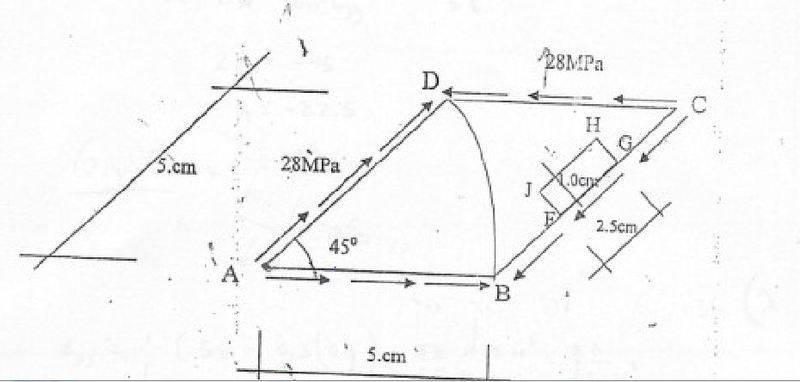
in the following question,

E=65 GPa
V=0.3
Capture.JPG


find the new length of the arc BD??

i have found the stresses

\sigmaxx=-56Mpa
\sigmayy=0
\sigmaxy=-28Mpa

using hookes law i can find the strains

\epsilonxx=-8.615e-5
\epsilonyy=2.58e-4
0.5*\epsilonxy=\gamma=-1.12e-3

but how do i calculate the change in the arc using this? i would know how to solve this if i had some kind of angular strain- i need to use a polar system not Cartesian. is there any way to do this?

also how do i know the new angle DAB? i know that the XY axis' new angle is 90.06417, and the n,t system (axes tilted 45 degrees to XY) is also 90.06417 but how do i find DAB,? generally is there any way of knowing how the axis is strained, for example, has the X axis dropped 0.06417 degrees, or the Y axis opened up 0.06417 degrees, or a bit each??
in this specific case can i say that since there is no yy strain the x-axis stays at the same angle?

DA*=DA(1+\epsilontt)=4.999569cm
AB*=5.0012923cm
 
Last edited:
Physics news on Phys.org
can i do this:

using the transformation equations, i know

εnn= (εxx + εyy)/2 + (εxx - εyy)/2*cos(2ϴ) + εxxsin(2ϴ)

since i have already found xx, yy, xy, instead of looking for a specific εnn can i take the whole eqaution and say

ΔL=\intεnndL {dL=r*dϴ}

=\intεnn*r*dϴ with my integral going from 0 to pi/4

is this a possibility?
 
i tried the following logic,
since in this special specific case, i have found that \epsilonxx = \epsilonAD, i know that the radiiii will stay rhe same lengths as each other after deformation therefore preserving the circular shape of the arc

knowing that the volume of the shape with an area of an eighth of a circle (DAB) before deformation is V and after deformation is V'
lets say the thickness of the board is "t"

the new angle DAB is " a' " after deformation

\Delta=(\epsilonxx +\epsilonyy + \epsilonzz)

V=(pi*R2)t/8

V'= (a')(R')2(t')/2

but i also know that

V'=\Delta*(1+V)
R'=R(1+\epsilonxx)
t'=t(1+\epsilonzz)

(a')(R')2(t')=(pi*R2)t/8*(1+\epsilonxx +\epsilonyy + \epsilonzz)

(a')(R(1+\epsilonxx))2(t(1+\epsilonzz))=(pi*R2)t/8*(1+\epsilonxx +\epsilonyy + \epsilonzz)therfore i get

(a')= (pi/4)*(1+\epsilonxx +\epsilonyy + \epsilonzz)/[(1+\epsilonxx))2((1+\epsilonzz))]

once i have the new angle, since it is still an arc of a circle

L'=R'*a'
L=R*pi/4

\deltaL=L'-L

but this gives me an incorrect answer

is this a correct method and do i maybe have something wrong in y calculations

i get \deltaL=1.016463761198405e-005
 

Similar threads

  • · Replies 1 ·
Replies
1
Views
2K
  • · Replies 1 ·
Replies
1
Views
2K
Replies
3
Views
5K
  • · Replies 1 ·
Replies
1
Views
2K
  • · Replies 5 ·
Replies
5
Views
4K
  • · Replies 5 ·
Replies
5
Views
3K
  • · Replies 1 ·
Replies
1
Views
4K
  • · Replies 1 ·
Replies
1
Views
14K
  • · Replies 2 ·
Replies
2
Views
3K
  • · Replies 5 ·
Replies
5
Views
14K