Dell
- 555
- 0
please help urgent!
in the following question,
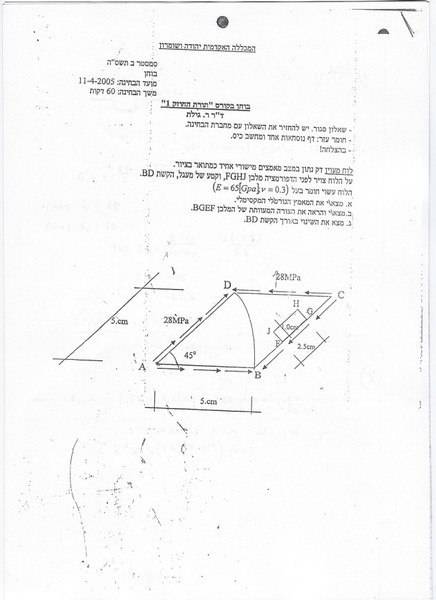
E=65 GPa
V=0.3
find the new length of the arc BD??
i have found the stresses
xx=-56Mpa
yy=0
xy=-28Mpa
using hookes law i can find the strains
xx=-8.615e-5
yy=2.58e-4
0.5*xy==-1.12e-3
but how do i calculate the change in the arc using this? i would know how to solve this if i had some kind of angular strain- i need to use a polar system not Cartesian. is there any way to do this?
also how do i know the new angle DAB? i know that the XY axis' new angle is 90.06417, and the n,t system (axes tilted 45 degrees to XY) is also 90.06417 but how do i find DAB,? generally is there any way of knowing how the axis is strained, for example, has the X axis dropped 0.06417 degrees, or the Y axis opened up 0.06417 degrees, or a bit each??
in this specific case can i say that since there is no yy strain the x-axis stays at the same angle?
DA*=DA(1+tt)=4.999569cm
AB*=5.0012923cm
can i do this:
using the transformation equations, i know
εnn= (εxx + εyy)/2 + (εxx - εyy)/2*cos(2ϴ) + εxxsin(2ϴ)
since i have already found xx, yy, xy, instead of looking for a specific εnn can i take the whole eqaution and say
ΔL=[tex]\int[/tex]εnndL {dL=r*dϴ}
=[tex]\int[/tex]εnn*r*dϴ with my integral going from 0 to pi/4
is this a possibility?
the correct answer is meant to be 2.2167e-5m
how do i know whhat my lims are for integratin, i thought maybe pi/2 -> 3pi/4 but can't get it
in the following question,
E=65 GPa
V=0.3
find the new length of the arc BD??
i have found the stresses
xx=-56Mpa
yy=0
xy=-28Mpa
using hookes law i can find the strains
xx=-8.615e-5
yy=2.58e-4
0.5*xy==-1.12e-3
but how do i calculate the change in the arc using this? i would know how to solve this if i had some kind of angular strain- i need to use a polar system not Cartesian. is there any way to do this?
also how do i know the new angle DAB? i know that the XY axis' new angle is 90.06417, and the n,t system (axes tilted 45 degrees to XY) is also 90.06417 but how do i find DAB,? generally is there any way of knowing how the axis is strained, for example, has the X axis dropped 0.06417 degrees, or the Y axis opened up 0.06417 degrees, or a bit each??
in this specific case can i say that since there is no yy strain the x-axis stays at the same angle?
DA*=DA(1+tt)=4.999569cm
AB*=5.0012923cm
can i do this:
using the transformation equations, i know
εnn= (εxx + εyy)/2 + (εxx - εyy)/2*cos(2ϴ) + εxxsin(2ϴ)
since i have already found xx, yy, xy, instead of looking for a specific εnn can i take the whole eqaution and say
ΔL=[tex]\int[/tex]εnndL {dL=r*dϴ}
=[tex]\int[/tex]εnn*r*dϴ with my integral going from 0 to pi/4
is this a possibility?
the correct answer is meant to be 2.2167e-5m
how do i know whhat my lims are for integratin, i thought maybe pi/2 -> 3pi/4 but can't get it
Last edited: