Calculating Line Integral on Curve C (IR3)

Join the discussion
Ask a follow-up here, or get your own question answered by working scientists, mathematicians and engineers — people, not an autocomplete.
Real named experts · corrections over time · the nuance an AI answer skips
11 replies · 3K views
portuguese
Messages
15
Reaction score
0
Consider that the curve C (IR3) is the intersection between x2+2z2=2 and y=1.

Calculate the line integral:
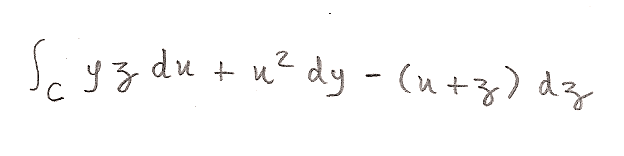
MmJ6C.png
Note: The curve C is traversed one time in the counter-clockwise direction (seen from the origin of IR3).

My attempt:

http://i.imgur.com/5EsJO.png

Can someone check? Thanks! :)
 
Last edited by a moderator:
Physics news on Phys.org
If I have the question right, a lot of simplification is possible.
Given y = 1, the integral wrt y is zero, and y can be set to 1 elsewhere.
I also notice there's integral x.dz - integral z.dx. Hmmm... what do you think that might simplify to? Think of the geometric meaning, or of integration by parts.
 
But it is still correct?
 
Thanks! Btw, I understand your simplifications, but I have to do this way... ;)
 
You have curve C defined in an xyz- coordinate system but you have u, y, and z in your integral. Did you intend
[tex]\int_C yzdx+ x^2dy- (x+ z)dz[/tex]?

Assuming that, since y= 1, a constant, dy= 0 so we can ignore the middle term.

I would be inclined to parameterize the curve by [itex]x= \sqrt{2}cos(\theta)[/itex], [itex]y= 1[/itex], [itex]z= sin(\theta)[/itex].

Then [itex]dx= -\sqrt{2}sin(\theta)d\theta[/itex] and [itex]dz= cos(\theta)d\theta[/itex].

The integral becomes
[tex]\int_0^{2\pi} sin(\theta)(-\sqrt{2}sin(\theta)d\theta)- (\sqrt{2}cos(\theta)+ sin(\theta))cos(\theta)d\theta[/tex]
[tex]= \int_0^{2\pi}[-\sqrt{2}(sin^2(\theta)+ cos^2(\theta))- \sqrt{2}sin(\theta)cos(\theta)]d\theta[/tex]
[tex]= -\sqrt{2}\int_0^{2\pi}[1+ sin(\theta)cos(\theta)]d\theta[/tex]

The answer you give, t/2- (1/4)sin(2t), can't possibly be correct because it is a function of t and there was not even a "t" in the problem! Did you intend to evaluate that at t= 0 and [itex]2\pi[/itex]?
 
Last edited by a moderator:
HallsofIvy said:
The answer you give, t/2- (1/4)sin(2t), can't possibly be correct because it is a function of t and there was not even a "t" in the problem! Did you intend to evaluate that at t= 0 and [itex]2\pi[/itex]?

The way I read it, the equations involving t are explanatory notes. The answer it gives earlier is "= 0".
 
Yeah, my answer is 0
 
I found my mistake. I wrote:
HallsofIvy said:
The integral becomes
[tex]\int_0^{2\pi} sin(\theta)(-\sqr{2}sin(\theta)d\theta)<span style="font-size: 22px">+ (\sqr{2}cos(\theta)+ sin(\theta))cos(\theta)d\theta</span>[/tex]
[tex]=...[/tex]
[tex] <br /> It's not 0, you're right. Thanks a lot! ;)[/tex]
 
portuguese said:
I found my mistake.
And I've found mine :blushing:.
As HofI, I reasoned that we can get rid of the y terms, leaving:
[itex]\int_C zdx- (x+ z)dz = \int_C (zdx-xdz) + zdz[/itex]
Around a closed loop, zdz goes to zero (at each z, a dz cancels a -dz).
[itex]\int_C zdx[/itex] and [itex]\int_C xdz[/itex] are each the area inside the loop. So I thought these canceled too. But I overlooked that one will effectively run the opposite direction around the loop, so will add, not cancel. So the whole reduces to twice the area of the ellipse.