Calculating Magnetic Flux: Understanding the Formula and Variables

Click For Summary

Homework Help Overview

The discussion revolves around calculating magnetic flux through a loop of wire shaped in an L configuration, with specific dimensions and a magnetic field defined by its magnitude and direction. Participants are exploring the application of the magnetic flux formula and the implications of the loop's orientation relative to the magnetic field.

Discussion Character

  • Exploratory, Assumption checking, Conceptual clarification

Approaches and Questions Raised

  • Participants discuss the application of the formula \(\phi = BA \cos \theta\) and question the correct interpretation of the angles and areas involved. There is a focus on identifying which parts of the loop contribute to the magnetic flux and the relationship between the magnetic field direction and the loop's planes.

Discussion Status

There is an ongoing exploration of the problem, with participants providing guidance on visualizing the magnetic field's interaction with the loop. Some participants suggest calculating the flux for different planes separately and combining the results, while others clarify the angles involved in the calculations.

Contextual Notes

Participants express confusion regarding the application of the formula and the interpretation of the magnetic field's direction. There is acknowledgment of potential misunderstandings in the initial setup and calculations, as well as a recognition of the need for clearer explanations in educational materials.

wr1015
Messages
53
Reaction score
0
A rectangular loop of wire 24 cm by 72 cm is bent into an L shape, as shown in Figure 23-37. The magnetic field in the vicinity of the loop has a magnitude of 0.034 T and points in a direction = 22° below the y axis. The mangnetic field has no x component. Find the magnitude of the magnetic flux through the loop.
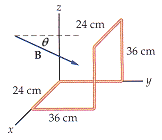
23-37alt.gif

why doesn't the formula [tex]\phi = BA cos \theta[/tex] work, when A = (.36)[tex]^2[/tex], [tex]\theta[/tex] = 22, and B = .034T?? what am i missing here?
 
Last edited:
Physics news on Phys.org
You've done the part parallel to the xz plane, so what about the xy plane? Don't just blindly use the formula, think about which parts of the loop have magnetic flux going through them.
 
Physics Monkey said:
You've done the part parallel to the xz plane, so what about the xy plane? Don't just blindly use the formula, think about which parts of the loop have magnetic flux going through them.

don't you mean the yz plane?? the magnetic field doesn't have any x-component
 
No, I mean the xy plane. Why is that what I mean? Does the x component of the field have anything to do with the flux through the xy plane?
 
Physics Monkey said:
No, I mean the xy plane. Why is that what I mean? Does the x component of the field have anything to do with the flux through the xy plane?

i don't understand what you're talking about... all i know is that if the loop is perpendicular to the field [tex]\theta[/tex] = 0 and if its parallel [tex]\theta[/tex] = 90

are you supposed to do 2 separate flux calcualtions (one for each plane) and add them accordingly?
 
Last edited:
You are going to have to do a little thinking here. I know you know more than just a formula. The flux is essentially how much field goes through the loop, right? So just by looking at your picture, can you tell if some of the field goes through the part of the loop in the xy plane. Just look and see.
 
Physics Monkey said:
You are going to have to do a little thinking here. I know you know more than just a formula. The flux is essentially how much field goes through the loop, right? So just by looking at your picture, can you tell if some of the field goes through the part of the loop in the xy plane. Just look and see.

yes it looks like it will eventually go through the xy plane
 
Good. However, remember that the field is at each point in space, so "eventually" isn't really the right word. The field does go through the xy plane part of the loop.

Ok, so now that you have your picture, try using your formula. What angle is the field at relative to the normal of the xy plane? Hint: it isn't just [tex]\theta = 22^\circ[/tex], but it's related to that angle.
 
Physics Monkey said:
Good. However, remember that the field is at each point in space, so "eventually" isn't really the right word. The field does go through the xy plane part of the loop.

Ok, so now that you have your picture, try using your formula. What angle is the field at relative to the normal of the xy plane? Hint: it isn't just [tex]\theta = 22^\circ[/tex], but it's related to that angle.

90-22 = 68.. right?
 
  • #10
Good. Now calculate the flux through the xy plane and add it to your previous result to obtain the total flux through the loop.
 
  • #11
Physics Monkey said:
Good. Now calculate the flux through the xy plane and add it to your previous result to obtain the total flux through the loop.

so ((.034) (.36*.36) (cos 22)) + ((.034) (.24 *.36) (cos 68)) ??
 
  • #12
Almost right. Why did you put .36*.36 for the first area? Aren't both areas the same?

Edit: I see now that you had it wrong in your first post, and I missed it. Sorry about that.
 
  • #13
Physics Monkey said:
Almost right. Why did you put .36*.36 for the first area? Aren't both areas the same?

Edit: I see now that you had it wrong in your first post, and I missed it. Sorry about that.

:redface: i see what you mean now.. thank you for your help, i really wished my book and professor would've explained this a lot better especially when dealing with different planes
 

Similar threads

  • · Replies 1 ·
Replies
1
Views
2K
  • · Replies 3 ·
Replies
3
Views
2K
  • · Replies 1 ·
Replies
1
Views
2K
  • · Replies 198 ·
7
Replies
198
Views
16K
Replies
2
Views
3K
  • · Replies 2 ·
Replies
2
Views
4K
Replies
4
Views
2K
  • · Replies 4 ·
Replies
4
Views
5K
  • · Replies 6 ·
Replies
6
Views
2K
Replies
3
Views
3K