Calculating Mass Moment of Inertia for Slider Crank | Explained

Click For Summary

Discussion Overview

The discussion revolves around calculating the mass moment of inertia for block C in a slider crank mechanism, focusing on the relationship between torque, angular acceleration, and the effective inertia of the block. Participants explore various approaches to derive the mass moment of inertia and its implications in the context of a variable inertia system.

Discussion Character

  • Technical explanation
  • Conceptual clarification
  • Debate/contested
  • Mathematical reasoning

Main Points Raised

  • One participant, Mick, seeks to calculate the mass moment of inertia 'I' of block C as a function of theta, considering the effects of torque and the motion constraints of the system.
  • Mick proposes using the relationship T=I*alpha and suggests calculating 'I' based on the force experienced by block C and its linear motion.
  • Another participant, OldEngr63, questions whether Mick truly wants the mass moment of inertia or the effective inertia of block C as perceived in the rotational dynamics of the crank arm.
  • OldEngr63 provides a method to derive the effective inertia by analyzing the kinetic energy of the system, leading to a formula for effective inertia based on the motion of block C.
  • Mick acknowledges OldEngr63's approach as clearer and confirms it aligns with his understanding of the problem.
  • Another participant introduces the concept of generalized inertia, suggesting it is not commonly addressed in physics classes but is relevant in mechanical engineering contexts.
  • Mick later expresses a new challenge regarding the conservation of angular momentum and discrepancies between calculated and actual kinetic energy in the system.
  • OldEngr63 points out that Mick's equation of motion may be incorrect due to the variable nature of inertia in the system, recommending further study of the provided references.

Areas of Agreement / Disagreement

Participants generally agree on the need to consider effective inertia in the context of the system's dynamics. However, there are differing views on the correct approach to calculating inertia and the implications of variable inertia on angular momentum and kinetic energy, leaving the discussion unresolved.

Contextual Notes

Participants note limitations in their calculations, particularly regarding the variable nature of inertia and its impact on angular momentum and energy conservation. There are references provided that may offer additional insights into the problem, but access to these materials is a barrier for some participants.

Mick
Messages
4
Reaction score
0
Hi,

I'm sorry my question is almost identical to an unanswered question here, but I was unable to reply to it (because it is old?).

I want to have the mass moment of inertia 'I'of the block C, which will be a function of theta. I am ignoring the contribution from the links.Due to the restrictions of motion and that block C is not simply rotating, the mass moment of inertia is not mr2. I am looking at an applied torque at z, which drives block C linearly, so would like to have T=I*alpha.

I believe I can calculate the mass moment of inertia by calculating the force seen by the block in the direction of travel for a given torque. i.e T=F*'r' , where 'r' is some trigonometry to give the vertical component of force carried by link B. Then I am hoping to use this 'r' in I=m'r'2. Is this correct?

I was also going to calculate the mass moment of inertia by having a function for block position as a function of theta, with the derivative of this with respect to theta giving dx/d(theta) see wiki (x' in wiki notation).

So if v = r*w, then 'r' = v/w.

v = dx/dt, and w=d(theta)/dt,

then v/w= dx/dt * dt/d(theta) = dx/d(theta), which is equal to x' on the wiki page.

So then two questions: 1)should my equivalent mass moment of inertia be m*(x')^2?
2) should this give me the same as calculating using the force produced from the torque about z, or do I have to combine the two equations e.g. I = m*'r'*x'?

Thank you for your help, I hope that my questions are clear.
-Mick
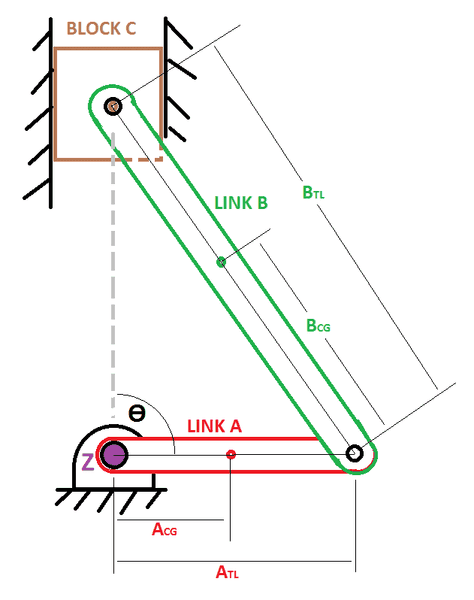
crank-slider-png.32319.png
 
Physics news on Phys.org
I don't think you said quite what you really want to know. I seriously doubt that you really want the mass moment of inertia of block C (If you do, just calculate it according the formula found in most textbooks for a rectangular block). You asked if it is M*x^2, but you did not show a coordinate x in your figure. I don't think this is what you really want either.

I imagine that what you really want is the effective inertia of the block C as seen in the rotational equation for the crank arm A. If I have correctly interpreted your difficulty, then read on.

The best way to see the effect of the mass of C in the rotational equation is by looking at the system kinetic energy. Define phi as the angle between the connecting rod and the vertical, so that these two equations are true:
Atl*cos(theta) + Btl *cos(phi) - Yc = 0
Atl*sin(theta) - Btl*sin(phi) = 0
where
Yc is the position of the block (actually the wrist pin which connects B and C).
These two equations are easily solved for phi and Yc for any assigned value of theta.

Now, differentiate these two equations with respect to time to get
- thetadot*Atl*sin(theta) - phidot*Btl*sin(phi) - Ycdot = 0
thetadot*Atl*cos(theta) - phidot*Btl*cos(phi) = 0
With theta and phi both known (phi was found above), these two equations are solvable for the ratios phidot/thetadot and Ycdot/thetadot.

Now, write the system kinetic energy in terms of theta and its derivatives ...
T = (1/2)*Mc*Ycdot^2 = (1/2)*Mc*(Ycdot/thetadot)^2*thetadot^2
The effective inertia of block C is
Ieff = Mc*(Ycdot/thetadot)^2
because this is the coefficient of the (1/2) thetadot^2 in the kinetic energy expression.

Now, is this what you wanted to know, or not?
 
Hi OldEngr63,

Thank you very much for your reply. That has solved my dilemma!

Sorry if I was unclear with my question, really I have a more complicated system where I know the torque on link A and will be looking at the linear velocity profile of block C. So yes, your response giving the effective inertia is what I need.

Also apologies for my notation being unclear (x' = Ycdot/thetadot) , but I had also come to the same result as your solution, although I much prefer your solution. It is nice to be able to come to the same result with slightly different approaches, but I believe your approach using KE is much clearer.

Thank you again for your help!
 
What you are looking for here is what is called the generalized inertia. I have never seen this addressed in a physics class, but it is common in the mechanical engineering course called Theory of Machines. Here are two references that explore this whole approach in much more detail:

B. Paul, Kinematics & Dynamics of Planar Machinery, Prentice-Hall, 1979.
S. Doughty, Mechanics of Machines, Wiley, 1988, also Lulu, 2003.

Either of these can take you quite a bit further along this process.
 
Hi again,

I have come across another hurdle.

My system has a torque about z acting on link A that drives the system, and this torque varies, it is a function of theta. I have calculated the total generalized inertia about the pivot point Z, and I have calculated the instantaneous angular acceleration for a given angle theta.
upload_2014-12-11_17-37-29.png


Then I have tried to calculate the angular velocity 'w' for a given angle using the following relationship:
upload_2014-12-11_17-41-37.png

derived from :
upload_2014-12-11_17-42-53.png

(integrated both sides of the second last line).

But my issue is that if I check my kinetic energy of the system with the energy input to the system, they do not match. The system has more kinetic energy than I gave it. I believe this is because I am not conserving angular momentum. I believe as my inertia starts low, the system accelerates rapidly and as the inertia increases, the system does not slow down with the way I have calculated 'w', only the instantaneous alpha is affected.

Is there another way I should be calculating velocity that will conserve momentum?

I have attached two graphs that I believe demonstrate that momentum is not being treated correctly. The larger kinetic energy is 1/2 I w^2 and the lower KE is the input energy. As you can see the inertia in this case increases significantly and this increases the KE. My system is not exactly as per the diagram, so the graphs might not match exactly if you think too hard about them, they are just there to help illustrate the point.

Thank you for any help, and sorry if this should be in the engineering section.

upload_2014-12-11_18-0-51.png


upload_2014-12-11_18-1-2.png
 

Attachments

  • upload_2014-12-11_17-36-50.png
    upload_2014-12-11_17-36-50.png
    1.5 KB · Views: 535
Mick, did you look at either of the references that I gave you? This entire problem is worked in detail in each of them.

Your equation of motion, alpha = T/I, is not correct because this is a variable inertia system (I is not constant, but varies with the angle).

Please check the references that I gave. The solution is a bit too detailed to write out here, but it is not hard to do. You should find the references available in your library or on line.
 
Hi OldEngr63,

Thanks again for the reply and confirming my troubles.

I wasn't able to find the references online and unfortunately do not have access to a library. I am still trying to get my hands on them though, hopefully I can get it from someone for some festive season reading.
 
How hard did you look on line? In less than two minutes, I found
1) the Paul book is available from Abe Used Books
2) the Doughty book is available from Amazon.
Neither one is very expensive. If you really want to understand this problem, I recommend that you get one (or both) of them.
 

Similar threads

  • · Replies 69 ·
3
Replies
69
Views
6K
  • · Replies 10 ·
Replies
10
Views
3K
  • · Replies 138 ·
5
Replies
138
Views
9K
Replies
2
Views
2K
  • · Replies 6 ·
Replies
6
Views
1K
  • · Replies 30 ·
2
Replies
30
Views
8K
  • · Replies 2 ·
Replies
2
Views
2K
  • · Replies 3 ·
Replies
3
Views
1K
  • · Replies 1 ·
Replies
1
Views
2K
  • · Replies 16 ·
Replies
16
Views
3K