stevero390
- 4
- 0
I am looking to calculate the area around the engine where, if an object enters this area, it would be "ingested" by the engine (subsonic flight).
In other words, I am looking to draw the shape around the engine, where the air within that shape is disturbed air (being ingested by the engine) and anything else would be ambient air.
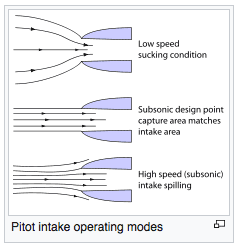
Similar to this:
I understand that this area would be a function of aircraft speed, altitude and engine power. I have tried to calculate this myself (but have gotten stuck) by doing the following:
By using the mass flow rate provided by the engine manufacturer (e.g. at max. power) and the air density, I have calculated the volumetric flow rate that the engine would require. The volumetric flow rate the engine actually received is then calculated by using the aircraft speed and the air intake area.
From this, I understand that if the volumetric flow rate the engine actually receives is less than the flow rate the engine requires then the engine would be "getting" air from a larger area around it. Similar to the diagram below, showing the danger areas around the engine when stationary on the ground.
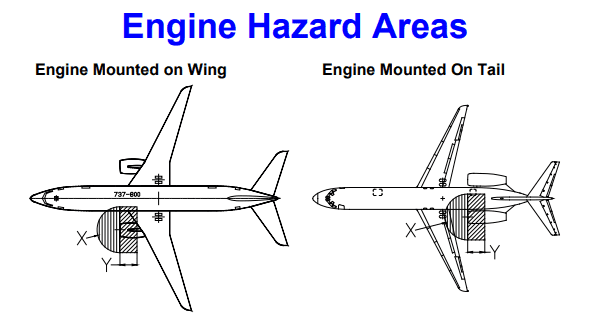
This area would be the case when the aircraft is stationary on the ground or flying slowly with high engine power (e.g. take-off/climb) - a semi-circular shape like in the image above. The diameter of this semi-circle can be calculated using the volumetric flow rate the engine "needs" together with the airspeed, giving you a diameter (which will be bigger than the fan diameter). This can then be used to draw the semicircular shape.
However, during high speed flight (say during cruise) with cruise engine power, I understand that the area in front of the engine will have the shape similar to a truncated cone (third pic in the first image).
I am struggling to think how this cone-like area around the engine can be calculated as I'm not sure how the same logic can be applied for the slow flight and high engine power scenario.
Thanks
In other words, I am looking to draw the shape around the engine, where the air within that shape is disturbed air (being ingested by the engine) and anything else would be ambient air.
Similar to this:
I understand that this area would be a function of aircraft speed, altitude and engine power. I have tried to calculate this myself (but have gotten stuck) by doing the following:
By using the mass flow rate provided by the engine manufacturer (e.g. at max. power) and the air density, I have calculated the volumetric flow rate that the engine would require. The volumetric flow rate the engine actually received is then calculated by using the aircraft speed and the air intake area.
From this, I understand that if the volumetric flow rate the engine actually receives is less than the flow rate the engine requires then the engine would be "getting" air from a larger area around it. Similar to the diagram below, showing the danger areas around the engine when stationary on the ground.
This area would be the case when the aircraft is stationary on the ground or flying slowly with high engine power (e.g. take-off/climb) - a semi-circular shape like in the image above. The diameter of this semi-circle can be calculated using the volumetric flow rate the engine "needs" together with the airspeed, giving you a diameter (which will be bigger than the fan diameter). This can then be used to draw the semicircular shape.
However, during high speed flight (say during cruise) with cruise engine power, I understand that the area in front of the engine will have the shape similar to a truncated cone (third pic in the first image).
I am struggling to think how this cone-like area around the engine can be calculated as I'm not sure how the same logic can be applied for the slow flight and high engine power scenario.
Thanks
Attachments


Last edited by a moderator: