Calculating Tension and Acceleration in a Pulley System with Applied Force

Click For Summary
SUMMARY

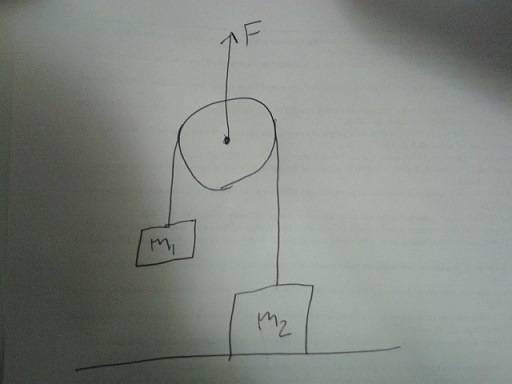
The discussion focuses on calculating tension and acceleration in a pulley system with two masses, M1 = 1.5 kg and M2 = 2.5 kg, under the influence of a 25 N applied force on the pulley. The tension in the strings is uniform, and the net forces acting on both masses can be described using the equations F_net1 = T - m1g and F_net2 = m2g - T. To determine the minimum force required to lift M2 off the ground, one must analyze the forces acting on both masses and the pulley, considering the acceleration and tension derived from the system's dynamics.

PREREQUISITES
  • Understanding of Newton's second law (ƩF = ma)
  • Ability to draw and interpret free body diagrams (FBDs)
  • Knowledge of tension in strings and its uniformity in massless systems
  • Familiarity with the concepts of acceleration and gravitational force
NEXT STEPS
  • Learn how to derive equations of motion for pulley systems with multiple masses
  • Study the effects of applied forces on tension and acceleration in mechanical systems
  • Explore the concept of massless pulleys and their implications on force calculations
  • Investigate the relationship between tension and gravitational forces in static and dynamic scenarios
USEFUL FOR

Students studying physics, particularly those focusing on mechanics, as well as educators and anyone interested in understanding the dynamics of pulley systems and force interactions.

  • #31
Panphobia said:

Homework Statement


2vhy77p.jpg

A force of 25 N is applied on the pulley. M1 = 1.5 kg, M2 = 2.5 kg, light frictionless strings and pulley.

a) What is the tension in the strings?
b) What is the acceleration of the masses?
c) What is the minimum Force to apply on the pulley so that M2 comes off the ground?

Homework Equations


ƩF = ma

The Attempt at a Solution


I am not totally sure how to do this question because of the extra force applied. I mean since there is another acceleration, I am thinking in my head that it won't be just mg but it will be something like m(g+ 25/9.8) but I am not sure. Also it seems like there won't be an acceleration in mass 2, but will be in mass 1. Can anyone point me in the right direction?
Yes, the pulley also accelerates. First you have to figure out the tension. The pulley is massless, so its mass times acceleration is zero: the net force acting on the pulley has to be zero. The net force is F-2T=0. Now you have T. What is it?

What forces act on the heavier mass? It is on the ground. There is an upward force T and the downward force m2g. If it is negative (is it?) the block can not accelerate upward. But it can not move downward, because of the support. Its acceleration is zero. The net force includes also the normal force and the sum of all forces is zero. The block stays on the ground. . How much should be F so it can rise?

You know T, so it is easy to find the acceleration of m1 from the equation you have shown : m1a1=T-m1g.

You see that the accelerations are not the same!

ehild
 
Physics news on Phys.org
  • #32
how did you put that image on the question??
 
  • #33
URL not relevant to the question, but there it is.
 
Last edited by a moderator:
  • #34
Panphobia said:
So F and T are in the same direction?
The direction of T depends on your standpoint. For the pulley, the Ts act downwards; for the masses, upwards.
Just to point out something I didn't notice mentioned elsewhere in the thread: the two tensions are the same because the pulley is massless (and frictionless). No mass means no moment of inertia, so no torque required to accelerate it on its axis.
 

Similar threads

  • · Replies 3 ·
Replies
3
Views
2K
  • · Replies 17 ·
Replies
17
Views
3K
Replies
15
Views
2K
  • · Replies 5 ·
Replies
5
Views
1K
  • · Replies 8 ·
Replies
8
Views
3K
  • · Replies 2 ·
Replies
2
Views
2K
  • · Replies 27 ·
Replies
27
Views
3K
  • · Replies 15 ·
Replies
15
Views
6K
  • · Replies 10 ·
Replies
10
Views
5K
  • · Replies 33 ·
2
Replies
33
Views
3K