Calculating the frequency response of filter with a matrix

Click For Summary
SUMMARY

The discussion focuses on calculating the frequency response of a filter using a 7x7 matrix in MATLAB. The frequency response is defined as the ratio of Vout (v3) to Vin (v0). The participant expresses uncertainty about incorporating the frequency response into the matrix due to the unknown frequency, suggesting that replacing resistor values with impedance may not be feasible. The conversation emphasizes the potential to compute multiple frequency points to generate a comprehensive frequency response graph.

PREREQUISITES
  • Understanding of frequency response in electrical circuits
  • Familiarity with MATLAB for matrix operations
  • Knowledge of impedance and its application in circuit analysis
  • Experience with solving linear equations and matrix equations
NEXT STEPS
  • Learn how to implement matrix operations in MATLAB for circuit analysis
  • Explore the concept of impedance in AC circuits
  • Research techniques for calculating frequency response across multiple frequencies
  • Study the use of potential divider formulas in complex circuits
USEFUL FOR

Electrical engineering students, circuit designers, and anyone involved in filter design and frequency response analysis using MATLAB.

Dethoven
Messages
13
Reaction score
0

Homework Statement


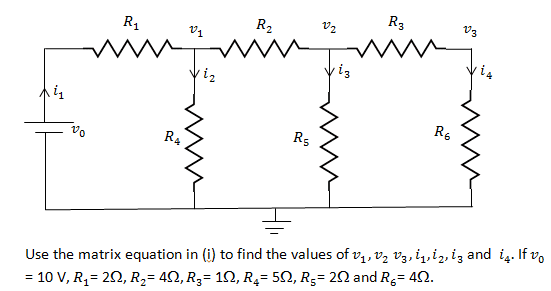
This is actually part 3 of the question. Part one was to form 7 equations to form a 7x7 matrix, part 2 was to solve it, which I've done. This question is to be done with Matlab, by the way.
proxy.php?image=http%3A%2F%2Fi.imgur.com%2FpGV1Vba.png

Part 3:
gK7ACJv.png


Homework Equations


Frequency response = Vout / Vin.

The Attempt at a Solution


I know the frequency response is the ratio of Vout and Vin, in this case, v3 and v0, I'm not sure how to incorporate that with the matrix I have. I could replace the resistor values with the impedance of the corresponding elements, but since the frequency is unknown, that wouldn't work. I've calculated frequency responses before, but that was for simpler circuit in which I could use the potential divider formula.
 
Physics news on Phys.org
calculating the frequency response at one frequency would get you one one point of the graph.
What if you compute 10 different frequencies?
What if you compute 100?
or 1000?

you can still use the same equations you used for the previous parts.

By the way you might want to show everyone the equations you got
 

Similar threads

  • · Replies 4 ·
Replies
4
Views
1K
  • · Replies 11 ·
Replies
11
Views
5K
Replies
2
Views
2K
Replies
2
Views
5K
Replies
16
Views
4K
Replies
1
Views
2K
  • · Replies 3 ·
Replies
3
Views
4K
  • · Replies 1 ·
Replies
1
Views
2K
  • · Replies 2 ·
Replies
2
Views
2K
  • · Replies 7 ·
Replies
7
Views
3K