Calculating the temperature of the sun using wavelength of iron atoms

Click For Summary
SUMMARY

The discussion centers on calculating the temperature of the Sun using the Doppler broadening of a spectral line from iron atoms, specifically at a wavelength of 637.4 nm with a width of 0.053 nm. The initial calculations yielded results significantly lower than the expected temperature of approximately 5778K. Participants clarified that the formula used for the Doppler width, which relates the width of the spectral line to temperature, was incorrectly applied. The correct formula incorporates factors such as the mass of the iron atom and the speed of light, leading to a better understanding of the temperature variations in the solar atmosphere.

PREREQUISITES
  • Doppler broadening principles
  • Understanding of spectral lines and their properties
  • Basic thermodynamics related to gas particles
  • Familiarity with the mass-energy equivalence and unit conversions (amu to kg)
NEXT STEPS
  • Study the derivation of the Doppler broadening formula in detail
  • Learn about the thermal distribution of gas particles and its effect on spectral lines
  • Explore the temperature gradients in the solar atmosphere, particularly in the chromosphere
  • Review the principles of spectroscopy and its applications in astrophysics
USEFUL FOR

Astrophysicists, students studying stellar physics, and anyone interested in the thermal dynamics of celestial bodies will benefit from this discussion.

KiNGGeexD
Messages
317
Reaction score
1
I had this question given in my class

A spectral line from iron (mass 55.934 amu) atoms in the sun is measured as 637.4 nm. It's width is measured to be 0.053 nm. Calculate the temperature of the sun?Now I done this using a formulae I was given but it yielded an answer no where near 5778K
ImageUploadedByPhysics Forums1398188217.034484.jpg
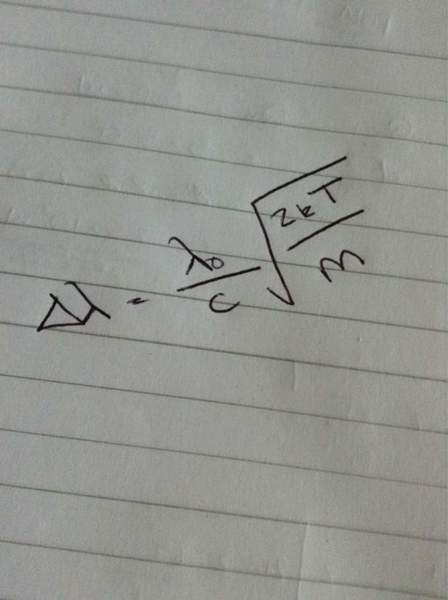
Above is the equation I actually used where delta lambda is width and lambda 0 is wavelength? I'm confused as to why my answer is two orders of magnitude out? Is it supposed to be like this as the iron atoms will be hotter because of the chemical composition or am I supposed to be able to get roughly 6000K with this question? I know there is little iron compared to hydrogen and helium in the sun so could that have something to do with it? So many questions

Anyways thanks for your help in advanced I hope you can help
 
Physics news on Phys.org
KiNGGeexD said:
I had this question given in my class

A spectral line from iron (mass 55.934 amu) atoms in the sun is measured as 637.4 nm. It's width is measured to be 0.053 nm. Calculate the temperature of the sun?

Now I done this using a formulae I was given but it yielded an answer no where near 5778K

View attachment 68928

Above is the equation I actually used where delta lambda is width and lambda 0 is wavelength? I'm confused as to why my answer is two orders of magnitude out? Is it supposed to be like this as the iron atoms will be hotter because of the chemical composition or am I supposed to be able to get roughly 6000K with this question? I know there is little iron compared to hydrogen and helium in the sun so could that have something to do with it? So many questions

Anyways thanks for your help in advanced I hope you can help
You have nearly 300 posts in these forums, so by now you should know that you need to show us your attempt at solving the problem.

Please show us what went into your calculation giving a result which is two orders of magnitude off.
 
SammyS said:
You have nearly 300 posts in these forums, so by now you should know that you need to show us your attempt at solving the problem.
Please show us what went into your calculation giving a result which is two orders of magnitude off.

Well

λo= 0.053 nm
λ= 637.4 nm
k= 1.38*10-23Mass I had 55.943 amu but I converted it into kilograms and got

m= 9.28*10-26 kgAnd it was using these numbers I solved the equation

First I took the fraction of λ/c across, then I simple squared both sides and solved for T
 
KiNGGeexD said:
Well

λo= 0.053 nm
λ= 637.4 nm
k= 1.38*10-23


Mass I had 55.943 amu but I converted it into kilograms and got

m= 9.28*10-26 kg


And it was using these numbers I solved the equation

First I took the fraction of λ/c across, then I simple squared both sides and solved for T
That looks good.

What does that give you?

I also get a very strange result using the given data.
 
Yea it's odd my thinking was maybe there is a reason it's so high and we have to notice it
 
Hello everyone! Sorry for my english in advance. It's not my first language so I will try to express myself as clear as possible.
These results should not surprise you since the temperature of the Sun "varies" somewhere between 5700 K (effective surface temperature) and 15 000 000 K (core temperature). Actually what you've found so far is the temperature of that iron particle whose photon was emmited from the Sun. From this result you can also conclude that this iron particle was located somewhere beneath the surface of the Sun because the temperature gets hotter if you get closer to the core.

P.S.

KiNGGeexD, I think you've wrongly defined some of the parameters. The original equation is given by

##\Delta \lambda =\frac{\lambda _0}{c}\sqrt{\frac{2kT}{m}}## , where ##\Delta \lambda =\lambda -\lambda _0##
##\Delta \lambda## - Doppler width (or just width of your spectral line)
##\lambda_0## - the wavelength that would be detected from a stationary atom
##\lambda## - your measured wavelength

P.S.S

Correct me if I am wrong:)
KiNGGeexD - hope it helped. Good luck with your coursework and greetings from Konstantin!
 
Note that temperatures in the solar atmosphere are also significantly higher than that of the Sun's surface. The chromosphere in particular, a region of lots of emission and absorption lines, has temperatures rising up through 20,000 K.
 
gneill said:
Note that temperatures in the solar atmosphere are also significantly higher than that of the Sun's surface. The chromosphere in particular, a region of lots of emission and absorption lines, has temperatures rising up through 20,000 K.
Yes. It makes sense that this is emission from iron atoms in the Sun's atmosphere.

That's the formula for the Doppler line width which arises from the thermal distribution of the velocity of atoms at a given temperature in the gaseous state. The width of the spectral lines is due to the various amount of the Doppler shift resulting from the velocity distribution of the emitting atoms.
 
I knew nothing of this subject until I saw this thread. I'm a bit confused about the formula quoted. Comparing it with http://en.wikipedia.org/wiki/Doppler_broadening, the formula in the OP seems to be taking the line width as √2 standard deviations. Wouldn't 2 SDs be more reasonable? Not that this gets us far in explaining the high temperature. I'm sure the explanation for that is gneill's.
 
  • #10
Yea the actual formula given is a little rubbish! I took a different approach using textbooks etc! I sorted the issue as best I could
 
  • #11
Thanks for all the help
 
  • #12
haruspex said:
I knew nothing of this subject until I saw this thread. I'm a bit confused about the formula quoted. Comparing it with http://en.wikipedia.org/wiki/Doppler_broadening, the formula in the OP seems to be taking the line width as √2 standard deviations. Wouldn't 2 SDs be more reasonable? Not that this gets us far in explaining the high temperature. I'm sure the explanation for that is gneill's.
Excellent point. Nothing like taking care of a few details.

It's common to quote the line width as being the full width at half maximum.

Using wavelength rather than frequency, the Doppler line width given in that Wikipedia entry becomes:

##\displaystyle \Delta \lambda = \lambda_{0}\sqrt{\frac{8k\,T\ln 2}{mc^2}}##
##\displaystyle = 2\sqrt{\ln 2}\ \frac{\lambda_{0}}{c}\sqrt{\frac{2k\,T}{m}}##​

That's the full-width at half maximum.

OP apparently used half-width at half maximum and ignored the factor of ln(2) .
 

Similar threads

Replies
1
Views
1K
Replies
0
Views
1K
  • · Replies 8 ·
Replies
8
Views
2K
  • · Replies 11 ·
Replies
11
Views
2K
Replies
3
Views
743
  • · Replies 26 ·
Replies
26
Views
2K
  • · Replies 2 ·
Replies
2
Views
2K
  • · Replies 6 ·
Replies
6
Views
2K
Replies
4
Views
3K
Replies
1
Views
4K