Calculating the V, I and R of resistor components

Click For Summary

Homework Help Overview

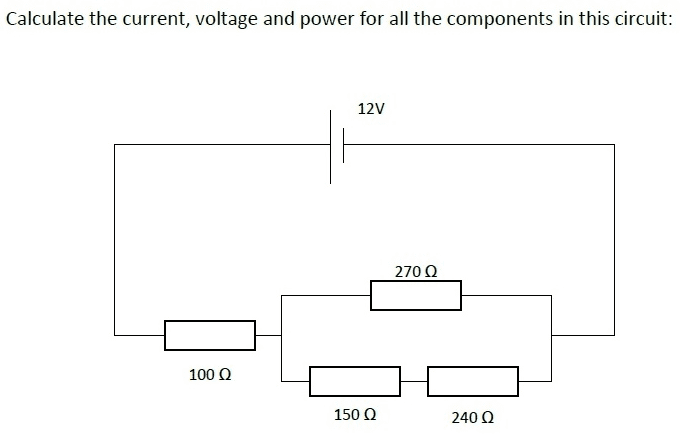
The discussion revolves around calculating the voltage, current, and power of components within a circuit that includes both parallel and series resistors. The original poster expresses confusion regarding the voltage drop across each resistor in a mixed configuration.

Discussion Character

  • Mixed

Approaches and Questions Raised

  • Participants explore the flow of current through the circuit, particularly focusing on the 100 Ohm resistor and its impact on voltage drops. There are attempts to clarify how to calculate voltage drops across resistors in parallel and series configurations.

Discussion Status

Some participants have provided guidance on calculating voltage drops and currents, suggesting methods to approach the problem. There is an ongoing exploration of how to account for the voltage across each resistor, with no explicit consensus reached on the final calculations.

Contextual Notes

The original poster mentions needing to show the voltage drop across each of the three resistors in a parallel configuration, indicating a requirement for detailed calculations. There is also a reference to ensuring that the power associated with the voltage source matches the sum of the powers dissipated by the resistors.

marand2017
Messages
3
Reaction score
1
Member advised to use the homework template for posts in the homework sections of PF.
Hi there,
upload_2017-4-24_19-51-43.png
The problem asks me to calculate the Voltage, Current and Power of each component within the circuit. I have already calculated the following:

V total = 12 Volts
R total = 259.54 Ohm
I total = 0.046 Amps

I am confused as to how I am supposed to calculate the voltage drop across each resistor. As the circuit contains parallel resistors followed by one in series it is a bit confusing and would greatly appreciate the help. I know how to calculate if all resistors are in parallel or if all are in series but a combination of each is confusing as I need the voltage drop across each resistor.

Thanks

Marco
 
Last edited by a moderator:
Physics news on Phys.org
Do you know how the current flows? How much current is flowing through the 100 Ohm resistor? It is the same as what the battery is delivering.
From that, you can calculate the voltage drop across the 100 Ohm resistor. Subtract that from 12 volts, and you have the voltage drop across the parallel network. Each branch in the parallel network has equal voltage across it. Think of it like water pipes of different diameters, if that helps. The pressure (voltage) at the 'top' of the parallel branch is the same in both branches, but there will be different currents flowing through each branch.
Note that these two currents added together, must equal the total current.
 
scottdave said:
Do you know how the current flows? How much current is flowing through the 100 Ohm resistor? It is the same as what the battery is delivering.
From that, you can calculate the voltage drop across the 100 Ohm resistor. Subtract that from 12 volts, and you have the voltage drop across the parallel network. Each branch in the parallel network has equal voltage across it. Think of it like water pipes of different diameters, if that helps. The pressure (voltage) at the 'top' of the parallel branch is the same in both branches, but there will be different currents flowing through each branch.
Note that these two currents added together, must equal the total current.

Thanks for your prompt reply. I know the Voltage drop over the 100 Ohm Resistor is 4.62 V leaving a voltage drop of 7.38V for the other 3 resistors. However I need to show how much voltage drop there is across each of those 3 resistors. It is not sufficient to consider them as a system.
 
So you will have 4.62 Volts across the 270 ohm resistor. You also have 4.62 Volts across the series of (150 ohm + 240 ohm = 390 ohm). Calculate the current through 270 ohms. Calculate the current through the 390 ohms. This video may help you understand what is going on.
 
as.png


I have pasted a image of my resolve. I would appreciate any input on it. Thanks.
 
  • Like
Likes   Reactions: scottdave
marand2017 said:
I have pasted a image of my resolve. I would appreciate any input on it. Thanks.
The values that you obtained look okay. You've left out one component though: What is the power associated with the 12 V voltage source? Does the sum of the powers dissipated by the resistors match the power that is associated with the power supply? (That's a good way to check to see if your results are consistent).
 
  • Like
Likes   Reactions: scottdave

Similar threads

Replies
2
Views
2K
  • · Replies 3 ·
Replies
3
Views
2K
  • · Replies 1 ·
Replies
1
Views
2K
Replies
3
Views
2K
  • · Replies 11 ·
Replies
11
Views
1K
  • · Replies 6 ·
Replies
6
Views
2K
  • · Replies 2 ·
Replies
2
Views
1K
Replies
10
Views
1K
  • · Replies 3 ·
Replies
3
Views
2K
Replies
3
Views
2K