Calculating this gauge pressure reading

Click For Summary
SUMMARY

The discussion centers on calculating gauge pressure using a U-tube manometer. The participants clarify that the gauge pressure reflects the static pressure at the height of the liquid, influenced by the trapped air in the tank. The final gauge pressure calculated was 33.5 kPa, achieved by establishing pressure relations on both sides of the manometer. Height x, initially considered a variable, was determined to be irrelevant in the final calculations.

PREREQUISITES
  • Understanding of U-tube manometer principles
  • Knowledge of gauge pressure and static pressure concepts
  • Ability to set up and solve equations involving pressure relations
  • Familiarity with basic fluid mechanics
NEXT STEPS
  • Study the principles of U-tube manometers in fluid mechanics
  • Learn how to derive gauge pressure equations from static pressure
  • Explore the effects of trapped gases on liquid pressure measurements
  • Investigate common applications of gauge pressure in engineering
USEFUL FOR

Students and professionals in engineering, particularly those focused on fluid mechanics, pressure measurement, and instrumentation. This discussion is beneficial for anyone looking to deepen their understanding of gauge pressure calculations using manometers.

Bolter
Messages
262
Reaction score
31
Homework Statement
See below
Relevant Equations
pressure = rho x g x h
specific weight = rho x g
Hi everyone!
How do I go about solving this problem?
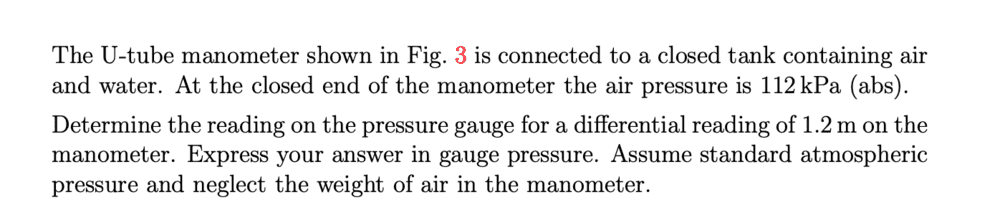
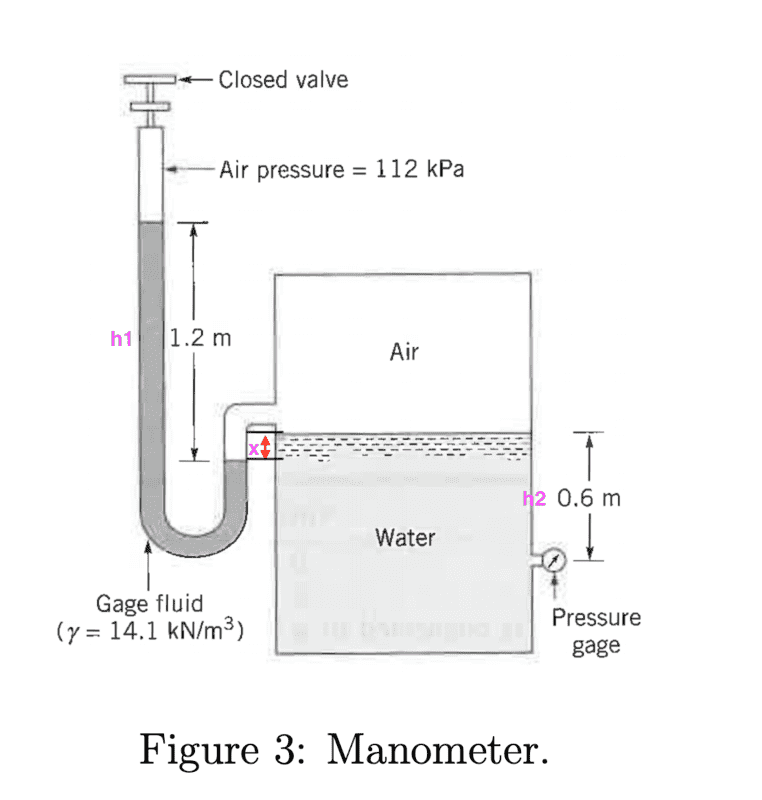
Screenshot 2020-09-30 at 13.04.21.png

Screenshot 2020-09-30 at 13.05.09.png


I tried working out the gauge pressure using this but I have a few unknowns which won't make this possible such as what is the length of x which I labelled in the figure
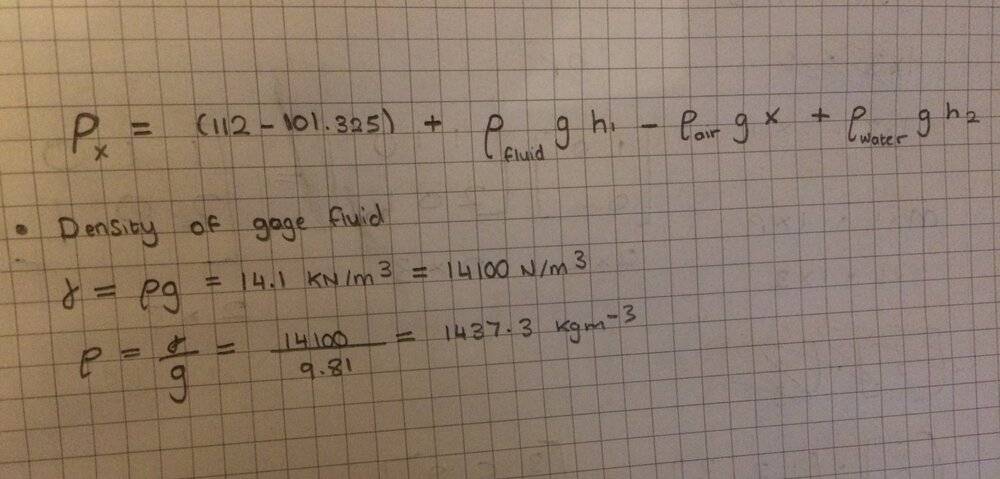
IMG_5299.JPG


Any help would be appreciated! Thanks
 
Physics news on Phys.org
The U-tube manometer is telling you the pressure of the volume of air trapped in the tank.
The pressure gauge should be telling you the static pressure at that height of liquid, which surface is being pressured down by the trapped air.
 
Lnewqban said:
The U-tube manometer is telling you the pressure of the volume of air trapped in the tank.
The pressure gauge should be telling you the static pressure at that height of liquid, which surface is being pressured down by the trapped air.

Ok I get that, but I am not entirely sure how I can form an equation with that statement. Do I begin off by setting up an expression on the left and right side of the figure then equate them?
 
The trapped pocket of air in the tank is simultaneously in contact with the surface of both liquids, having a unique pressure.
I would establish relations for each side around that common pressure.

I believe that height x is irrelevant, do you agree?
 
Last edited:
  • Like
Likes   Reactions: Bolter
Lnewqban said:
The trapped pocket of air in the tank is simultaneously in contact with the surface of both liquids, having a unique pressure.
I would establish relations for each side around that common pressure.

I believe that height x is irrelevant, do you agree?

Thanks I got the right answer from making relations on both sides and then equalling those 2. Gauge pressure turned out to be 33.5 kPa

IMG_5300.JPG
 
  • Like
Likes   Reactions: Lnewqban
You are welcome. :smile:
Your result is correct.
 
  • Like
Likes   Reactions: Bolter

Similar threads

  • · Replies 31 ·
2
Replies
31
Views
3K
Replies
3
Views
2K
  • · Replies 24 ·
Replies
24
Views
3K
  • · Replies 2 ·
Replies
2
Views
5K
Replies
1
Views
3K
  • · Replies 5 ·
Replies
5
Views
4K
Replies
2
Views
1K
  • · Replies 2 ·
Replies
2
Views
2K
  • · Replies 4 ·
Replies
4
Views
2K
Replies
3
Views
1K