Calculation of the field due to a dipole at an arbitrary point

Join the discussion
Registration is free. Start your own thread to ask a follow-up.
7 replies · 3K views
Hamiltonian
Messages
296
Reaction score
193
Homework Statement
Calculate the magnitude of the field due to a dipole at a point P which is at a distance ##r## from the midpoint of the two charges and makes an angle ##\theta## with the dipole moment Vector ##P##. the distances between the two opposite charges is ##a## and ##(a<<r)##.
Relevant Equations
-
I know how to derive field using ##E = -\nabla V## in polar coordinates and doing so gave me $$E = (kP/r^3)(1 + 3cos^3\theta)^{1/2}$$

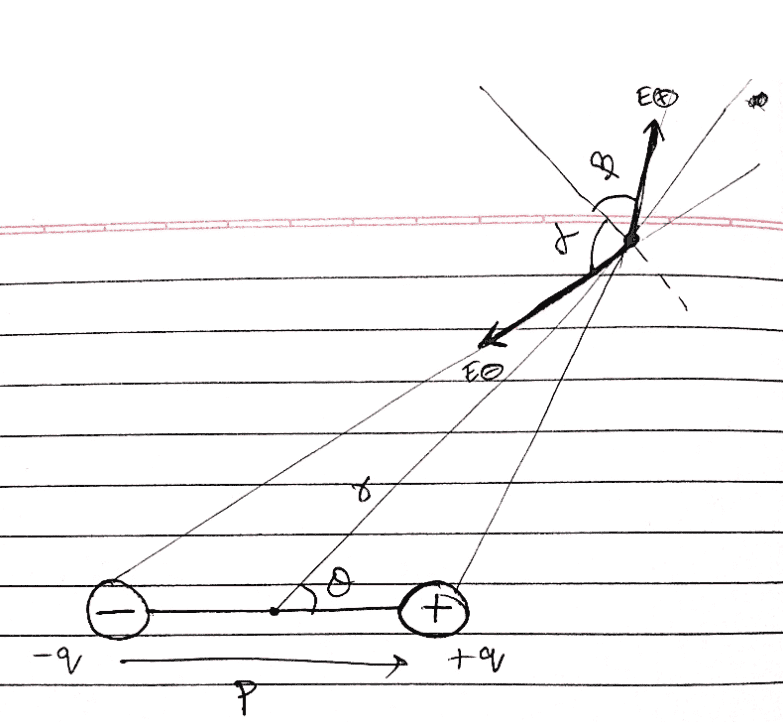
now I am trying to derive ##E## at point P using the fields produced by +ve and -ve charge respectively and taking components of each along the radial direction along ##r## and perpendicular to ##r##. I assumed angles ##\alpha## and ##\beta## with the perpendicular to the radial direction in hopes they get eliminated when finding ##E_{net}##.
1618064353633.png

$$E_+ = \frac {kq}{r^2} (1+ (2a/r) cos\theta)$$
$$E_- = \frac {kq}{r^2} (1- (2a/r) cos\theta)$$
here ##E_+## and ##E_-## are fields due to the -ve and +ve charges at point P.
$$E_r = E_+ sin\beta - E_- simn\alpha$$
$$E_{r'} = E_+ cos\beta + E_- cos\alpha$$
here ##E_r## is the componetnt of ##E_{net}## at P along ##r## and ##E_{r'}## is the component of ##E_{net}## perpendicular to ##r##.
$$| E_{net}| = \sqrt{(E_r)^2 + (E_{r'})^2}$$
I am not able to eliminate ##\alpha## and ##\beta## from the final expression for ##E_{net}##.
 
Last edited:
  • Like
Likes   Reactions: Delta2
Physics news on Phys.org
Hamiltonian299792458 said:
I know how to derive field using E=−∇V in polar coordinates and doing so gave me E=(kP/r3)(1+3cos3θ)1/2
This doesn’t seem right. You have given a scalar, but the electric field is a vector field. Please show your work
 
Orodruin said:
This doesn’t seem right. You have given a scalar, but the electric field is a vector field. Please show your work
I forgot to put an arrow on top of ##E##:sorry:
$$\vec E = -\nabla V$$

although my doubt wasn't related to this, this is what I did
$$V_p = (kPcos\theta)/r^2$$
$$ |\vec E| = \sqrt{(-\frac{\partial V}{\partial r})^2 + (-\frac{1}{r}\frac {\partial V}{\partial \theta})^2} = \frac{kP}{r^3}\sqrt{1+3cos^2\theta}$$
 
.
Hamiltonian299792458 said:
View attachment 281253
$$E_+ = \frac {kq}{r^2} (1+ (2a/r) cos\theta)$$
$$E_- = \frac {kq}{r^2} (1- (2a/r) cos\theta)$$
I don't think the factors of 2 are correct in the right-hand sides of these two equations. Post your work if you would like us to check it.

$$E_r = E_+ sin\beta - E_- sin\alpha$$
$$E_{r'} = E_+ cos\beta + E_- cos\alpha$$

I am not able to eliminate ##\alpha## and ##\beta##
Try to relate ##\beta## and ##\theta##. Hint: apply the law of sines to one of the triangles in your figure.
 
  • Like
Likes   Reactions: Hamiltonian
TSny said:
.
I don't think the factors of 2 are correct in the right-hand sides of these two equations. Post your work if you would like us to check it.
the distance between the two opposite charges is ##2a##
applying the cosine rule to both the triangles gives
$$r_+^2 = r^2 + a^2 -2arcos\theta \approx r^2 -2arcos\theta$$
$$r_-^2 = r^2 +a^2 -2arcos\theta \approx r^2 +2arcos\theta$$

also after applying the sine rule to both the triangles and making a few approximations I was able to get the required answer thanks!
 
the distance between the two opposite charges is ##2a##
OK. In the original post, the distance is given to be ##a## rather than ##2a##. That accounts for why I thought you were off by a factor of 2. I'm glad everything worked out.
 
  • Like
Likes   Reactions: Hamiltonian
Hamiltonian299792458 said:
I forgot to put an arrow on top of ##E##:sorry:
$$\vec E = -\nabla V$$

although my doubt wasn't related to this, this is what I did
$$V_p = (kPcos\theta)/r^2$$
$$ |\vec E| = \sqrt{(-\frac{\partial V}{\partial r})^2 + (-\frac{1}{r}\frac {\partial V}{\partial \theta})^2} = \frac{kP}{r^3}\sqrt{1+3cos^2\theta}$$
My concern was not the missing arrow, it was the fact that your computed ##E## is a scalar field and not a vector.
Hamiltonian299792458 said:
and doing so gave me $$E = (kP/r^3)(1 + 3cos^3\theta)^{1/2}$$
 
Orodruin said:
My concern was not the missing arrow, it was the fact that your computed ##E## is a scalar field and not a vector.
the question states calculate the magnitude of the electric field due to an electric dipole at a point ##P##

$$|\vec E| = \frac{kP}{r^3}(1+ 3 cos^2\theta)^{1/2}$$