Can a Magnetic Dipole Form a Circle?

Click For Summary

Discussion Overview

The discussion revolves around the concept of magnetic dipoles and the possibility of creating perpetual motion through their arrangement in a circle. Participants explore the implications of this idea within the frameworks of classical and quantum physics, touching on thermodynamics and energy conservation.

Discussion Character

  • Exploratory
  • Debate/contested
  • Technical explanation
  • Conceptual clarification

Main Points Raised

  • Some participants question whether arranging magnetic dipoles in a circle could lead to perpetual motion, suggesting that it might negate friction or involve energy transfer mechanisms.
  • Others assert that perpetual motion is impossible according to the laws of thermodynamics, emphasizing that energy must have a source.
  • A participant mentions the potential for quantum systems to generate free energy, although this is met with skepticism and requests for credible sources.
  • There are discussions about the nature of perpetual motion, with some clarifying that it refers to constant motion while extracting energy, which violates energy conservation.
  • One participant proposes an experimental approach to observe magnetic fields, using a metaphor involving a watermelon and a seed to illustrate the three-dimensional nature of magnetic fields.
  • Some participants express frustration with the speculative nature of the thread and urge adherence to forum rules regarding discussions of perpetual motion and free energy devices.

Areas of Agreement / Disagreement

Participants generally agree that perpetual motion is not feasible according to established physical laws, but there are multiple competing views regarding the implications of quantum mechanics and the nature of energy transfer. The discussion remains unresolved with respect to the potential for new theories or interpretations.

Contextual Notes

Limitations include the speculative nature of claims regarding quantum systems and free energy, as well as the lack of consensus on the interpretation of perpetual motion and its implications in various physical contexts.

LaPXL8R
Messages
1
Reaction score
0
Sorry for my lack of knowledge, I'm in Grade 7


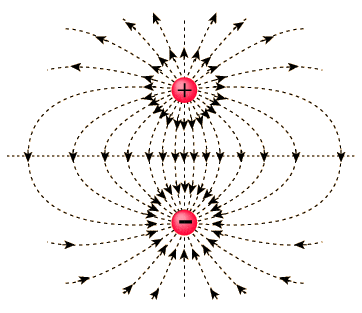
I just learned that Magnets have dipoles--like this:
edip2.gif

If those dipoles formed a circle, wouldn't it be possible to create perpetual motion?
 
Physics news on Phys.org
Perpetual motion under the Maxwell Equations? Doubt it. Energy must have a source.

There are some situations where we think quantum systems have a very slight chance of generating free energy...but it's a difficult inquiry and it doesn't seem promising. Under classical physics, it's a big fat zero for free energy.
 
Nope.

Perpetual motion is forbidden by the laws of thermodynamics.

Gamesguru, do you have any sources for your claims about quantum systems? I'm yet to see anything credible in that respect.
 
Perpetual motion and free energy devices are not discussable per PF rules. The simple fact is that it is impossible to generate perpetual motion. Period. LaPXL8R if you have another question on magnets or dipoles that doesn't involve perpetual motion please make another thread.
 
Huummm... I would say yes, but the question is a little “vague”, so for all the seventh graders, the tougher than a twelve year old sentient, each one teach one.

Consider instead a sphere, rather than a circle, the field is a three dimensional construct, generated by the magnet. You can easily observe this effect with a simple experiment, think of a watermelon with a seed in the middle (represents magnet) if you cut through the melon, your cut might appear as circle, if you cut at an angle it will appear oval. The experiment for you, take a piece of glass or paper (represents cutting plane), support in some type of “frame”, place magnet under, dust ferrous material on glass or paper, then tap the surface like a drum (vibration supplies energy needed for “sorting”, which will reflect magnetic fields).

If you do that, you will see layered fields much like the figure above, change the position and orientation of magnet, and try again, you should find some interesting things (this is where Maxwell comes in) Now the question was “perpetual energy”, by classical physics answered No (thermodynamics, you lose and generate heat all the time, think friction)
Now, consider that whenever a “ring” of conductive metallic composite is brought in existence, it, on its “own”, is generating a current or electron movement, very very small, but still an effect... I will leave that explanation for those trying to achieve alphabet soup behind their names,by agreeing with the new democratic forms of “science”.

I guess what I'm saying, is there are those whom might tell you “Maxwell” needs to be worked on, probably by seventh graders asking questions. I suggest a little google work “ Thom Bearden, cheniere” maybe you will be able to gather a bit more insight on fields

The question was good , just needs a little tuning, somebody should have suggested the induction of “circular magnet fields with rotation” being the bases of a practically all electrical power generation. I mean “nuclear plants” only boil water for steam to turn a magnet.

Thank goodness this Kid didn't ask how to account of a Pyroclastic observance, using only mass and gravity... Excuse me, I'm going to light my head on fire and beat it out with a sedge hammer now.
 
LaPXL8R said:
Sorry for my lack of knowledge, I'm in Grade 7


I just learned that Magnets have dipoles--like this:
edip2.gif

If those dipoles formed a circle, wouldn't it be possible to create perpetual motion?


Erm... why? Would it negate friction somehow? In some ways, perpetual motion may already exist. As far as I know, neutrinos have mass, but don't slow down from their near-lightspeed velocity.
 
jetwaterluffy said:
As far as I know, neutrinos have mass, but don't slow down from their near-lightspeed velocity.

The term "Perpetual Motion" does not mean inertial motion, but rather constant motion as energy is extracted. It obviously violates energy conservation, is therefore pseudo-science and not up for discussion on Physics Forums.
 
jetwaterluffy said:
Erm... why? Would it negate friction somehow? In some ways, perpetual motion may already exist. As far as I know, neutrinos have mass, but don't slow down from their near-lightspeed velocity.

Would it negate friction somehow ... mag trains (magnetic levitation) lessons friction, in vacuum, maybe pure energy transfer... Think super conductor "NO" resistance, you have classically defined the problem between astrophysics, and current thought on quantum structure ... try thinking plank in term of "frames" and movement steps, where something is always moving toward future, what you think of as arrow of time ... does everything evolve to chaos or do system simplify themselves ... and do not discount strange attachments remember you're trying to work with probabilities Everything is moving all the time or the construct as known would not exist ... the question is the energy transfer that makes it vibrate and thus visible
 
e.bar.goum said:
Nope.

Perpetual motion is forbidden by the laws of thermodynamics.

Gamesguru, do you have any sources for your claims about quantum systems? I'm yet to see anything credible in that respect.
Superconductivity and superfluidity open many doors.

I agree I haven't seen anything else substantiated...it's all ********. I can probably dig up some of the crazier claims I've come across if you want. PM me.

There might also be technologies which allow us to extract energy from the CMB. That's purely theoretical as yet however.
 
  • #10
This whole thread is one speculation on top of another. Please reread the PF Rules everybody!
 

Similar threads

  • · Replies 1 ·
Replies
1
Views
2K
  • · Replies 1 ·
Replies
1
Views
9K
  • · Replies 2 ·
Replies
2
Views
2K
  • · Replies 10 ·
Replies
10
Views
4K
  • · Replies 16 ·
Replies
16
Views
3K
  • · Replies 3 ·
Replies
3
Views
2K
Replies
1
Views
2K
  • · Replies 3 ·
Replies
3
Views
2K
  • · Replies 7 ·
Replies
7
Views
3K
  • · Replies 4 ·
Replies
4
Views
7K