- 2,346
- 124
In a nutshell, does Newton's "action = -reaction" law apply to massless particles? If a spaceship directs a condensed light beam on its own heat-resistant photon sail, what would happen?
The discussion centers on the application of Newton's third law to massless particles, specifically in the context of a spaceship utilizing a photon sail to generate thrust. Participants agree that while a photon sail can produce thrust, it is no more effective than simply shining a light beam backward. The momentum of the light beam can be calculated using the formula p = E/c, and the efficiency of the sail is contingent on its reflectivity and design. Ultimately, the consensus is that momentum conservation applies equally to light and matter, confirming that Newton's laws hold true in this scenario.
PREREQUISITESPhysicists, aerospace engineers, and students interested in advanced propulsion systems and the fundamental principles of physics related to momentum and light behavior.
Is the sail reflective? And what is the desired direction of travel?EnumaElish said:In a nutshell, does Newton's "action = -reaction" law apply to massless particles? If a spaceship directs a condensed light beam on its own heat-resistant photon sail, what would happen?
jbriggs444 said:Is the sail reflective? And what is the desired direction of travel?
What do you think? And why?EnumaElish said:Let's say the sail is 100% reflective and the direction is "any which way."
EnumaElish said:In a nutshell, does Newton's "action = -reaction" law apply to massless particles? If a spaceship directs a condensed light beam on its own heat-resistant photon sail, what would happen?
ZapperZ said:do you not see why this doesn't work?
Vanadium 50 said:It does work. It just works no better than shining aflashlight out the back.
ZapperZ said: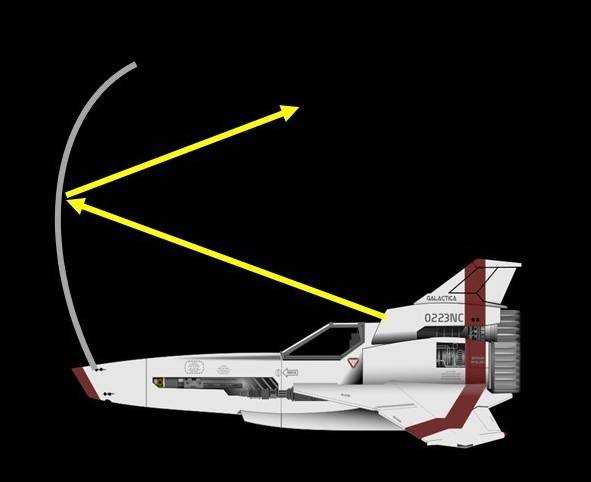
If it is, do you not see why this doesn't work?
No, they don't cancel.ZapperZ said:You get recoil when the light leaves the source, but then you get the opposite impulse when it bounces off the sail. If you do this colinearly, and assume ideal condition, they all cancel out.
A.T. said:No, they don't cancel.
The arrangement as depicted is a flashlight. A parabolic reflector is how you arrange for the beam to be emitted in a particular direction in the first place.Vanadium 50 said:Shine the flashlight back,
Right, but with reflection as your picture shows you get net thrust. It works with air too, if you "divert" some of the air backwards:ZapperZ said:What I said is true if it is absorbed.
ZapperZ said:I really do not understand this. Is this what you are describing? The spaceship shoots a beam of light (yellow arrow) onto a sail (curved line in front of the ship) that is attached to the ship itself?
View attachment 113783
ZapperZ said:But then, as Vanadium stated, why not just simply shoot it out the back and get the same effect?
Zz.
jbriggs444 said:The arrangement as depicted is a flashlight. A parabolic reflector is how you arrange for the beam to be emitted in a particular direction in the first place.
Edit: Or, at least it was, back in the days when flashlights used incandescent filaments.
EnumaElish said:I guess this does not imply Newton's 3rd law does not apply to photons? The space traveler could eject any object to propel the ship in the opposite direction. And the same applies to light.
If the initial source of light had a wide beam then using the reflector could improve the efficiency by directing the momentum of the beam more accurately in one direction. (Any off axis components would tend to cancel, losing energy but not gaining momentum for the ship).ZapperZ said:But then, as Vanadium stated, why not just simply shoot it out the back and get the same effect?
Zz.
That's adorable!EnumaElish said:It's okay guys.

Sow the wind and reap the whirlwind!DaveC426913 said:That's adorable!
You thought that a question - posted on a physics forum with a quarter million nerds - would stop being discussed once the question was answered?
