Discussion Overview
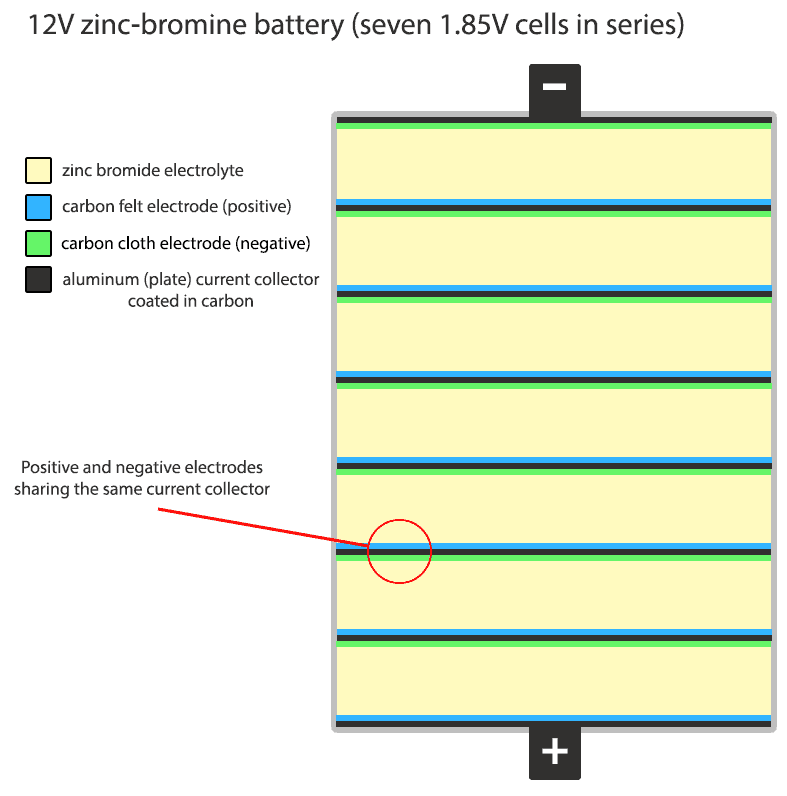
The discussion revolves around the feasibility of using a shared current collector for positive and negative electrodes in battery cells arranged in series. Participants explore the implications of this design choice in the context of creating a 12V battery without individual current collectors for each cell.
Discussion Character
- Technical explanation
- Debate/contested
Main Points Raised
- One participant questions whether sharing a current collector between positive and negative electrodes could lead to short-circuiting the cells.
- Another participant describes a design where the current collector is a common aluminum sheet coated in carbon, with the negative and positive electrodes attached on either side.
- A participant clarifies the ambiguity around the term "electrodes sharing current collector," suggesting that connecting electrodes via a common sheet of metal is functionally similar to using external wiring.
- There is mention of a membrane-free design that addresses the dissolution of zinc dendrites in the context of the battery's operation.
Areas of Agreement / Disagreement
Participants express differing views on the implications of sharing a current collector, with some suggesting it may lead to issues like short-circuiting, while others assert that it is a valid approach for connecting cells in series. The discussion remains unresolved regarding the safety and effectiveness of this design.
Contextual Notes
Participants do not fully explore the potential limitations or assumptions related to the shared current collector design, such as the effects of corrosion or the specific materials used.