Can n-slit interference produce subwavelength stripes?

  • Context: Undergrad 
  • Thread starter Thread starter genxium
  • Start date Start date
  • Tags Tags
    Interference
Click For Summary

Discussion Overview

The discussion revolves around the potential for n-slit interference to produce subwavelength intensity patterns using a monochromatic light source. Participants explore the implications of the intensity formula and the conditions under which such patterns might be achieved, considering both theoretical and practical aspects of the setup.

Discussion Character

  • Exploratory
  • Technical explanation
  • Debate/contested
  • Mathematical reasoning

Main Points Raised

  • One participant presents an intensity formula and proposes that using a large number of slits (n = 1500) and a small distance to the imaging medium (r = 20 µm) could yield subwavelength stripe widths.
  • Another participant questions the significance of the "subwavelength" term, suggesting that the calculated pattern is a far-field diffraction pattern and that the minima would be larger than the wavelength of light.
  • Concerns are raised about the "reasonably small" distance to the imaging plate, with one participant suggesting that this characterization may be misleading given the number of slits involved.
  • Discussion includes the idea that near-field patterns may differ significantly from far-field patterns, with potential complications and the presence of nulls in the intensity distribution.
  • Participants express interest in the implications of achieving subwavelength stripes and reference existing methods for producing such patterns in other contexts, such as photolithography.
  • There is mention of the need to consider the resultant amplitude variations in the context of the overall pattern, rather than just the presence or absence of nulls.

Areas of Agreement / Disagreement

Participants express differing views on the feasibility of producing subwavelength stripes with the proposed setup. While some acknowledge the theoretical possibility, others highlight practical limitations and the need for further investigation into the near-field effects and intensity distributions.

Contextual Notes

Participants note limitations related to the assumptions made in the intensity formula, the definition of "reasonably small" in the context of slit-to-imaging distance, and the unresolved nature of the near-field intensity patterns.

Who May Find This Useful

This discussion may be of interest to those exploring advanced optics, diffraction patterns, and applications in photolithography or other fields requiring precision in light manipulation.

genxium
Messages
137
Reaction score
2
TL;DR
If n(number of slits) is around 1000, can we produce an intensity pattern whose adjacent local minimas are separated by a distance less than the wavelength of incident light?
According to the intensity formula
I = I_0 \cdot \frac{sin^2(n\phi/2)}{sin^2(\phi/2)}
(quoted from Feynman Lectures Vol I)

Therefore the 2 local minimas adjacent to each global maxima are angularly \Delta \phi_{localmin} = \frac{4\pi}{n} apart. When trying to think of a use case to exploit this formula I got something like this
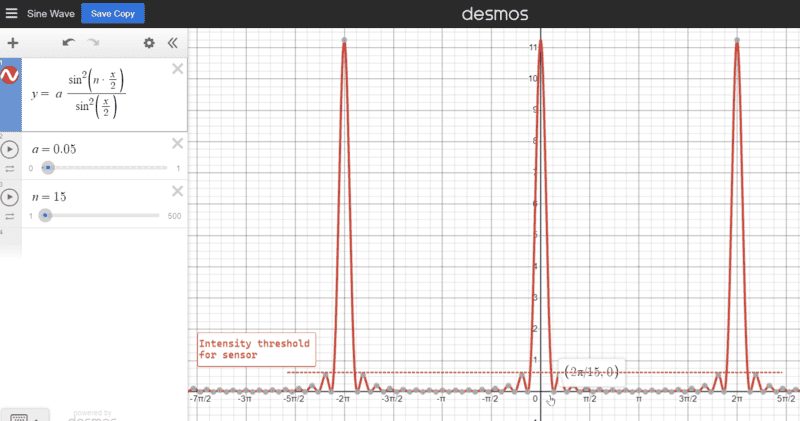
Given an imaging medium whose intensity response is only non-zero when the intensity is above certain threshold, can I cast subwavelength stripes of monochromatic light on it by an n-slit apparatus?
(the orange dash line marks the threshold intensity below which the imaging medium wouldn't respond)
ffZUcMgUWj.png


It seems possible to me that if we use a monochromatic red laser with wavelength \lambda=650nm, a reasonably large n = 1500, and a reasonably small "slit-to-imaging-plate distance" r = 20um, by far-field approximation it produces a stripe width w = r \cdot \Delta \phi_{localmin} = 167.55nm < \lambda on the presumed imaging medium.

Is there something I overlooked here that'll prohibit such subwavelength stripe?

There're two possible caveats of the derivation that I'm aware of but not sure whether they're critical enough to break the argument (still checking them theoretically).
  • The formula above doesn't take into account the impact from intensity distribution of single slit diffraction, by regarding each single slit just as a perfect point source.
  • When having n = 1500, the "slit-to-imaging-plate distance" r = 20um might not be an eligible far-field compared to the total length of all slits, e.g. n \cdot (SlitWidth + SlitPitch) which easily exceeds r for slits of a few microns.
Any advice is appreciated :)
 
Science news on Phys.org
genxium said:
TL;DR Summary: If n(number of slits) is around 1000, can we produce an intensity pattern whose adjacent local minimas are separated by a distance less than the wavelength of incident light?

Is there something I overlooked here that'll prohibit such subwavelength stripe?
Your "sub wavelength" term seems to have some special significance for you. The sin(Nx)/sin(x) type of pattern simply shows the distribution of angles at which minima can be found. Those are directions of the features of just a pattern.

If you were a radio antenna designer you wouldn't be at all surprised that there can be very tight patterns of side lobes from a directional antenna. There is no spacial significance in this.
1698950630877.png

You need to think where you could actually measure this pattern. The pattern you have calculated is essentially a far field (Fraunhofer diffraction) pattern. The width of your multiple slit array would be much greater than a wavelength and you'd need to be a long way away to see your minima - many wavelengths away - and the separation of the minima would be larger than the wavelength of your light / radio / sea waves / (and probably gravity waves, if you could make the equipment).. In close, there would be a different (Fresnel) pattern.
 
  • Like
Likes   Reactions: Gleb1964, vanhees71 and genxium
genxium said:
reasonably small "slit-to-imaging-plate distance" r=20 ##\mu##m
How wide is the beam spot at the position of grating if it illuminates 1500 lines ?

I think 'reasonably small' is the understatement of the month !

ah, beaten by sophie

##\ ##
 
  • Like
Likes   Reactions: sophiecentaur
sophiecentaur said:
In close, there would be a different (Fresnel) pattern.
Furthermore, iirc, when you're close into the array of slits, the pattern will be complicated but not have nulls in it. I think this is what was nudging the back of the mind of @genxium : there's still no 'violation' of anything because there will be few or no nulls near the array.
 
sophiecentaur said:
Furthermore, iirc, when you're close into the array of slits, the pattern will be complicated but not have nulls in it. I think this is what was nudging the back of the mind of @genxium : there's still no 'violation' of anything because there will be few or no nulls near the array.
Thanks sophie that was a thorough answer. As both you and @BvU pointed out the "reasonably small r = 20um" part is what looks unreasonable here, I'd look more into it :)

I used to put some efforts into searching for a near-field intensity formula of the n-slit apparatus, and come across something useful like this paper (which does contain examples like an aperture or a convex lens, but not the n-slit) and later this other paper (which contains exactly the n-slit).

From the second paper, it seems like there're still some nulls in the pattern predicted by the near-field model
i53NSRDv8C.png

, and even if there were no null I'm happy to see that the peeks are easily distinguishable by drawing a certain threshold.
NyJo46KlAW.png


The term "sub-wavelength" does have some special significance for me. The processing capability I can access would only produce slit width & pitch as well as positioning resolution at a few microns -- the feasibility of "sub wavelength stripes" just intrigues me out of no reason.

There're already many existing ways to achieve "sub-wavelength" interference
, yet I'm still quite interested in how "minimum" the setup for these "sub-wavelength stripes" can be.
 
  • Like
Likes   Reactions: vanhees71
genxium said:
From the second paper, it seems like there're still some nulls in the pattern predicted by the near-field model
The total width of the array is many wavelengths so is the result a surprise? The relevant condition for 'stripes' is not the absence or presence of nulls but a variation of resultant amplitude. What you can see in "Fig 7" is a variation in amplitude of the resultant. I would say that having no variation in the Fresnel patterns would actually be very unexpected.

So the sums look right and the result is not unexpected.
 
sophiecentaur said:
So the sums look right and the result is not unexpected.
You have to be careful when looking at the result image. There is zero amplitude in between the slits because of the individual slit pattern (2 wavelengths wide), which will launch no energy parallel to the surface. I couldn't see any numbers for the resultant amplitudes of the pattern close in and the density of the blacks and greys is not specified. The troughs near-in are very low level and are spaced by less than a wavelength but they do not represent, in themselves, a travelling wave; they are the result of a number of waves, adding vectorally.
 

Similar threads

  • · Replies 4 ·
Replies
4
Views
2K
  • · Replies 7 ·
Replies
7
Views
2K
  • · Replies 0 ·
Replies
0
Views
3K
  • · Replies 3 ·
Replies
3
Views
2K
  • · Replies 5 ·
Replies
5
Views
2K
  • · Replies 24 ·
Replies
24
Views
24K
  • · Replies 4 ·
Replies
4
Views
5K
Replies
1
Views
3K
Replies
1
Views
3K
  • · Replies 1 ·
Replies
1
Views
6K