Can Symmetry Simplify a Hard Resistor Network?

Click For Summary
SUMMARY

The discussion focuses on simplifying a resistor network using symmetry and Delta-Y transforms. Participants emphasize that by recognizing nodes at the same potential, one can simplify the circuit by connecting them or removing components without affecting circuit behavior. The primary method involves applying symmetry to identify parallel resistance opportunities and performing series/parallel resistor simplifications. Ultimately, the problem can be resolved with minimal Delta-Y transformations after applying symmetry techniques.

PREREQUISITES
  • Understanding of resistor networks and circuit analysis
  • Familiarity with Delta-Y (Δ-Y) transforms
  • Knowledge of series and parallel resistor combinations
  • Concept of electrical potential and node analysis
NEXT STEPS
  • Study the principles of symmetry in electrical circuits
  • Learn about Delta-Y (Δ-Y) transforms in depth
  • Practice simplifying complex resistor networks using series and parallel combinations
  • Explore advanced circuit analysis techniques, including Thevenin and Norton theorems
USEFUL FOR

Electrical engineers, circuit designers, and students studying circuit analysis who seek to enhance their understanding of resistor network simplification techniques.
mooncrater
Messages
215
Reaction score
18
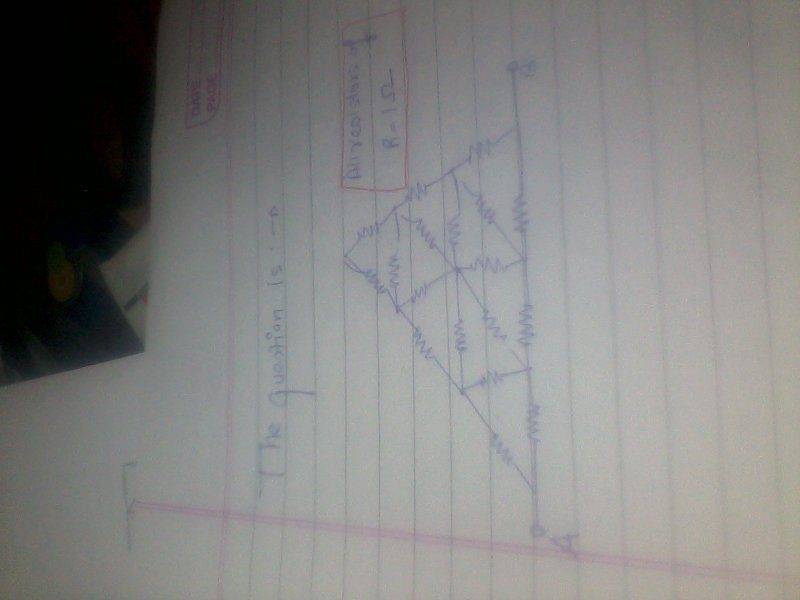
the question is , to find the net resistance across the points a and b as marked in the figure(attached).Here I think that the method of Symmetry should work . But I am not sure about it and moreover its not clear to me how to use it.

The Attempt at a Solution


IMG_20150211_191911.jpg
IMG_20150211_192056.jpg
 
Last edited by a moderator:
Physics news on Phys.org
Was it foggy in your room when you took these pix? They're barely legible. :(
 
I can hardly see your diagram at all (this is bad form, by the way ... posting illegible diagrams and expecting people to be able to decipher them). Do you know about delta-Y transforms? I seem to recall that there is a trick to the pyramid construct and you are right that it involves symmetry but I don't remember for sure that there is and certainly not how to do it. Delta-Y transforms will give you a brute-force method for getting it.
 
Here's a depiction of the problem:

Fig1.gif


To begin with all line segments between nodes represent a 1 Ohm resistors.

By symmetry all points on the center-line (dotted blue vertical line passing through point C) are at the same potential if a potential difference is applied between A and B. So use that fact to recognize new parallel resistance opportunities. Hint: Don't be afraid to cut a 1 Ohm resistor into two 1/2 Ohm resistors in series.

The problem should reduce to something more tractable at least. Still may require an application of Delta-Y or other other circuit analysis methods, but it will be on a trivial circuit.
 
  • Like
Likes   Reactions: mooncrater
I studied you post , actually i didn't understand the symmetry method , moreover i didn't know about delta star methods . So i searched about them , studied them , applied them(delta star) in the problem , and in 3 long(+hard) tries I DID IT . Thank you.
 
@mooncrater : The symmetry method relies on the fact that when separate nodes are at the same potential you can connect them together with a wire or remove components connected to both without changing the circuit behavior in any way.

The simplest case is that of a bridge circuit where the arms of the bridge are balanced and there is no potential across the "bridge".

Fig1.gif
These circuits have identical characteristics

No current can flow if there is no potential difference, so if there's a component on the bridge it can be removed. If there's no component there you can add what you want, even a shorting wire, and no change will occur to the circuit's operation. In the above diagram the placement of resistor R between the nodes a and b has no effect. Recognizing that two nodes previously thought separate can be treated as one can lead to new parallel component reduction opportunities, or serial reduction opportunities if you can remove a redundant component.
 
You need at most one delta-star transformation at the very end, everything else can be solved with parallel/series resistor simplifications (after using the symmetry).
 

Similar threads

  • · Replies 6 ·
Replies
6
Views
2K
  • · Replies 31 ·
2
Replies
31
Views
4K
Replies
1
Views
1K
  • · Replies 7 ·
Replies
7
Views
2K
Replies
10
Views
3K
  • · Replies 1 ·
Replies
1
Views
1K
  • · Replies 1 ·
Replies
1
Views
3K
Replies
3
Views
2K
  • · Replies 5 ·
Replies
5
Views
2K
Replies
3
Views
2K