Can the Lorentz Oscillator Model be Modified to Include Radiation Force?

Click For Summary

Discussion Overview

The discussion revolves around the modification of the Lorentz oscillator model to incorporate radiation force, particularly in the context of electron acceleration and its implications for radiation damping. Participants explore theoretical frameworks and literature related to this topic.

Discussion Character

  • Exploratory
  • Technical explanation
  • Debate/contested

Main Points Raised

  • One participant inquires about modifying the Lorentz model to include radiation force due to electron acceleration.
  • Another participant suggests consulting classical texts on electrodynamics, specifically mentioning "radiation damping" and "radiation reaction" as relevant concepts.
  • A different participant discusses the limitations of the Lorentz model when applied to extended charged objects, recommending the Lorentz-Abraham and Landau-Lifshitz formulas while noting their deficiencies.
  • This participant also points out that the derivation of the Poynting theorem and Larmor formula is not valid for point electrons, questioning the necessity of using the Lorentz-Abraham formula in such cases.
  • Several participants recommend literature, including F. Rohrlich's "Classical Charged Particles," while expressing mixed opinions about the author's mathematical validity and confidence in his conclusions.

Areas of Agreement / Disagreement

Participants express differing views on the applicability and validity of various models and formulas related to radiation force, indicating that multiple competing perspectives remain without a clear consensus.

Contextual Notes

Participants highlight limitations in the existing models and the need for careful consideration of assumptions, particularly regarding the treatment of point versus extended charged objects.

hpjack
Messages
2
Reaction score
0
Hi Guys,

I'm looking into the Lorentz model
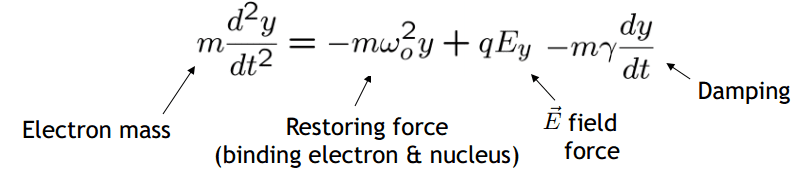
upload_2015-2-16_20-43-0.png


Since the acceleration/de-acceleration of electron can cause radiation hence create force, can anyone tell me how to modify the above equation to include the term of radiation force?

Thanks.

jack
 
Physics news on Phys.org
That's a delicate isssue. Have a look at Jackson, Classical Electrodynamics or Becker/Sauter under the keyword "radiation damping" or "radiation reaction".
 
hpjack said:
Hi Guys,

I'm looking into the Lorentz model
View attachment 79181

Since the acceleration/de-acceleration of electron can cause radiation hence create force, can anyone tell me how to modify the above equation to include the term of radiation force?

Thanks.

jack

Approximately, force on extended charged object due to its acceleration is given by the result of the calculation first done by Lorentz (check his book Theory of electrons). However, it is only approximate and gives results in contradiction to the rest of physics when used verbatim.

So if you have extended electron, you can use the Lorentz-Abraham formula (or better yet, Landau-Lifshitz formula) with some ground, but learn its deficiencies (check Feynman's textbooks, Landau&Lifshitz Classical Theory of Fields).

The derivation of the Poynting theorem and the Larmor formula is invalid for point electrons, so there is no necessity and convincing reason to use the Lorentz-Abraham formula for them.

The equation above is a model of damped oscillation of electron. The damping is modeled by the last term ##\gamma dy/dt## and since there is no single reason for its presence, it is understood as a way to model the resulting motion even if we do not know the details of forces acting on the electron. That means if self-force is present, part of it may be already described by this term.
 
Another great book is: F. Rohrlich, Classical charged particles.
 
vanhees71 said:
Another great book is: F. Rohrlich, Classical charged particles.

Some parts of the book discuss interesting topics and it is worth having a look, but author's views and support of procedures of questionable mathematical validity are not very convincing, in my opinion. Although the author was very self-confident in his papers and his book, I recommend taking it as one possible view on the problem, not as the work that solved it.
 

Similar threads

  • · Replies 9 ·
Replies
9
Views
3K
Replies
2
Views
2K
  • · Replies 14 ·
Replies
14
Views
2K
  • · Replies 1 ·
Replies
1
Views
2K
  • · Replies 2 ·
Replies
2
Views
1K
  • · Replies 14 ·
Replies
14
Views
4K
  • · Replies 5 ·
Replies
5
Views
3K
  • · Replies 2 ·
Replies
2
Views
2K
  • · Replies 1 ·
Replies
1
Views
2K
  • · Replies 15 ·
Replies
15
Views
4K