Can the work of a counterclockwise cycle be positive?

Click For Summary

Discussion Overview

The discussion revolves around the work done by an ideal gas during a thermodynamic cycle represented on a P-V plane, specifically questioning whether the orientation of the cycle (clockwise or counterclockwise) determines the sign of the work done. Participants explore various scenarios involving different types of processes within the cycle, including isochoric and adiabatic processes.

Discussion Character

  • Debate/contested
  • Technical explanation
  • Conceptual clarification

Main Points Raised

  • Some participants assert that a clockwise cycle indicates positive work done by the gas, while a counterclockwise cycle indicates negative work, but this may not hold true in all cases.
  • One participant presents a specific cycle involving two adiabatic processes and one isochoric process, arguing that the work can be positive even if the cycle is traveled counterclockwise.
  • Another participant challenges this view, emphasizing that the work done by the gas during expansion and the work done on the gas during compression must be considered, suggesting that the area under the P-V curve dictates the sign of the work.
  • There is a discussion about the heat flow during isothermal and isochoric processes, with some participants arguing that heat flow is not limited to the isochoric process and that it must be accounted for in the overall cycle.
  • Concerns are raised regarding the implications of irreversible processes on the validity of the work calculations, with suggestions that the pressure at the piston must be considered for accurate work determination.
  • One participant questions whether a cycle can exist with certain characteristics, leading to a broader inquiry about the conditions under which work and heat flow can be positive or negative.

Areas of Agreement / Disagreement

Participants express differing views on the relationship between cycle orientation and work sign, with no consensus reached. Some argue for the validity of the clockwise/counterclockwise rule, while others present counterexamples and challenge the generality of this rule.

Contextual Notes

Participants note that the discussion involves complexities related to irreversible processes and the assumptions made about heat flow during different types of thermodynamic processes. The implications of these factors on the overall analysis of work and heat in cycles remain unresolved.

Soren4
Messages
127
Reaction score
2
Consider an ideal gas following a thermodynamics cycle, represented on a ##P-V## plane. I read that if the cycle is "travelled" clockwise then ##W_{gas, cycle}>0## so the gas does positive work, while if the cycle is "travelled" counterclockwise then ##W_{gas, cycle}<0## but it seems to me that this cannot be always true.
For example take the cycle in the picture, made of two adiabatics and one isochoric.
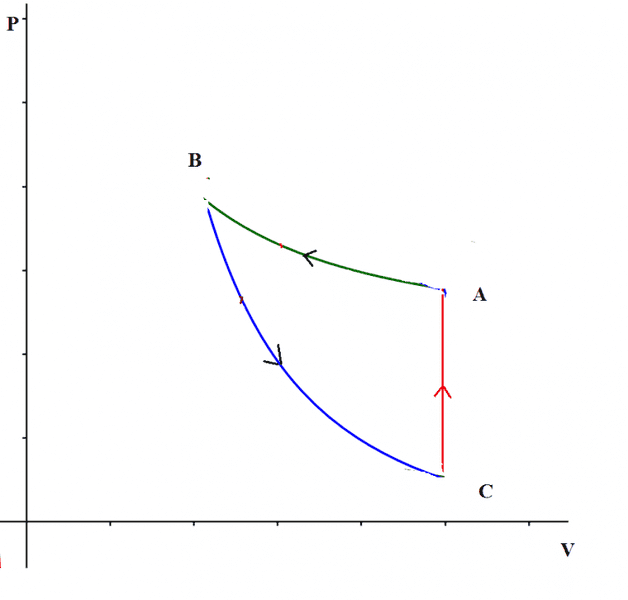
44444.png

$$W_{cycle}=Q_{C->A}>0$$

So the work is positive even if the cycle is traveled anticlockwise.

So is the orientation of the cycle really a general rule to understand if work is positive or negative?
 
Physics news on Phys.org
The gas does negative work.
Unbenannt.jpg

The work done in a gas can be defined as ## \int P dV ##
So the work is the surface under the p V curve.
The work done by the gas from B to C is shaded red. The gas does work since it expands.
The work done on the gas from the outside is the area that is striped blue. It is performed during the compression from A to B.
The blues striped area is bigger than the red shaded one so it takes more work to compress it than the work done by the gas during expansion.
The difference in work during both processes is shaded in green.
The statemen about "clockwise and anticlockwise" determining the sign of this work seems to be correct, not false as you implied.
 
Tazerfish said:
The gas does negative work.
View attachment 103015
The work done in a gas can be defined as ## \int P dV ##
So the work is the surface under the p V curve.
The work done by the gas from B to C is shaded red. The gas does work since it expands.
The work done on the gas from the outside is the area that is striped blue. It is performed during the compression from A to B.
The blues striped area is bigger than the red shaded one so it takes more work to compress it than the work done by the gas during expansion.
The difference in work during both processes is shaded in green.
The statemen about "clockwise and anticlockwise" determining the sign of this work seems to be correct, not false as you implied.
Thanks for the reply! But this is in constrast with the fact that, in any cycle, since ##\Delta U=0## we have ##Q=W##, and in this case ##Q## is only the heat in the isochoric process, which is positive and this leads to ##W>0## necessarily.
 
Soren4 said:
Thanks for the reply! But this is in constrast with the fact that, in any cycle, since ##\Delta U=0## we have ##Q=W##, and in this case ##Q## is only the heat in the isochoric process, which is positive and this leads to ##W>0## necessarily.
Sorry to tell you this but no, Q is not only the heat in the isochoric process.
How can you follow an isothermal during compression ?
Without heat-flow, you would certainly follow an adiabatic curve not an isothermal.
The work you do during the compression of the gas in an isothermal is flowing to the outside as heat that leaves the system.
So we can conclude that you actually have more heat flow out of the system during the isothermal compression than the heat that is added during the isochoric heating.
If the only heat flow would happen during the isochoric heating then the diagram would not connect, it wouldn't be a cycle.
(And you would have positive work and heat flow.)
 
  • Like
Likes   Reactions: Soren4
Tazerfish said:
Sorry to tell you this but no, Q is not only the heat in the isochoric process.
How can you follow an isothermal during compression ?
Without heat-flow, you would certainly follow an adiabatic curve not an isothermal.
The work you do during the compression of the gas in an isothermal is flowing to the outside as heat that leaves the system.
So we can conclude that you actually have more heat flow out of the system during the isothermal compression than the heat that is added during the isochoric heating.
If the only heat flow would happen during the isochoric heating then the diagram would not connect, it wouldn't be a cycle.
(And you would have positive work and heat flow.)

Thanks for the reply! I made a stupid example. If I got your point the cycle with A->B isochoric, B->C adiabatic and C->A adiabatic cannot exist. I looked for the reason of this and effectly in the case I proposed ##\Delta S_{universe}=\Delta S_{environment}=\Delta S_{environment, A->B}<0## which of course cannot be true. Is this the reason why B->C cannot be adiabatic too?

So I find another (hopefully possible) example of what I meant (or better the viceversa), in the following diagram.

333333333333333.png

One of the adiabatics must be irreversible otherwise the two curves cannot be connected (and it is improper to represent the irreverseible process on the diagram but I made it to make things clear). And also this (irreversible) cycle seems possible to me, since ##\Delta S_{universe}=\Delta S_{environment}=\Delta S_{environment, A->B}>0##.

This cycle is clockwise, but $$Q_{cycle}=W_{cycle}=Q_{A->B}<0$$

Is this possible?
 
There is something VERY wrong here.
I don't really know what it is...:confused::rolleyes: I suspect it is the irreversible adiabatic...
The way you drew it, the cycle would have a positive heat flow out(Isothermal compression) AND positive work.
Well, it isn't like conservation of energy is one of the most fundamental things EVER.o0)

My best guess is that the blue line in your diagram is the pressure on the inside of the container somewhere.
The statement ##\int p dV = W## may not be correct anymore when you draw the diagram for an irreversible process(with p as a pressure somewhere in the container). You would need to consider the pressure at the piston surface, the pressure that you actually push against.
When considering the pressure at the interface, (since ##\int p dV = W## would work again if we did that) I suspect you would get a curve with two jumps.
So the curve actually "cuts" itself. And there is negative work done by the system.
It turns out I am horrible at drawing this but here's a try:
Unbenannt.png

The rule would still work for the two individual surfaces.
EDIT: You are really going to great lengths just to break this rule:wink:
May I ask why ?
 
Last edited:
  • Like
Likes   Reactions: Soren4
Tazerfish said:
There is something VERY wrong here.
I don't really know what it is...:confused::rolleyes: I suspect it is the irreversible adiabatic...
The way you drew it, the cycle would have a positive heat flow out(Isothermal compression) AND positive work.
Well, it isn't like conservation of energy is one of the most fundamental things EVER.o0)

My best guess is that the blue line in your diagram is the pressure on the inside of the container somewhere.
The statement ##\int p dV = W## may not be correct anymore when you draw the diagram for an irreversible process(with p as a pressure somewhere in the container). You would need to consider the pressure at the piston surface, the pressure that you actually push against.
When considering the pressure at the interface, (since ##\int p dV = W## would work again if we did that) I suspect you would get a curve with two jumps.
So the curve actually "cuts" itself. And there is negative work done by the system.
It turns out I am horrible at drawing this but here's a try:View attachment 103052
The rule would still work for the two individual surfaces.
EDIT: You are really going to great lengths just to break this rule:wink:
May I ask why ?
Thanks a lot for the answer!

Don't want to find an exception to the rule! :biggrin: But I found these two cycles in two exercises and I wondered how to behave in this case. My only worry is (and I suppose the answer is yes):

In any "clockwise" cycle is the work done by gas positve? (And viceversa for "anticlockwise")?

In this way, when I look to a clockwise cycle I can surely say: "the work is positive"
 
Soren4 said:
In any "clockwise" cycle is the work done by gas positve? (And viceversa for "anticlockwise")?
Yes. At least for reversible cycles that rule seems to be quite water-proof.
I already hinted at the mess irreversible cycles can cause (because the pressue in the diagram is not necessarily the pressure at the piston doing the work), so keep an eye out for that.

One last thing:
I usually find it more useful to remember a few very fundimental rules from which you can derive the others, rather than having a lot of specific rules.
For example, if you know that the work is ##\int F(s) ds ## and know this :##p=\frac{F}{A}##
You can easily conclude that ## \int p(V) dV ## is the work done in the compression or expansion of a gas.
From that you can derive that the are under the p-V curve is the work.
Clockwise means that the upper part of the cycle is an expansion(up moves right(more V)) and the lower part is a compression(down moves left(less V)).
That means that there is more work done during expansion than you do during compresssion.
With this thought you can basically proove the rule.
These things are so simple you are unlikely to forget them later on, and with that knowledge of the simple rules you can check or proove the more specific rules yourself. :smile:(Although the process does involve a little more thinking)
I hope this approach may help in the future.
 

Similar threads

Replies
13
Views
2K
  • · Replies 3 ·
Replies
3
Views
2K
  • · Replies 9 ·
Replies
9
Views
3K
  • · Replies 10 ·
Replies
10
Views
3K
  • · Replies 3 ·
Replies
3
Views
3K
Replies
1
Views
2K
Replies
7
Views
3K
  • · Replies 7 ·
Replies
7
Views
3K
  • · Replies 12 ·
Replies
12
Views
5K