Can You Derive the Gain Equation for a Non-Ideal Op Amp?

  • Thread starter Thread starter GRW
  • Start date Start date
  • Tags Tags
    Amp Op amp
Click For Summary
SUMMARY

The discussion centers on deriving the gain equation for a non-ideal operational amplifier (Op Amp). The ideal gain is expressed as 1 + Rf/R1, but participants emphasize the importance of considering the input resistance (Rin) in the derivation. A key takeaway is that understanding the equivalent circuit and the relationship between components is crucial for accurately deriving the gain in non-ideal conditions. The conversation highlights the necessity of drawing circuit diagrams and analyzing them to facilitate the derivation process.

PREREQUISITES
  • Understanding of operational amplifier fundamentals
  • Knowledge of circuit analysis techniques
  • Familiarity with gain equations in non-ideal conditions
  • Ability to draw and interpret circuit diagrams
NEXT STEPS
  • Study non-ideal Op Amp characteristics and their impact on gain
  • Learn about equivalent circuit modeling for Op Amps
  • Explore the concept of virtual ground in feedback circuits
  • Practice deriving gain equations for various Op Amp configurations
USEFUL FOR

Electrical engineering students, circuit designers, and anyone involved in analog electronics who seeks to deepen their understanding of operational amplifier behavior in non-ideal scenarios.

GRW
Messages
5
Reaction score
0
[ mod note: thread title corrected ][/color]

Hi All,

My first post in the forums, hopefully I'll be able to give out as much help as I receive. I'm currently stuck on an Op Amp gain derivation.

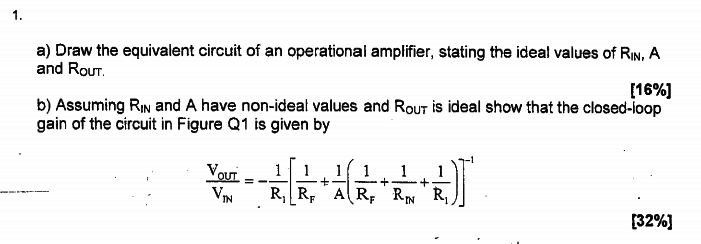
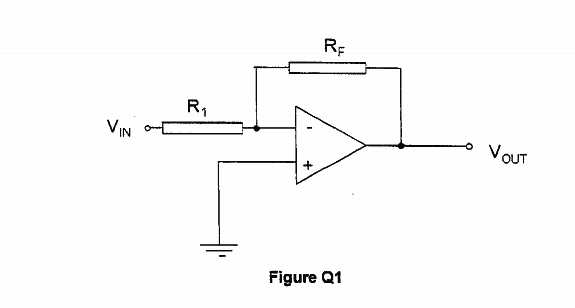
Attached is the question and diagram, the derivation I am struggling with is part B.

I understand the gain for this Op Amp were it ideal would be 1+ Rf/R1 but I cannot seem to derive the equation if the input resistance is not ideal.

Thanks in advance,

George

Capture2.PNG
Capture.PNG
 
Last edited by a moderator:
Physics news on Phys.org
Hi GRW. :welcome:

You won't be able to derive the equation in (b) until you have completed part (a), drawing the equivalent circuit with ideal components.
 
Thanks for your reply Nascent,

I have already completed part A but I can't see how is it that relevant to part B? I know the equivalent circuit and that Rin is in the Op Amp internally and that A is the Op Amp gain.

Any further guidance on how the two relate / where to start with part B would be much appreciated.
 
Can you attach your completed circuit diagram for (a), with RI and RF arranged around it as in Fig Q1.
 
Sorry but I don't have any way of uploading my paper working to a computer. It is as in Fig 1, with Rin linked between the + and - terminals of the Op Amp.
 
GRW said:
Sorry but I don't have any way of uploading my paper working to a computer. It is as in Fig 1, with Rin linked between the + and - terminals of the Op Amp.
That is the circuit you analyze, but this time without a reliance on the dodge of a "virtual earth".
 
It's the circuit analysis for the derivation here that I am struggling with. Sorry if my initial explanation was poor.
 
You draw a large circuit diagram. Mark vin. Label the voltage at the input to the amplifier proper, at the junction of the 3 resistances, I called it va.

How will you label the output of the amplifier?
 
GRW said:
[ mod note: thread title corrected ]

Hi All,

My first post in the forums, hopefully I'll be able to give out as much help as I receive. I'm currently stuck on an Op Amp gain derivation.
Attached is the question and diagram, the derivation I am struggling with is part B.
I understand the gain for this Op Amp were it ideal would be 1+ Rf/R1 but I cannot seem to derive the equation if the input resistance is not ideal.
Thanks in advance
George

View attachment 86256View attachment 86255

Question to you: The input voltage is connected (via a resistor) to the inverting terminal of the opamp. Wouldn`t you expect a negative gain in this case?
(Your ideal gain value (1+Rf/R1) is not correct!)
You have stated: "I understand that the gain ...".
Did you really "understand"? I don`t hope that you understood a false result! That would be fatal!.
 
Last edited:
  • #10
a) This you must draw on your own. If you could somehow take a picture and upload it, we could verify if it is correct. What do you think the ideal values for ##A##, ##R_{in}##, and ##R_{out}## are? Hint: Think about preserving the signal. Do you need a large input impedance or a small one?

b) For the closed loop gain, what equation is relevant to op-amp operation? Use this equation, and the virtual ground between ##R_1## and ##R_F##.
 
  • #11
Thanks for all your help guys, after a decent sleep last night I woke up this morning and after re reading the suggestions I was able to derive it no trouble. Thanks again and I look forward to being part of the forum!
GRW
 
  • #12
GRW said:
Thanks for all your help guys, after a decent sleep last night I woke up this morning and after re reading the suggestions I was able to derive it no trouble. Thanks again and I look forward to being part of the forum!
GRW
GRW, to be honest - did you derive the correct result really without any help?
 

Similar threads

Replies
15
Views
2K
  • · Replies 13 ·
Replies
13
Views
3K
  • · Replies 4 ·
Replies
4
Views
2K
  • · Replies 3 ·
Replies
3
Views
2K
  • · Replies 8 ·
Replies
8
Views
3K
  • · Replies 9 ·
Replies
9
Views
3K
  • · Replies 11 ·
Replies
11
Views
4K
  • · Replies 21 ·
Replies
21
Views
2K
  • · Replies 18 ·
Replies
18
Views
3K
  • · Replies 4 ·
Replies
4
Views
3K