Can you just give me a hint for how to solve this problem?

  • Thread starter Thread starter HAF
  • Start date Start date
Join the discussion
Ask a follow-up here, or get your own question answered by working scientists, mathematicians and engineers — people, not an autocomplete.
Real named experts · corrections over time · the nuance an AI answer skips
18 replies · 2K views
HAF
Messages
58
Reaction score
6
Mentor note = moved to homework hence no template

Good evening everyone. I have a problem with solving this problem. I just don't know where to start. Can you please just "bounce" me somehow?

The radius of the big circle is 1m. What is the radius of the small ones?

The only thing I found out is that the diagonal of the small square is 1m. Nothing else.

Can you help me please?

Thank You
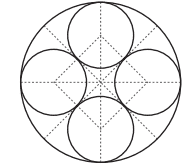
7180_20.PNG
 

Attachments

  • 7180_20.PNG
    7180_20.PNG
    3.7 KB · Views: 1,173
Last edited by a moderator:
on Phys.org
HAF said:
Good evening everyone. I have a problem with solving this problem. I just don't know where to start. Can you please just "bounce" me somehow?

The radius of the big circle is 1m. What is the radius of the small ones?

The only thing I found out is that the diagonal of the small square is 1m. Nothing else.

Can you help me please?

Thank You
View attachment 227081
I don't think it is correct to say that the diagonal of any in this diagram square is 1. I suggest that you label the picture with what you know already. For example, choose one quadrant containing a small circle and label all of the radii of the small circle as having length ##r##. Label the radius of the large circle in that quadrant as having length 1. Now look at the small square formed by the quadrant boundaries and the large square. What is the length of its diagonal?
 
  • Like
Likes   Reactions: jedishrfu and HAF
tnich said:
I don't think it is correct to say that the diagonal of any in this diagram square is 1. I suggest that you label the picture with what you know already. For example, choose one quadrant containing a small circle and label all of the radii of the small circle as having length ##r##. Label the radius of the large circle in that quadrant as having length 1. Now look at the small square formed by the quadrant boundaries and the large square. What is the length of its diagonal?
So the diagonal of the square in the middle is not 1m? If you are correct than I'm completely lost. Help me please. Can you give me some hints for solving this problem?
 
HAF said:
So the diagonal of the square in the middle is not 1m? If you are correct than I'm completely lost. Help me please. Can you give me some hints for solving this problem?
I gave you some hints in my last post.
 
  • Like
Likes   Reactions: jedishrfu
tnich said:
I gave you some hints in my last post.
Is this thought correct?

1529357876458.jpg
 

Attachments

  • 1529357876458.jpg
    1529357876458.jpg
    31.1 KB · Views: 636
jtbell said:
You've marked the angle at the top with an arc and a dot. I've never seen that notation. What does it mean?
I'm sorry for that. This is how I mark right angles.
 
jtbell said:
OK, you have a right triangle. One of the sides adjacent to the right angle has length r. What's the length of the other side (adjacent to the right angle)?
It's also r i think.
 
jtbell said:
So the hypotenuse of that triangle is...
2r^2
 
jtbell said:
I think that's the square of the hypotenuse. :oldwink:
Yeah I'm sorry. 2^1/2r
 
HAF said:
2^1/2r
Or (√2)r. Click on the big "sigma" sign at the left, above the message box, and you'll get a palette of symbols that you can enter directly. I used parentheses to make clear that the square root applies only to the 2, not to the r.

Now you can "piece together" the radius of the large circle, which equals 1.
 
  • Like
Likes   Reactions: jedishrfu and HAF
jtbell said:
Or (√2)r. Click on the big "sigma" sign at the left, above the message box, and you'll get a palette of symbols that you can enter directly. I used parentheses to make clear that the square root applies only to the 2, not to the r.

Now you can "piece together" the radius of the large circle, which equals 1.
Thank You very very much. I don't know why I didn't find it out by myself. I have to practise more.

Thank You guys. You are amazing.
 
  • Like
Likes   Reactions: jedishrfu
Did this one get solved yet? I don't see a final answer from the OP @HAF . ## \\ ## The way I would do it basically uses 2 equations and 2 unknowns: ## r ## and a distance ## s ## from the origin to where the line ## x=0 ## intersects the top circle of radius ##r ##. It's fairly straightforward to write two equations with ## r ## and ## s ##. The one equation is very simple, and the second uses the properties of the 45 degree right triangle. ## \\ ## If you just consider one circle of radius ##r ##, the problem can be solved with x and y axes and a circle of radius ##r ## that fits into one quadrant. The distance ## s ## is then along the line ##y=x ##, from the origin to where the line first intersects the circle.
 
Last edited:
Charles Link said:
Did this one get solved yet? I don't see a final answer from the OP @HAF . ## \\ ## The way I would do it basically uses 2 equations and 2 unknowns: ## r ## and a distance ## s ## from the origin to where the line ## x=0 ## intersects the top circle of radius ##r ##. It's fairly straightforward to write two equations with ## r ## and ## s ##. The one equation is very simple, and the second uses the properties of the 45 degree right triangle. ## \\ ## If you just consider one circle of radius ##r ##, the problem can be solved with x and y axes and a circle of radius ##r ## that fits into one quadrant. The distance ## s ## is then along the line ##y=x ##, from the origin to where the line first intersects the circle.

Charles Link said:
Did this one get solved yet? I don't see a final answer from the OP @HAF . ## \\ ## The way I would do it basically uses 2 equations and 2 unknowns: ## r ## and a distance ## s ## from the origin to where the line ## x=0 ## intersects the top circle of radius ##r ##. It's fairly straightforward to write two equations with ## r ## and ## s ##. The one equation is very simple, and the second uses the properties of the 45 degree right triangle. ## \\ ## If you just consider one circle of radius ##r ##, the problem can be solved with x and y axes and a circle of radius ##r ## that fits into one quadrant. The distance ## s ## is then along the line ##y=x ##, from the origin to where the line first intersects the circle.

Yeah I solved it. I will definitely use your method also.

I solved it with the right angled triangle.

It's hypotenuse is (√2)r.

(√2)r + r = 1
r= 0,41m

Thank you for your tip Charles.
 
  • Like
Likes   Reactions: tnich and Charles Link
HAF said:
Yeah I solved it. I will definitely use your method also.

I solved it with the right angled triangle.

It's hypotenuse is (√2)r.

(√2)r + r = 1
r= 0,41m

Thank you for your tip Charles.
What you did is very similar to how I solved it. The hypotenuse that you computed to be ## \sqrt{2} r ## is what I called ## r+s ##. I saw that ## (r+s) \frac{\sqrt{2}}{2}=r ## because of the 45 degree right triangle. And then ## (r+s)+r=1 ##. Your solution is essentially the same thing, and perhaps a step quicker to the answer.
 
  • Like
Likes   Reactions: HAF
Charles Link said:
What you did is very similar to how I solved it. The hypotenuse that you computed to be ## \sqrt{2} r ## is what I called ## r+s ##. I saw that ## (r+s) \frac{\sqrt{2}}{2}=r ## because of the 45 degree right triangle. And then ## (r+s)+r=1 ##. Your solution is essentially the same thing, and perhaps a step quicker to the answer.
Most important thing is that we solved it. :)

Thank You
 
  • Like
Likes   Reactions: Charles Link