Can You Recall the Formula for Finding the Area of a Spherical Patch?

  • Context: Graduate 
  • Thread starter Thread starter Curl
  • Start date Start date
  • Tags Tags
    Area Spherical
Click For Summary
SUMMARY

The area of a spherical patch defined by two angles can be calculated using the formula derived from surface integrals. Specifically, for a sphere of radius R, the area is given by the integral ∫(θ=θ₀)^(θ₁) ∫(φ=φ₀)^(φ₁) R² sin(φ) dφ dθ, which simplifies to R²(θ₁ - θ₀)(cos(φ₀) - cos(φ₁)). Additionally, if the patch is defined by segments of great circles, the area can be computed using the pyramid solid angle formula: Ω = 4 arcsin(sin(a/2) sin(b/2)), multiplied by R² for a sphere of radius R. This discussion clarifies the distinction between different types of spherical patches.

PREREQUISITES
  • Understanding of spherical coordinates and surface integrals
  • Familiarity with the concept of solid angles
  • Knowledge of trigonometric functions and their properties
  • Basic calculus skills, particularly in evaluating double integrals
NEXT STEPS
  • Research the derivation of surface area integrals in spherical coordinates
  • Study the properties and applications of solid angles in geometry
  • Explore the differences between great circles and other types of circles on a sphere
  • Learn about the applications of spherical patches in physics and engineering
USEFUL FOR

Mathematicians, physicists, and engineers interested in geometry, particularly those working with spherical surfaces and solid angles.

Curl
Messages
756
Reaction score
0
Does anyone remember the formula for the area of a spherical patch in terms of two angles?

Obviously you parametrize the surface and do the surface integral but I'm a bit too lazy/busy right now. So does anyone just remember the result?

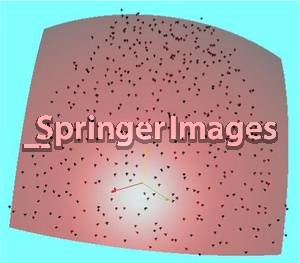
By spherical patch I mean something like this:
.
WATER_366_2007_76_Fig12_HTML.jpg
.

I want to define it by two angles which are between some arbitrary values. The z-axis passes through the center of the patch and is normal to the surface at the intersection point.
 
Physics news on Phys.org
The "differential of surface area" of a sphere of radius R is R^2 sin(\phi)d\phi d\theta so the area of a spherical patch with \theta between \theta_0 and \theta_1, \phi between \phi_0 and \phi_1 is given by
\int_{\theta= \theta_0}^{\theta_1}\int_{\phi= \phi_0}^{\phi_1} R^2 sin(\phi)d\phi d\theta
= R^2(\theta_1- \theta_0)(cos(\phi_0)- cos(\phi_1))
 
I have the impression that HallsofIvy did not answer Curl's question... however, I'm extrapolating a bit based on Curl's verbiage and picture.

I think Curl is depicting what would be the intersection of two orthogonal lunes, that is: all for "sides" of the patch are segments along great circles. (I'd informally call this a "rectangular patch of a sphere"...)

I think HallsofIvy answered as if the "sides" of the patch are like "latitude and longitude lines" on the globe. As we know, latitude lines are NOT great circles, except for latitude = 0°. (I'd informally call this a "trapezoidal patch of a sphere"...)

So I think Curl's question is yet to be answered.

However -- if I'm right -- then I got the answer I was looking for, which was the "latitude-longitude" sense.
 
If the sides of the "patch" are segments of great circles, then the area on the surface of a sphere of radius 1 is given by the "pyramid solid angle formula",
\Omega = 4 \arcsin \left( \sin \frac{a}{2} \sin \frac{b}{2} \right)
where a and b are the apex angles. Mutiply by R^2 for a sphere of radius R.

See the section titled "Pyramid" in
http://en.wikipedia.org/wiki/Solid_angle
 

Similar threads

  • · Replies 7 ·
Replies
7
Views
5K
Replies
17
Views
1K
  • · Replies 2 ·
Replies
2
Views
4K
Replies
1
Views
1K
  • · Replies 3 ·
Replies
3
Views
7K
  • · Replies 3 ·
Replies
3
Views
3K
  • · Replies 2 ·
Replies
2
Views
1K
  • · Replies 1 ·
Replies
1
Views
1K
  • · Replies 5 ·
Replies
5
Views
90K
  • · Replies 1 ·
Replies
1
Views
2K