Can You Recall the Formula for Finding the Area of a Spherical Patch?

  • Context: Graduate 
  • Thread starter Thread starter Curl
  • Start date Start date
  • Tags Tags
    Area Spherical
Click For Summary

Discussion Overview

The discussion centers around the formula for calculating the area of a spherical patch defined by two angles. Participants explore different interpretations of what constitutes a spherical patch and the corresponding mathematical expressions for its area, considering both surface integrals and specific geometric configurations.

Discussion Character

  • Exploratory
  • Technical explanation
  • Debate/contested
  • Mathematical reasoning

Main Points Raised

  • One participant requests a formula for the area of a spherical patch defined by two angles, indicating a preference for a direct answer rather than performing a surface integral.
  • Another participant provides a formula for the area of a spherical patch based on the differential surface area of a sphere, presenting an integral that involves the angles defining the patch.
  • A third participant suggests that the original question may not have been fully addressed, interpreting the patch as the intersection of two orthogonal lunes rather than as latitude and longitude lines, which leads to a different understanding of the geometry involved.
  • Another participant introduces the "pyramid solid angle formula" for calculating the area of a spherical patch with sides along great circles, suggesting a specific formula that involves apex angles and the radius of the sphere.

Areas of Agreement / Disagreement

Participants express differing interpretations of what constitutes a spherical patch, leading to multiple competing views on the appropriate formulas and methods for calculating the area. The discussion remains unresolved regarding the exact nature of the patch and the corresponding formulas.

Contextual Notes

There are limitations in the assumptions made about the geometry of the spherical patch, particularly concerning the definitions of the angles and the types of lines used to define the sides of the patch. The discussion does not resolve these ambiguities.

Curl
Messages
756
Reaction score
0
Does anyone remember the formula for the area of a spherical patch in terms of two angles?

Obviously you parametrize the surface and do the surface integral but I'm a bit too lazy/busy right now. So does anyone just remember the result?

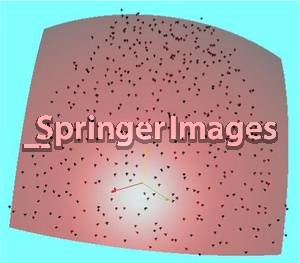
By spherical patch I mean something like this:
.
WATER_366_2007_76_Fig12_HTML.jpg
.

I want to define it by two angles which are between some arbitrary values. The z-axis passes through the center of the patch and is normal to the surface at the intersection point.
 
Physics news on Phys.org
The "differential of surface area" of a sphere of radius R is [itex]R^2 sin(\phi)d\phi d\theta[/itex] so the area of a spherical patch with [itex]\theta[/itex] between [itex]\theta_0[/itex] and [itex]\theta_1[/itex], [itex]\phi[/itex] between [itex]\phi_0[/itex] and [itex]\phi_1[/itex] is given by
[tex]\int_{\theta= \theta_0}^{\theta_1}\int_{\phi= \phi_0}^{\phi_1} R^2 sin(\phi)d\phi d\theta[/tex]
[tex]= R^2(\theta_1- \theta_0)(cos(\phi_0)- cos(\phi_1))[/tex]
 
I have the impression that HallsofIvy did not answer Curl's question... however, I'm extrapolating a bit based on Curl's verbiage and picture.

I think Curl is depicting what would be the intersection of two orthogonal lunes, that is: all for "sides" of the patch are segments along great circles. (I'd informally call this a "rectangular patch of a sphere"...)

I think HallsofIvy answered as if the "sides" of the patch are like "latitude and longitude lines" on the globe. As we know, latitude lines are NOT great circles, except for latitude = 0°. (I'd informally call this a "trapezoidal patch of a sphere"...)

So I think Curl's question is yet to be answered.

However -- if I'm right -- then I got the answer I was looking for, which was the "latitude-longitude" sense.
 
If the sides of the "patch" are segments of great circles, then the area on the surface of a sphere of radius 1 is given by the "pyramid solid angle formula",
[tex]\Omega = 4 \arcsin \left( \sin \frac{a}{2} \sin \frac{b}{2} \right)[/tex]
where a and b are the apex angles. Mutiply by [itex]R^2[/itex] for a sphere of radius [itex]R[/itex].

See the section titled "Pyramid" in
http://en.wikipedia.org/wiki/Solid_angle
 

Similar threads

  • · Replies 7 ·
Replies
7
Views
6K
Replies
17
Views
1K
  • · Replies 2 ·
Replies
2
Views
4K
Replies
1
Views
1K
  • · Replies 3 ·
Replies
3
Views
7K
  • · Replies 3 ·
Replies
3
Views
3K
  • · Replies 2 ·
Replies
2
Views
1K
  • · Replies 1 ·
Replies
1
Views
1K
  • · Replies 5 ·
Replies
5
Views
90K
  • · Replies 1 ·
Replies
1
Views
2K