Cant get Venn diagram to agree with Demorgan's Law

Click For Summary

Discussion Overview

The discussion revolves around the application of DeMorgan's Law in probability, particularly in the context of calculating the probability of failures in a communications link involving multiple nodes. Participants explore the use of Venn diagrams to visualize and understand these concepts, addressing issues related to independent and non-mutually exclusive events.

Discussion Character

  • Exploratory
  • Technical explanation
  • Debate/contested
  • Mathematical reasoning

Main Points Raised

  • One participant attempts to apply DeMorgan's Law to calculate probabilities but encounters discrepancies in expected results, particularly with P(A∪B) and P(A∪B)'.
  • Another participant points out that the equality P(A' ∩ B') = (1-P(A))(1-P(B)) holds only if A and B are independent, which is not the case in the original example.
  • There is a discussion about the meaning of the value 0.05 in the context of P(A ∩ B) and its implications for the calculations.
  • Participants clarify that DeMorgan's laws are not restricted to independent events, and provide alternative methods for calculating P(A' ∩ B').
  • One participant describes a scenario involving multiple links in a circuit, explaining how to calculate the probability of success based on the independence of link failures.
  • Another participant confirms that the calculations for the probability of success align with their Venn diagram representation.

Areas of Agreement / Disagreement

Participants express differing views on the application of DeMorgan's Law, particularly regarding independence and mutual exclusivity. While some clarify the conditions under which certain equations hold, consensus on the initial misunderstanding is reached as participants refine their understanding of the concepts.

Contextual Notes

Limitations include the dependence on the definitions of independence and mutual exclusivity, as well as the unresolved nature of the initial probability values used in the examples.

Who May Find This Useful

This discussion may be useful for individuals studying probability theory, particularly those interested in the nuances of applying DeMorgan's Law and understanding the implications of event independence in probability calculations.

FrankJ777
Messages
140
Reaction score
6
I was trying to solve a problem about calculating the probability of failures of a communications link with several nodes, and figured I need to use Demorgan's law since it would involve non mutually exclusive events. So I tried to go back to the basics to make sure I understand the axioms of probability and prove to my self that this is correct using Venn diagrams, but I can't make the numbers come out right trying to apply Demorgan's Law. Here is the example:

P(A) = .3
P(B) = .2

P(A∪B) = P(A) + P(B) - P(A∩B)
P(A∪B) = .3 + .2 - .05 = .45

But if I try to apply Demorgans's I don't get what I expect.

P(A∪B)' = P(A' ∩ B')
P(A∪B)' = (1-P(A))(1-P(B))
P(A∪B)' = (1-.3)(1-.2)
P(A∪B)' = (.7)(.8) = .56

but clearly P(A∪B)' = .55

so where am i going wrong? All parts of my Venn diagram add up to 1. Also I believe that the identity P(A∩B) = P(A)P(B) but this doesn't seem to be correct either as .3 x .2 ≠ .05. So I guess I'm misapplying the use of the Venn diagram but I'm not sure how. Can someone please explain what I'm doing wrong?
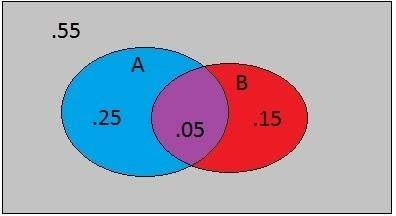
2u9pr8n.jpg


Thanks in advance.
 
Physics news on Phys.org
FrankJ777 said:
P(A∪B)' = P(A' ∩ B')
P(A∪B)' = (1-P(A))(1-P(B))
2u9pr8n.jpg

The latter equality only holds if A and B are independent, i.e. if P(A ∩ B) = P(A)P(B) (which implies that also A' and B' are independent), but that is not the case here.
 
Where does the .05 come from, then ?
 
FrankJ777 said:
But if I try to apply Demorgans's I don't get what I expect.

P(A∪B)' = P(A' ∩ B')
P(A∪B)' = (1-P(A))(1-P(B))
P(A∪B)' = (1-.3)(1-.2)
P(A∪B)' = (.7)(.8) = .56

Your second step is not correct. P(A' \cap B') is only equal to (1-P(A))(1-P(B)) if A and B are mutually exclusive, that is, if P(A \cap B) = 0
 
stevendaryl said:
Your second step is not correct. P(A' \cap B') is only equal to (1-P(A))(1-P(B)) if A and B are mutually exclusive, that is, if P(A \cap B) = 0
Independent, not mutually exclusive. If we change P(A ∩ B) to 0.06, then the formula holds, but A and B are not mutually exclusive.
 
Erland said:
Independent, not mutually exclusive. If we change P(A ∩ B) to 0.06, then the formula holds, but A and B are not mutually exclusive.

Right, my mistake.
 
Ok. So can you only use Demorgan's for independent relations? If not I don't see how you can get P(A' ∩ B') if I can't use P(A' ∩ B') = (1 - P(A))(1-P(B)) .
 
FrankJ777 said:
Ok. So can you only use Demorgan's for independent relations?
No, DeMorgan's laws aren't restricted to independent events.

If not I don't see how you can get P(A' ∩ B') if I can't use P(A' ∩ B') = (1 - P(A))(1-P(B)) .
The diagram can be partitioned into disjoint sets labeled according to whether they are in or not-in each of the named sets. This is like a coordinate system. So the distinct areas of the diagram have "coordinates" (A,B), (A,B'),(A',B), (A'B').

If you want the probability of the set ##A'\cap B'## (which corresponds to (A'B') ) take 1 minus the sum of the probabilities of the other sets in the partition. So ##p(A'\cap B') = 1 - P(A'\cap B) - P(A\cap B') - P(A\cap B)##.
 
Anyways I started this discussion because I was trying to figure out how to determine the probability of failure or success of a circuit, made of multiple links. Like this:
Node A-------link 1--------Node B---------link 2--------Node C
What is the chance a message getting to Node C from Node A if the chance of an individual link failing is .1?
Now, each link has an equal probability of failing.
Only one link needs to fail for the entire circuit to fail. But because multiple links could fail, their probabilities aren't mutually exclusive, so I can't just add the probabilities of the individual failures.
However since the failure of one link doesn't impact the probability that any other fails, they are independent meaning that the probability the probability of failure of link 1 and link 2 is P(f1 ∩ f2 ) = P(f1)P(f2)

So if i try to determine the probability of success of the circuit, that means both links must not fail, which is equivalent to P(f1 ∪ f2)' = P(f1' ∩ f2')
So the probability of success is:
P(f1 ∪ f2)' = P(f1' ∩ f2')
P(f1 ∪ f2)' = (1-P(f1))(1-P(f2))
P(f1 ∪ f2)' = (1-.1)(1-.1) = .9 x .9
P(f1 ∪ f2)' = . 81

Which agrees with my Venn diagram!
venn_link_failiure.jpg


So I guess the key here was that the link failures are independent of each other and that's why I could use this technique.

Thanks a lot for the help guys. Hopefully I'll understand this better with some more practice.
 
  • #10
Oops. Correction on the Venn diagram.

venn_link_failiure.jpg
 
  • #11
Seems correct.
 

Similar threads

  • · Replies 12 ·
Replies
12
Views
8K
  • · Replies 8 ·
Replies
8
Views
3K
  • · Replies 7 ·
Replies
7
Views
1K
  • · Replies 6 ·
Replies
6
Views
2K
  • · Replies 29 ·
Replies
29
Views
6K
  • · Replies 36 ·
2
Replies
36
Views
5K
  • · Replies 9 ·
Replies
9
Views
2K
  • · Replies 13 ·
Replies
13
Views
3K
  • · Replies 3 ·
Replies
3
Views
4K
  • · Replies 11 ·
Replies
11
Views
3K