ibuildstuff
- 5
- 0
So, I was playing around with a couple of voltage multiplier circuits a few months ago, and while optimizing one design, I came up with a pretty neat (not to brag) way of converting a sine wave to a square wave by using transformers in a completely different way than normally. A little while ago, I got bored and decided to test it in some free online simulator I found. Surprisingly, it seemed to work perfectly. Even more surprisingly, after playing around with it for a while, I was able to observe some pretty surprising effects.
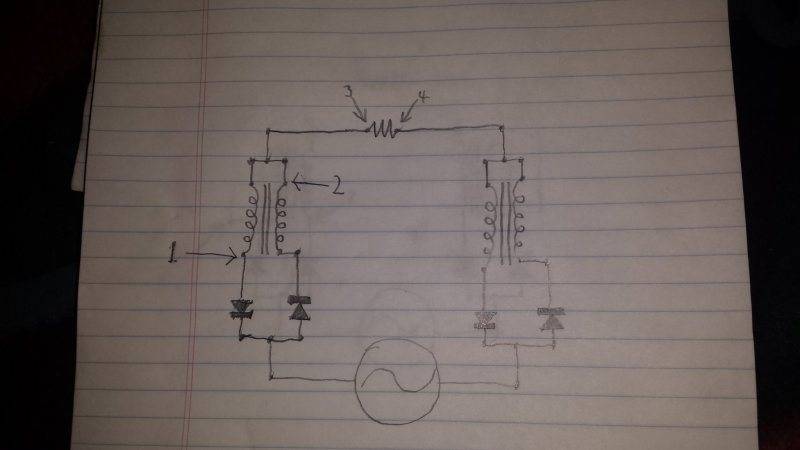
Here's the circuit diagram, as best as I can remember it. It's pretty simple, but if you probe the voltage difference between points 1 and 2, you'll see a very odd periodic pattern: a sine wave for half of the period, followed by rapid, chaotic oscillations for the other half, if I remember correctly. Measure 3 and 4 to see the square wave:
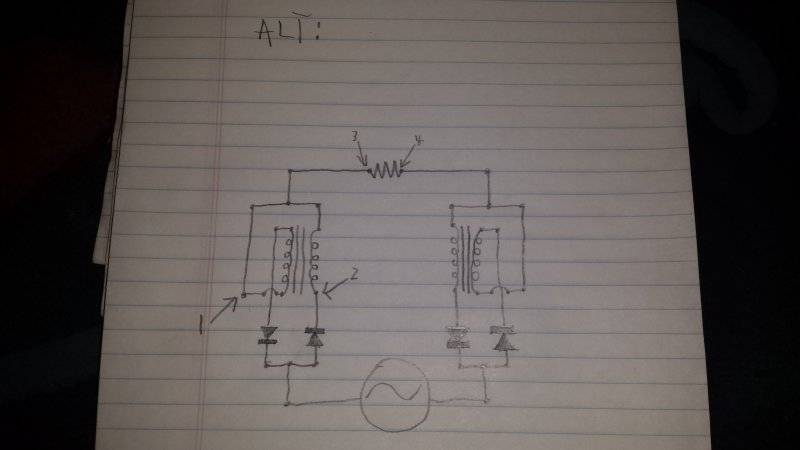
If you're using a simulator, you may have to wire it like this (I don't remember why. Something about the direction the current is traveling or something):
So, is this truly chaotic behavior? Also, I'm sure everyone will agree with me when I say inductors are weird, but I still can't figure out why this circuit would behave so erratically. Any ideas?
Here's the circuit diagram, as best as I can remember it. It's pretty simple, but if you probe the voltage difference between points 1 and 2, you'll see a very odd periodic pattern: a sine wave for half of the period, followed by rapid, chaotic oscillations for the other half, if I remember correctly. Measure 3 and 4 to see the square wave:
If you're using a simulator, you may have to wire it like this (I don't remember why. Something about the direction the current is traveling or something):
So, is this truly chaotic behavior? Also, I'm sure everyone will agree with me when I say inductors are weird, but I still can't figure out why this circuit would behave so erratically. Any ideas?