Undergrad How is unit norm axis rotation represented and derived in R3?

Click For Summary
SUMMARY

The discussion focuses on the representation and derivation of unit norm axis rotation in R3, specifically through the use of infinitesimal rotations corresponding to Euler angles. The conversation highlights the algebraic relationships between the representation A and the canonical basis, emphasizing the construction of unitary matrices from operators A_i. The participants also reference the theorem classifying finite-dimensional representations of the generators L_± and L_3, culminating in the expression for group elements using the exponential of linear combinations of these operators.

PREREQUISITES
  • Understanding of R3 vector space and rotation matrices
  • Familiarity with Euler angles and their application in rotations
  • Knowledge of canonical basis and its role in representation theory
  • Basic grasp of unitary matrices and their significance in quantum mechanics
NEXT STEPS
  • Study the derivation of infinitesimal rotations in R3 using Euler angles
  • Learn about the canonical basis in representation theory and its applications
  • Explore the construction of unitary matrices from operator algebra
  • Investigate the Taylor expansion of exponential functions in the context of Lie groups
USEFUL FOR

Students and researchers in physics, particularly those focused on quantum mechanics and representation theory, as well as mathematicians interested in the algebra of rotations and unitary transformations.

LCSphysicist
Messages
644
Reaction score
162
TL;DR
I am having trouble to understand the reasoning that the author follows in these pages.
A rotation about an unit norm axis in R3
1624685734661.png
can be given by the following, that gives basically the elements of the matrix of the rotation:


1624685272932.png

With these expression, we can obtain the three infinesimal rotations that corresponds to the three euler angles by first writing the three individuals matrix of these rotations, and then, taking the derivative:
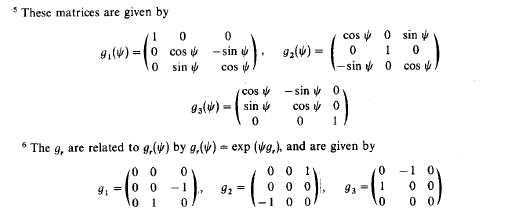
1624685381104.png

Now, the autor gives the algebra regardind these transformations and talk about its representation in Rn
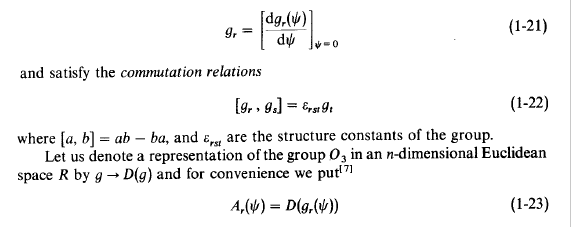
1624685431887.png

It is said that the representation A have the same algebra that g. And so he starts to talk about the canonical basis to represent as a way to write the representations.
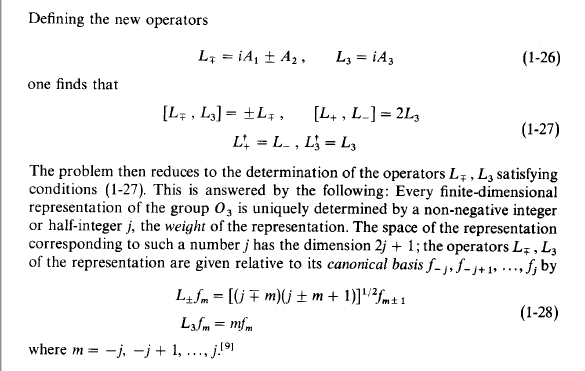
1624685476549.png

After that, he returns to the beginning and says that
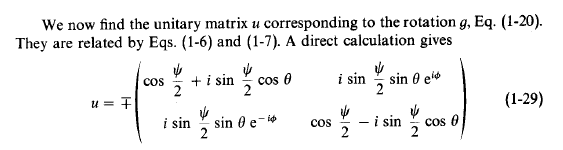
1624685560659.png

The relatios six and seven he says is that:

1624685593061.png

Now, i am extremelly confused about all this thing. More preciselly, i can't understand how 1.29 was obtained. It was used the A representation? How do he uses it? There is something to do with the canonical basis?
 
Physics news on Phys.org
Since you want to obtain a 2d representation, you need to use the representation with ##2=2j+1## i.e. ##j=1/2##. Then the "canonical basis" is 2d and consists of ##f_{-1/2}, f_{1/2}##. With eq. 1-28 you now know how ##L_3## and ##L_{\pm}## act on that base, and therefore you can construct the matrices in this base.
Now, knowing these 3 operators you can easily compute, using 1-26 the operators ##A_i##. And from that, you can construct the unitary matrix.
 
Gaussian97 said:
Since you want to obtain a 2d representation, you need to use the representation with ##2=2j+1## i.e. ##j=1/2##. Then the "canonical basis" is 2d and consists of ##f_{-1/2}, f_{1/2}##. With eq. 1-28 you now know how ##L_3## and ##L_{\pm}## act on that base, and therefore you can construct the matrices in this base.
Now, knowing these 3 operators you can easily compute, using 1-26 the operators ##A_i##. And from that, you can construct the unitary matrix.
Hello. Thank you. The real problem to me is, following your reasoning, make the last step. Tthat is, from the Ai obtained, how to construct the unitary matrix. How do exact we could do it? I am still new in these representations things, so i am a little confused about that.
 
Given the set of generators ##A_i##, you can construct the elements of the group as
$$g(\alpha, \beta, \gamma) = \exp{(\alpha A_1 + \beta A_2 + \gamma A_3)}$$
Where the exponential must be understood as its Taylor expansion. The evaluation can be, in general, very difficult, fortunately for the 2d representation of SO(3) you can find easy expressions for the matrices ##(\alpha A_1 + \beta A_2 + \gamma A_3)^n## which allows you to write the exponential in the form 1-29
 
I am studying the mathematical formalism behind non-commutative geometry approach to quantum gravity. I was reading about Hopf algebras and their Drinfeld twist with a specific example of the Moyal-Weyl twist defined as F=exp(-iλ/2θ^(μν)∂_μ⊗∂_ν) where λ is a constant parametar and θ antisymmetric constant tensor. {∂_μ} is the basis of the tangent vector space over the underlying spacetime Now, from my understanding the enveloping algebra which appears in the definition of the Hopf algebra...

Similar threads

  • · Replies 6 ·
Replies
6
Views
3K
  • · Replies 3 ·
Replies
3
Views
3K
Replies
2
Views
2K
  • · Replies 3 ·
Replies
3
Views
2K
  • · Replies 26 ·
Replies
26
Views
5K
Replies
9
Views
8K
  • · Replies 13 ·
Replies
13
Views
3K
  • · Replies 20 ·
Replies
20
Views
5K
  • · Replies 10 ·
Replies
10
Views
5K
  • · Replies 2 ·
Replies
2
Views
3K