Alex999
- 1
- 0
Hi guys, first time poster so play nice :)
Outline of problem:
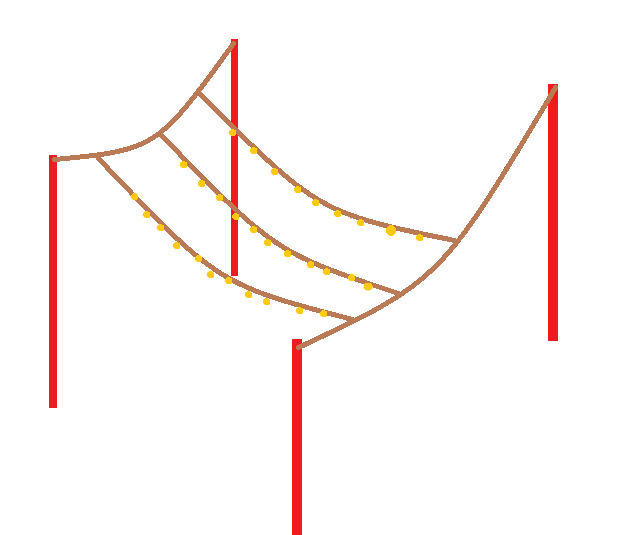
The situation I have is that there are 4 supporting columns. These columns support support a wire and this wire is then used to hang wires which support festive lights. (see diagram below)
What I'm looking for as an end point is to be able to say what are the forces going onto the columns
I'm not looking for a numerical answer as such, hence i haven't provided any figures, I'm just looking for the right way to think about it and then I can put numbers to it later.
equations:
n/a
attempted solution:The way I'm thinking of it initially is the middle wires are effectively catenary systems (as the lights are placed at regular and relatively close intervals and I can therefore approximate it as the wire having a self weight that includes the lights) and therefore I can specify a vertical and horizontal force at each point where these inner wires connect to the outer wires.
However I'm hitting a bit of a mental block when it comes to thinking about the outer wires which connect to the columns and how I would go about it. I remember doing the simpler tension problems (weight hung between two wires) when I did mechanics and was wondering whether this would be the path to take... but like I've said I'm in abit of a muddle thinking about it and could use some guidance.
Outline of problem:
The situation I have is that there are 4 supporting columns. These columns support support a wire and this wire is then used to hang wires which support festive lights. (see diagram below)
What I'm looking for as an end point is to be able to say what are the forces going onto the columns
I'm not looking for a numerical answer as such, hence i haven't provided any figures, I'm just looking for the right way to think about it and then I can put numbers to it later.
equations:
n/a
attempted solution:The way I'm thinking of it initially is the middle wires are effectively catenary systems (as the lights are placed at regular and relatively close intervals and I can therefore approximate it as the wire having a self weight that includes the lights) and therefore I can specify a vertical and horizontal force at each point where these inner wires connect to the outer wires.
However I'm hitting a bit of a mental block when it comes to thinking about the outer wires which connect to the columns and how I would go about it. I remember doing the simpler tension problems (weight hung between two wires) when I did mechanics and was wondering whether this would be the path to take... but like I've said I'm in abit of a muddle thinking about it and could use some guidance.