GoldShadow
- 23
- 0
The question is:
"In an automatic clothes dryer, a hollow cylinder moves the clothes on a vertical circle (radius r=0.32m). The appliance is designed so that the clothes tumble as they dry. This means that when a piece of clothing reaches an angle of [tex]\theta[/tex] above the horizontal, it loses contact with the wall of the cylinder and falls onto the clothes below. How many revolutions per second should the cylinder make in order that the clothes lose contact with the wall when [tex]\theta[/tex]=70.0 degrees?
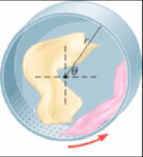 I set it up like so:
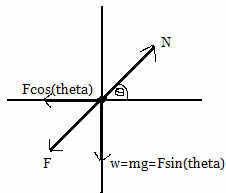
Where the center of the drawing is an article of clothing on the edge of the dryer. F is the centripetal force toward the center of the dryer, N is the normal force against the walls of the dryer. Since I'm looking for the number of revolutions per sec, I need to solve for velocity. I figure that the clothing will fall when the vertical component of the normal force is just equal to the force of gravity (mg). The vertical component of centripetal force should be equal to gravity, like I put in my diagram.
So I used mg=Fsin[tex]\theta[/tex], which I rewrote as [tex]mg=\frac{mv^{2}}{R}sin\theta[/tex]. Using the given 70.0 deg for theta and 0.32m for R, and 9.8 for g, I got that v=1.83 m/s. Then I just got the circumference using 2(pi)R, which was 2.01m. Divided velocity by circumf. to get number of revolutions/sec. Final answer was 0.91 rev/sec.
Could somebody tell me if I approached this correctly at all or if I did something wrong?
"In an automatic clothes dryer, a hollow cylinder moves the clothes on a vertical circle (radius r=0.32m). The appliance is designed so that the clothes tumble as they dry. This means that when a piece of clothing reaches an angle of [tex]\theta[/tex] above the horizontal, it loses contact with the wall of the cylinder and falls onto the clothes below. How many revolutions per second should the cylinder make in order that the clothes lose contact with the wall when [tex]\theta[/tex]=70.0 degrees?
Where the center of the drawing is an article of clothing on the edge of the dryer. F is the centripetal force toward the center of the dryer, N is the normal force against the walls of the dryer. Since I'm looking for the number of revolutions per sec, I need to solve for velocity. I figure that the clothing will fall when the vertical component of the normal force is just equal to the force of gravity (mg). The vertical component of centripetal force should be equal to gravity, like I put in my diagram.
So I used mg=Fsin[tex]\theta[/tex], which I rewrote as [tex]mg=\frac{mv^{2}}{R}sin\theta[/tex]. Using the given 70.0 deg for theta and 0.32m for R, and 9.8 for g, I got that v=1.83 m/s. Then I just got the circumference using 2(pi)R, which was 2.01m. Divided velocity by circumf. to get number of revolutions/sec. Final answer was 0.91 rev/sec.
Could somebody tell me if I approached this correctly at all or if I did something wrong?
Last edited: