Change in angular velocity of the following system

Click For Summary

Discussion Overview

The discussion revolves around a hypothetical scenario involving a system of spheres causing accelerations towards themselves, attached to a rotating ring. Participants explore the implications of this setup on the change in angular velocity of the ring, considering both instantaneous and relativistic transmission of acceleration. The conversation touches on concepts of torque, gravitational forces, and the applicability of physical laws.

Discussion Character

  • Exploratory
  • Debate/contested
  • Mathematical reasoning
  • Conceptual clarification

Main Points Raised

  • One participant describes a system where pink and aqua spheres exert different accelerations towards themselves, questioning how this affects the ring's velocity over time.
  • Another participant challenges the scenario's physical validity, noting that acceleration should depend on distance and questioning the conservation of energy.
  • A different viewpoint suggests that the problem is more of a mathematical exercise rather than a physical one, while still expressing curiosity about the mathematical solution.
  • Some participants propose using Newton's laws as an approximation, while others argue that the scenario requires general relativity for accurate treatment.
  • There is a discussion about calculating torque on the wheel, with conflicting opinions on whether instantaneous force transmission can yield a net torque.
  • One participant expresses skepticism about the relevance of the numbers involved, suggesting they lack meaningful context.
  • Another participant indicates a desire to illustrate a point using fictional forces, despite criticism from others regarding the scenario's practicality.
  • Several posts express humor and lightheartedness regarding the discussion, with some participants acknowledging the absurdity of the scenario.
  • Technical details about using WxMaxima for calculations are shared, indicating an interest in exploring the problem computationally.

Areas of Agreement / Disagreement

Participants do not reach a consensus on the validity of the scenario or the appropriate physical laws to apply. Multiple competing views remain regarding the nature of the problem, the relevance of the proposed calculations, and the implications of instantaneous versus relativistic force transmission.

Contextual Notes

Participants express uncertainty about the assumptions underlying the scenario, particularly regarding the nature of acceleration and the applicability of physical laws. The discussion includes references to fictional forces and exaggerated conditions, which may limit the applicability of traditional physics principles.

Matt Benesi
Messages
134
Reaction score
7
The pink spheres cause an acceleration of 1 cm per second squared towards themselves.

The aqua spheres cause an acceleration of 2 cm per second towards themselves.

All spheres have the same mass.

The spheres are attached to a massless, yet mysteriously solid perfectly circular green ring, equidistant from the closest spheres (pi/2 from one another).

The 10 cm diameter green ring is rotating at a velocity of 1 cm per second.

Everything except the pedestal experiences an acceleration of 10 cm per second squared downwards (in the direction from the bearing towards the pedestal). The pedestal is fixed in place (does not accelerate downwards).

The ring is held up from the pedestal by a post with a frictionless bearing.
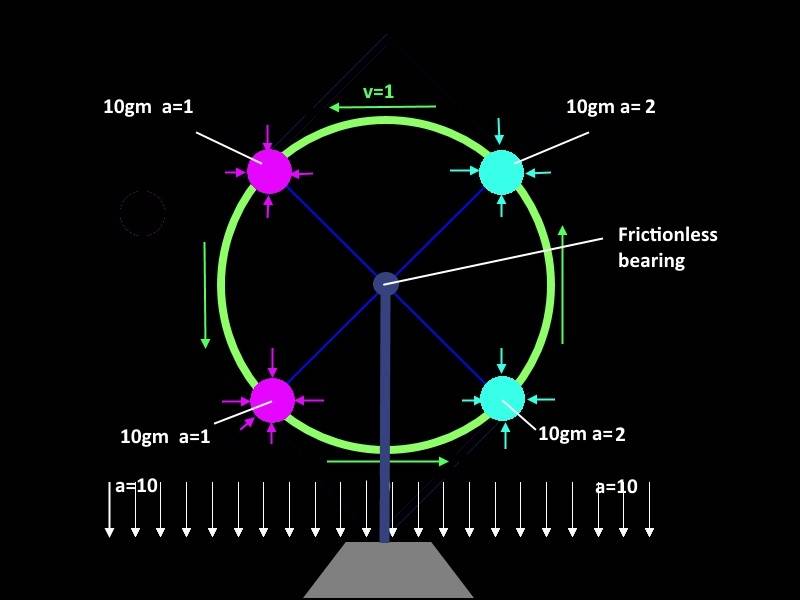
math%2Bproblem.jpg
At what rate does the velocity of the ring change over time if acceleration transmission is instantaneous?

At what rate does the velocity of the ring change over time if acceleration transmission is relativistic?
 
Last edited:
Physics news on Phys.org
What is this, a strange homework problem? An attempt to violate conservation of energy?
It is certainly not mathematics, but I'm unsure where to put the thread.
Matt Benesi said:
The pink spheres cause an acceleration of 1 cm per second squared towards themselves.

The aqua spheres cause an acceleration of 2 cm per second towards themselves.

All spheres have the same mass.
That doesn't make sense. Acceleration depends on distance, and for the same mass the gravitational force is the same.
 
mfb said:
What is this, a strange homework problem? An attempt to violate conservation of energy?
It is certainly not mathematics, but I'm unsure where to put the thread.
It's a math question about an exaggerated fictional scenario. I wouldn't call it physics. It will help me understand a concept.
mfb said:
That doesn't make sense. Acceleration depends on distance...
I thought of adding that later, it should say (although I'm still curious about the mathematical solution with non proportional acceleration!):
The pink spheres cause an acceleration of 1 cm per second squared towards themselves at a distance of 5√2cm.

The aqua spheres cause an acceleration of 2 cm per second towards themselves at a distance of 5√2cm.

The arrows point to "where" (greatly exaggerated) the acceleration is towards in the relativistic scenario.
math%2Bproblem.jpg
I'm assuming similar scenarios come up a lot, so thought there would be some ready made formulas to plug values into to determine the acceleration.
 
Last edited:
Matt Benesi said:
I'm assuming similar scenarios come up a lot
Not really.

If you want to use the physical laws of our universe, the correct treatment is general relativity. Calculating that system in general relativity is way beyond your knowledge. There are also no perfectly rigid materials any more.
You can use Newton's laws as approximation, then you can ignore all internal forces and just calculate the net torque on the wheel.
 
mfb said:
If you want to use the physical laws of our universe, the correct treatment is general relativity. Calculating that system in general relativity is way beyond your knowledge.
Ehh, I want to calculate torque on the wheel using fictional forces to illustrate a point.

I was going to use the following approximation (more or less, pressed for time):

For the shortest acceleration distance:
1) Constrain 0< s < 5√2 cm / c
2) τ = v / 10π
3) calculate s by using 10 sin(π/4 - τs/2)- c s /100 = 0 (c in cm) // ?
4) Use s to determine the distance from accelerating body
5) calculate magnitude of acceleration vector
6) multiply by sin (π/4 +τs/2)... now you have a relativistic approximation
...

You can use Newton's laws as approximation, then you can ignore all internal forces and just calculate the net torque on the wheel.
You can't. Instantaneous transmission of forces results in no net torque on the wheel.
 
Last edited:
Matt Benesi said:
Ehh, I want to calculate torque on the wheel using fictional forces to illustrate a point.
The point is pointless. It's like 5 random numbers you see in 5 different places. Sure you can add them, but how would that give any interesting result.
You can't. Instantaneous transmission of forces results in no net torque on the wheel.
As I said, you can ignore all internal forces... net torque can still come from external forces, like gravity.
 
Matt Benesi said:
At what rate does the velocity of the ring change over time if acceleration transmission is instantaneous?
0
 
  • Like
Likes   Reactions: CWatters and Matt Benesi
Dale said:
0
That cracked me up. Thanks for the morning happiness.
 
mfb said:
The point is pointless.
I'm assuming you know how cool that comment is.
mfb said:
It's like 5 random numbers you see in 5 different places. Sure you can add them, but how would that give any interesting result.
If you input non-random numbers from a similar (actual) physical problem the result is interesting. The results set constraints on what certain experimental setups can detect within their margins of error. It shows that claims that the experiments detected these things are false.

I'll post the results later, and try to explain some of the reasoning behind bringing up this problem in the first place.
 
  • #10
Please keep our policy on personal speculation in mind.
 
  • #11
Matt Benesi said:
That cracked me up. Thanks for the morning happiness.
You are welcome!

If it isn't obvious to you why 0 is correct then I would be glad to explain.
 
  • #12
Dale said:
You are welcome!

If it isn't obvious to you why 0 is correct then I would be glad to explain.
lol. Leave it open for someone who doesn't know the answer to figure out.
 
  • #13
mfb said:
Please keep our policy on personal speculation in mind.
It's never personal when it's math. It's just right, wrong, or undefined.
 
  • #14
Matt Benesi said:
lol. Leave it open for someone who doesn't know the answer to figure out.
OK.
 
  • #15
I dropped the downward acceleration for the following, just did a ring with 4 spherical masses. You can run this in WxMaxima if you want to play with it.

function usage in WxMaxima is:

fiterall(r,v,mass,accmult,iter,skippy)$

with:

r= radius of ring body
v= tangential velocity of ring
mass= "mass" of sphere to calculate acceleration from G (used G because I wanted to check something)
accmult= multiplier for acceleration for aqua colored spheres
iter= # of iterations to perform the homing function** set it > 100 for decent accuracy
skippy= number of iterations between displaying iteration number (you can set this really high if you don't care about tracking calculation times)

**each iteration of the homing function reduces error in position of acceleration source

Input the following code (between lines of "**************") into WxMaxima for function declaration:

*********************************************************************************************************
fpprec:128$fpprintprec:32$
fiterall(r,v,mass,accmult,iter,skippy):=
[pi:bfloat(%pi),acc1:mass*6.67408b-14*(100b0/r)^2b0, acc2:acc1*accmult,
c:299792458b0*100b0, t:v/(2b0*r*pi*2b0),
i:1,ss:r*sqrt(2b0)/c,zz: r*2b0*sin(pi/4b0-ss*t)-c*s,
steppy:ss*.1b0,
for i thru iter do[zold:abs(zz),
if (zz>0b0) then [ss:ss+steppy] else [ss:ss-steppy],

zz: r*2b0*sin(pi/4b0-ss*t)-c*ss,
if (abs(zz)>zold) then steppy:steppy/2b0,
if integerp(i/skippy) then disp(sconcat(" iterations: ",(i)))],
disp(sconcat(" Short Error (from perfect time): ", float(zz))),
smalltime:ss,
i:1,ss:r*2b0/c,zz: r*2b0*sin(pi/2b0-ss*t)-c*s,
steppy:ss*.1b0,
for i thru iter do[zold:abs(zz),
if (zz>0b0) then [ss:ss+steppy] else [ss:ss-steppy],

zz: r*2b0*sin(pi/2b0-ss*t)-c*ss,
if (abs(zz)>zold) then steppy:steppy/2b0,
if integerp(i/skippy) then disp(sconcat(" iterations: ",(i)))],
disp(sconcat(" Diag. Error (from perfect time): ", float(zz))),
diagtime:ss,

i:1,ss:r*sqrt(2b0)/c,zz: r*2b0*sin(pi/4b0+ss*t)-c*s,
steppy:ss*.1b0,
for i thru iter do[zold:abs(zz),
if (zz>0b0) then [ss:ss+steppy] else [ss:ss-steppy],

zz: r*2b0*sin(pi/4b0+ss*t)-c*ss,
if (abs(zz)>zold) then steppy:steppy/2b0,
if integerp(i/skippy) then disp(sconcat(" iterations: ",(i)))],
disp(sconcat(" Long Error (from perfect time): ", float(zz))),
longtime:ss,
shortacc:(r^2b0*2b0/((smalltime*c)^2b0))*sin(t*2*smalltime+pi/2),
diagacc:(r^2b0*4b0/((diagtime*c)^2b0))*sin(-t*2*diagtime+pi),
longacc:(r^2b0*2b0/((longtime*c)^2b0))*sin(-t*2*longtime/c+pi/2),

aqua1:(shortacc+diagacc)*acc1-longacc*acc2,
aqua2:shortacc*acc2+(diagacc-longacc)*acc1,
pink3:acc2*(shortacc+diagacc)-longacc*acc1,
pink4:shortacc*acc1+acc2*(diagacc-longacc),
total:aqua1+aqua2+pink3+pink4,
disp(" "),
disp(sconcat(" acceleration: ", float(acc1))),
disp(sconcat(" total a: ", float(total))),
disp(sconcat(" smalltime: ", float(smalltime))),
disp(sconcat(" diagtime: ", float(diagtime))),
disp(sconcat(" longtime: ", float(longtime))) ]$
*********************************************************************************************************

Then run it with the following command to get some results:

fiterall(5b0,1b0,1b0,1.000b0,580,190)$

At v~.3289948*c, tangential acceleration of the ring is equal to acceleration towards the test masses (when all test masses have the same acceleration towards themselves).
 
  • #16
In the Newtonian case the angular acceleration is 0. I guess you are treating the relativistic case. If so then it can only decelerate, not accelerate.
 
  • #17
The ring is rotating counterclockwise. Assume equal masses, equal acceleration.

The point the masses are attracted to is shifted like (greatly exaggerated):

math%2Bproblem%2Bdirections.jpg


We only add the tangential components to the acceleration of the ring.
 
  • #19
Dale said:
It cannot happen that way. Any relativistic field will radiate away the angular momentum, not gain more out of nowhere.
I wanted to see what relativistic propagation of a gravity like acceleration would do in that scenario. Basically, if the gravity like acceleration propagates at c, and there are no other forces acting on the ring, the ring will experience an angular acceleration if all 4 sources are the same "mass".

Maybe frame dragging, or some other effect cancels out the acceleration in real life. Maybe not.

I corrected the WxMaxima code:
fpprec:128$fpprintprec:32$
fiterall(r,v,mass,accmult,iter,skippy):=[
pi:bfloat(%pi),
c:299792458b0*100b0,

t:v/(2b0*r*pi*2b0),

i:1,ss:r*sqrt(2b0)/c,zz: r*2b0*sin(pi/4b0-ss*t)-c*s,
steppy:ss*.1b0,
for i thru iter do[zold:abs(zz),
if (zz>0b0) then [ss:ss+steppy] else [ss:ss-steppy],

zz: r*2b0*sin(pi/4b0-ss*t)-c*ss,
if (abs(zz)>zold) then steppy:steppy/2b0,
if integerp(i/skippy) then disp(sconcat(" iterations: ",(i)))],
disp(sconcat(" Short Error (from perfect time): ", float(zz))),
smalltime:ss,

i:1,ss:r*2b0/c,zz: r*2b0*sin(pi/2b0-ss*t)-c*s,
steppy:ss*.1b0,
for i thru iter do[zold:abs(zz),
if (zz>0b0) then [ss:ss+steppy] else [ss:ss-steppy],

zz: r*2b0*sin(pi/2b0-ss*t)-c*ss,
if (abs(zz)>zold) then steppy:steppy/2b0,
if integerp(i/skippy) then disp(sconcat(" iterations: ",(i)))],
disp(sconcat(" Diag. Error (from perfect time): ", float(zz))),
diagtime:ss,

i:1,ss:r*sqrt(2b0)/c,zz: r*2b0*sin(pi/4b0+ss*t)-c*s,
steppy:ss*.1b0,
for i thru iter do[zold:abs(zz),
if (zz>0b0) then [ss:ss+steppy] else [ss:ss-steppy],

zz: r*2b0*sin(pi/4b0+ss*t)-c*ss,
if (abs(zz)>zold) then steppy:steppy/2b0,
if integerp(i/skippy) then disp(sconcat(" iterations: ",(i)))],
disp(sconcat(" Long Error (from perfect time): ", float(zz))),
longtime:ss,

squareacc:sqrt(r*sqrt(2b0)/(r*sqrt(2b0)-2b0*mass*6.67408b-14/c^2b0))
*mass*6.67408b-14*(100b0/(r*sqrt(2b0)))^2b0,
diagonalacc:sqrt(r*2b0/(r*2b0-2b0*mass*6.67408b-14/c^2b0))
*mass*6.67408b-14*(100b0/(r*2b0))^2b0,
sr:smalltime*c,
shortacc:(sqrt(sr/(sr-2b0*mass*6.67408b-14/c^2b0))
*mass*6.67408b-14*(100b0/sr)^2b0)
*sin(t*2*smalltime+pi/2),
sr:diagtime*c,
diagacc:(sqrt(sr/(sr-2b0*mass*6.67408b-14/c^2b0))
*mass*6.67408b-14*(100b0/sr)^2b0)
*sin(-t*2*diagtime+pi),
sr:longtime*c,
longacc:(sqrt(sr/(sr-2b0*mass*6.67408b-14/c^2b0))
*mass*6.67408b-14*(100b0/sr)^2b0)
*sin(-t*2*longtime/c+pi/2),

aqua1:(shortacc+diagacc)-longacc*accmult,
aqua2:shortacc*accmult+(diagacc-longacc),
pink3:accmult*(shortacc+diagacc)-longacc,
pink4:shortacc+accmult*(diagacc-longacc),
total:aqua1+aqua2+pink3+pink4,
disp(" "),
disp(sconcat(" square acc: ", float(squareacc))),
disp(sconcat(" diagonal acc: ", float(diagonalacc))),
disp(sconcat(" total acc: ", float(total))),
disp(sconcat(" smalltime: ", float(smalltime))),
disp(sconcat(" diagtime: ", float(diagtime))),
disp(sconcat(" longtime: ", float(longtime)))
]$

squareacc and diagonalacc are the Schwarzschild approximation accelerations for the ring at rest... which is sort of pointless, because they cancel out at rest.


So, assume that the ring is super small, Planck scale small, and its momentum ramps up really quickly at that level. It would be like a tiny little gyroscope. Neat huh?
 
  • #20
Matt Benesi said:
. Basically, if the gravity like acceleration propagates at c
It isn't that simple. That is why general relativity was developed. Einstein tried to do exactly what you are describing, but found that it leads to an inconsistent theory.

In the simplest consistent relativistic theory of gravity, GR, the angular momentum of the system radiates away in the gravitational waves.
 
  • Like
Likes   Reactions: mfb
  • #21
If the four masses are equal, I'm not sure if that system has a variable quadrupole moment. It could rotate without radiating, in the same way a ring will do.
 
  • Like
Likes   Reactions: Matt Benesi and Dale
  • #22
mfb said:
If the four masses are equal, I'm not sure if that system has a variable quadrupole moment. It could rotate without radiating, in the same way a ring will do.
Good point. As you say, it isn't obvious to me that there is any GW emission, but it is obvious that any change in angular momentum must be negative.
 
  • #23
Why?

Imagine observers in other locations.
 
  • #24
It does not matter where the observers are. All observers will agree on whether gravitational waves are emitted, and no observer will see a speedup of angular velocity.
 
  • #25
Nor does it matter how fast they are traveling (assuming an asymptotically flat background). They may disagree on the magnitude of the change in angular velocity, but not the sign.
 
  • Like
Likes   Reactions: Matt Benesi
  • #26
Would frame dragging be a stretch to explain this at these distances/velocities/masses?
 
  • #27
What do you mean by "this"?

No.
 
  • #28
lol
 
  • #29
These calculations are beyond me right now, and I don't have a well informed intuition about which effects will be larger. Both gravitational waves and frame dragging may be present.
 
  • #30
Dale said:
These calculations are beyond me right now, and I don't have a well informed intuition about which effects will be larger. Both gravitational waves and frame dragging may be present.
Do gravitational waves emit from symmetric bodies rotating around an axis of symmetry?
 

Similar threads

  • · Replies 4 ·
Replies
4
Views
2K
Replies
1
Views
1K
  • · Replies 4 ·
Replies
4
Views
9K
  • · Replies 22 ·
Replies
22
Views
2K
  • · Replies 2 ·
Replies
2
Views
1K
  • · Replies 9 ·
Replies
9
Views
2K
  • · Replies 21 ·
Replies
21
Views
20K
  • · Replies 1 ·
Replies
1
Views
2K
Replies
7
Views
3K
  • · Replies 30 ·
2
Replies
30
Views
4K