Science Advisor
Gold Member
- 1,753
- 143
Calculate the ratio of the electrostatic force to the gravitational force between two electrons.
My effort:
[tex] \begin{array}{l}<br /> \frac{{\left( {\frac{{kq_{electron}^2 }}{{r^2 }}} \right)}}{{\left( {\frac{{GM_{electron}^2 }}{{r^2 }}} \right)}} \Rightarrow \\ <br /> \\ <br /> \frac{{kq_{electron}^2 }}{{GM_{electron}^2 }} = \frac{{8.988 \times 10^9 Nm^2 C^{ - 2} \times \left( { - 1.60217653 \times 10^{ - 19} C} \right)^2 }}{{6.97 \times 10^{ - 11} Nm^2 kg^{ - 2} \times \left( {9.10953826 \times 10^{ - 31} kg} \right)^2 }} = 3.9889 \times 10^{42} \\ <br /> \end{array}[/tex]
Sorry for small tex. This should be better:
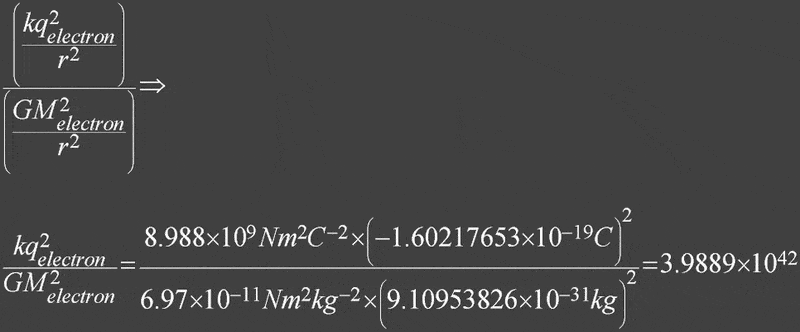
My units cancel nicely, so I assume I did it right. However, the book doesn't give the formula I used: F=kqq/r^2
It gives
[tex] F = Q\left( {E + v \times B} \right)[/tex]
Most textbooks give you the formulas you need to do the questions at the end of the chapter. So I figure I'd double check here.
In Wikipedia I looked up the mass and charge of the electron. It gave
9.109 3826(16) × 10−31 kg
−1.602 176 53(14) × 10−19 C
What do the (16) and (14) in these numbers mean?
*** Edit
I'm seeing an answer of 10^36 on
http://en.wikipedia.org/wiki/Fundamental_force
and 10^39 on
http://public.lanl.gov/alp/plasma/EM_forces.html
So I'm a bit less confident about my answer now.
My effort:
[tex] \begin{array}{l}<br /> \frac{{\left( {\frac{{kq_{electron}^2 }}{{r^2 }}} \right)}}{{\left( {\frac{{GM_{electron}^2 }}{{r^2 }}} \right)}} \Rightarrow \\ <br /> \\ <br /> \frac{{kq_{electron}^2 }}{{GM_{electron}^2 }} = \frac{{8.988 \times 10^9 Nm^2 C^{ - 2} \times \left( { - 1.60217653 \times 10^{ - 19} C} \right)^2 }}{{6.97 \times 10^{ - 11} Nm^2 kg^{ - 2} \times \left( {9.10953826 \times 10^{ - 31} kg} \right)^2 }} = 3.9889 \times 10^{42} \\ <br /> \end{array}[/tex]
Sorry for small tex. This should be better:
My units cancel nicely, so I assume I did it right. However, the book doesn't give the formula I used: F=kqq/r^2
It gives
[tex] F = Q\left( {E + v \times B} \right)[/tex]
Most textbooks give you the formulas you need to do the questions at the end of the chapter. So I figure I'd double check here.
In Wikipedia I looked up the mass and charge of the electron. It gave
9.109 3826(16) × 10−31 kg
−1.602 176 53(14) × 10−19 C
What do the (16) and (14) in these numbers mean?
*** Edit
I'm seeing an answer of 10^36 on
http://en.wikipedia.org/wiki/Fundamental_force
and 10^39 on
http://public.lanl.gov/alp/plasma/EM_forces.html
So I'm a bit less confident about my answer now.
Last edited by a moderator: