Circuit breaker with parallel resistor

Click For Summary

Discussion Overview

The discussion revolves around the purpose of a 68 Ω resistor found in parallel with a circuit breaker in a battery-powered lawnmower. Participants explore the implications of using a replacement breaker that does not include this resistor, considering its role in the circuit during normal operation and overload conditions.

Discussion Character

  • Exploratory
  • Technical explanation
  • Debate/contested

Main Points Raised

  • One participant questions the purpose of the 68 Ω resistor, suggesting it may prevent damage to the battery gauge by limiting current flow when the breaker opens.
  • Another participant speculates that the resistor may serve as a heat source for the breaker during overload conditions, implying that newer breakers may not require it due to different mechanisms.
  • A different viewpoint suggests that the resistor keeps the breaker open while the main switch is on, preventing the mower motor from starting unexpectedly when the breaker cools and resets.
  • Some participants emphasize the importance of using a breaker with the resistor or a mechanical reset, warning that omitting these features could compromise safety.

Areas of Agreement / Disagreement

Participants express differing views on the function of the 68 Ω resistor and the implications of using a replacement breaker without it. There is no consensus on the exact role of the resistor or the necessity of including it in future replacements.

Contextual Notes

Participants note that the original circuit breaker is no longer available, which may affect the reliability of alternative solutions. The discussion also highlights the potential for different types of breakers (e.g., bi-metal) that may operate without the resistor.

Redbelly98
Staff Emeritus
Science Advisor
Homework Helper
Insights Author
Messages
12,179
Reaction score
186
In my battery-powered lawnmower there is a circuit breaker. I have replaced the breaker, and when I cut apart the old one I found a 68 Ω resistor in parallel with the breaker switch. My question is, what is the purpose of this resistor?

Here is the basic mower circuit:
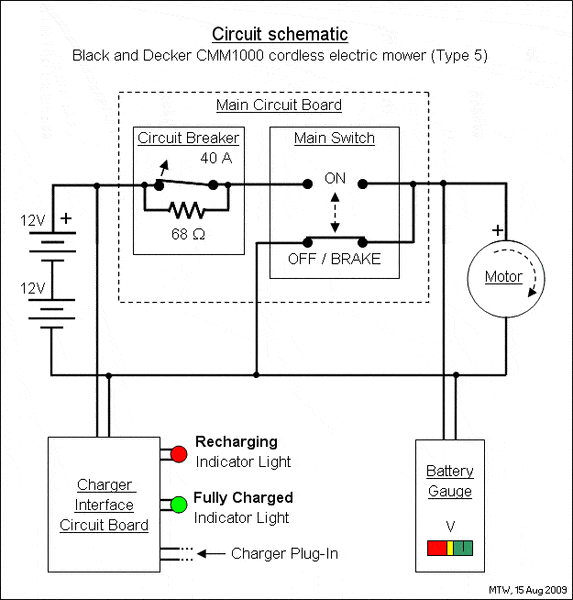
MowerCMM1000_circuit_2009-08-15.gif
(Imagine that the Main Switch is in the "On" position when the circuit breaker opens.

I'm thinking the Charger Interface does not really interact with the circuit during normal operation, only when I'm charging the batteries.

The Battery Gauge is reading the motor voltage, and is a series combination of 680Ω, 16V Zener, and solenoid (to deflect a magnetic indicator needle):

Code:
       \
(+) ---|<|-------(coil)-----/\/\/\/----- (-)
       \ 16V                 680Ω

The motor runs on 24 V DC, is the permanent magnet type, runs at 12A during normal operation or as high as 40 A to trip the breaker.

Mainly I want to know about the 68Ω because I just purchased some cheap breakers from an alternate supplier, to be ready for the next time this happens. I opened one up and these do not have the resistor, so I'm wondering if I should add a resistor in parallel if I use one of these in the future.

Oh, just taking an educated guess here: without the 68Ω, if the breaker opens then the motor, being an inductive load, would try to drive it's current through the Battery Gauge and fry one or more of its components. That's my guess but I'm interested in other opinions, especially if you have come across this yourself.

Thanks in advance!

p.s. photo of the breaker:
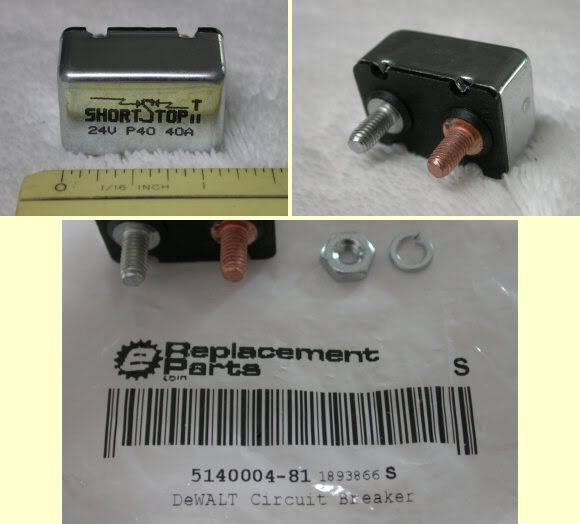
MowerBreaker40A-1.jpg
 
Engineering news on Phys.org
I did a little googling and found that the original circuit breaker is no longer available from the manufacturer. According to this site anyway: http://www.ereplacementparts.com/circuit-breaker-p-100616.html?osCsid=aksc0nc3sk91tlnkp2bl99su55"

[STRIKE]I'm guessing here, but I'm thinking the old breaker used the 68 Ω resistor as a heat source for breaking the breaker on overload. I'm also guessing the new breaker uses a bi-metal type switch and doesn't require the resistor.[/STRIKE]

WRONG
 
Last edited by a moderator:
Probably the breaker was a bi-metal type. The 68 ohm resistor kept the breaker open as long as the main switch was on. This was to keep the mower motor from starting when the breaker cooled and reset.
If you use a breaker without the resistor or without a mechanical reset YOU ARE DISABLING AN IMPORTANT SAFETY FEATURE.
 
Carl Pugh said:
Probably the breaker was a bi-metal type. The 68 ohm resistor kept the breaker open as long as the main switch was on. This was to keep the mower motor from starting when the breaker cooled and reset.
If you use a breaker without the resistor or without a mechanical reset YOU ARE DISABLING AN IMPORTANT SAFETY FEATURE.
Good point. That makes perfect sense.
 
dlgoff said:
I did a little googling and found that the original circuit breaker is no longer available from the manufacturer. According to this site anyway: http://www.ereplacementparts.com/circuit-breaker-p-100616.html?osCsid=aksc0nc3sk91tlnkp2bl99su55"
Yes, exactly. I bought a new one of those 2 years ago, and that's what's in the mower now. I recently realized they were discontinued, that's why I bought the ones from an alternative manufacturer.

Carl Pugh said:
Probably the breaker was a bi-metal type. The 68 ohm resistor kept the breaker open as long as the main switch was on. This was to keep the mower motor from starting when the breaker cooled and reset.
If you use a breaker without the resistor or without a mechanical reset YOU ARE DISABLING AN IMPORTANT SAFETY FEATURE.
Makes sense, thanks. That would also mean just adding a 68 ohm somewhere physically outside the breaker would not work.
 
Last edited by a moderator:

Similar threads

  • · Replies 3 ·
Replies
3
Views
2K
  • · Replies 5 ·
Replies
5
Views
2K
  • · Replies 12 ·
Replies
12
Views
2K
  • · Replies 15 ·
Replies
15
Views
2K
  • · Replies 38 ·
2
Replies
38
Views
8K
  • · Replies 15 ·
Replies
15
Views
4K
  • · Replies 17 ·
Replies
17
Views
3K
  • · Replies 2 ·
Replies
2
Views
2K
Replies
3
Views
2K
  • · Replies 3 ·
Replies
3
Views
3K