Circuit Explanation: 12V CFL and LED Usage?

  • Thread starter Thread starter Manoj Sahu
  • Start date Start date
  • Tags Tags
    Circuit Work
Click For Summary

Discussion Overview

The discussion revolves around an inverter circuit using a CD4047 oscillator to drive a transformer for powering 12V CFL and LED lights. Participants explore the circuit's operation, current calculations, frequency adjustments, and load capacities, with a focus on technical details and practical applications.

Discussion Character

  • Technical explanation
  • Mathematical reasoning
  • Debate/contested

Main Points Raised

  • Some participants explain the CD4047's role as an oscillator and its output characteristics, noting the frequency is determined by the resistor and capacitor values.
  • There are inquiries about calculating current and frequency, with one participant providing a formula for free-running frequency.
  • Some participants discuss the implications of load on current, highlighting that the transformer’s output current is higher than the load current due to its step-up nature.
  • Questions arise regarding the circuit's ability to handle specific loads, such as two 20W CFLs and one 3W LED, with some suggesting it should not be a problem.
  • Participants express concerns about potential damage to the transformer if the FETs draw excessive current.
  • There are discussions on how to achieve a 50% duty cycle using the CD4047, with suggestions to use a toggle flip-flop.
  • One participant suggests considering 12V CFL and LED options instead of 230V alternatives.

Areas of Agreement / Disagreement

Participants express varying views on the circuit's load capacity and the implications of current draw on the transformer. There is no clear consensus on the best approach to achieve the desired frequency or the optimal load configuration.

Contextual Notes

Some calculations depend on specific assumptions about the circuit components and configurations, which may not be universally applicable. The discussion includes unresolved questions about the transformer’s ratings and the effects of different load types.

Who May Find This Useful

Electronics enthusiasts, students studying circuit design, and individuals interested in inverter technology may find this discussion relevant.

Manoj Sahu
Messages
54
Reaction score
1
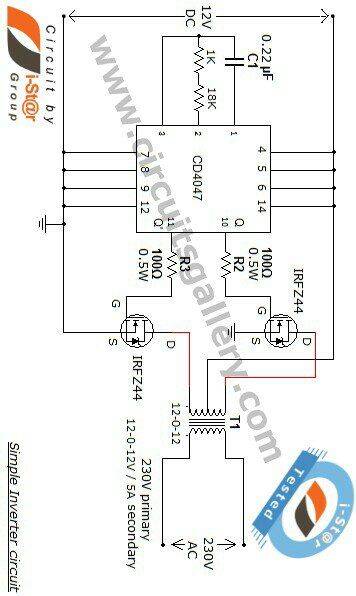
I stumbled upon this inverter circuit while searching for the same on internet. Can anyone please explain working of this circuit to me.
IMG_20170315_114520_114.jpg
 
Engineering news on Phys.org
The CD4047 is connected as an oscillator (frequency determined by19kΩ / 0.22μF). The outputs on pins 10 and 11 are in opposite phase (when one is high, the other is low) and in 50% duty cycle. Therefore the two MOSFETs are turned on alternately, driving the transformer with a square wave. This waveform is amplified through the transformer, creating a 230V square wave.
 
  • Like
Likes   Reactions: davenn
Svein said:
The CD4047 is connected as an oscillator (frequency determined by19kΩ / 0.22μF). The outputs on pins 10 and 11 are in opposite phase (when one is high, the other is low) and in 50% duty cycle. Therefore the two MOSFETs are turned on alternately, driving the transformer with a square wave. This waveform is amplified through the transformer, creating a 230V square wave.
Thanks. How do I calculate the current and frequency ?
 
The free-running frequency (taken from the data sheet) is typically 1/(2.2*R*C) = 1/(2.2*19E3* 0.22E-6)Hz ≈ 110Hz. The output frequency is half of that.
 
  • Like
Likes   Reactions: Manoj Sahu
The current depends on the load. Note that the output transformer is a 12:230 step up transformer so the current flowing in the FETs is much much higher than the load current. You may well need heatsinks on the FETs and suitably sized conductors/wires and 12v battery.
 
  • Like
Likes   Reactions: Manoj Sahu
CWatters said:
The current depends on the load. Note that the output transformer is a 12:230 step up transformer so the current flowing in the FETs is much much higher than the load current. You may well need heatsinks on the FETs and suitably sized conductors/wires and 12v battery.
If I use two 20w cfl and one 3w led light, will the circuit be able to draw that kind of load? How much power the circuit is capable of drawing?
 
CWatters said:
The current depends on the load. Note that the output transformer is a 12:230 step up transformer so the current flowing in the FETs is much much higher than the load current. You may well need heatsinks on the FETs and suitably sized conductors/wires and 12v battery.
As you said that FET's will draw much more current, will it not damage the transformer winding (assuming transformer is rated 12-0-12/230V, 5amp).?
 
Svein said:
The free-running frequency (taken from the data sheet) is typically 1/(2.2*R*C) = 1/(2.2*19E3* 0.22E-6)Hz ≈ 110Hz. The output frequency is half of that.
If I have to get frequency =50.xx Hz assuming that CD4047 is used in Astable mode where Ta=4.40RC, do I have to increase the resistance (+2.5 ohm)/capacitance.
 
Svein said:
The CD4047 is connected as an oscillator (frequency determined by19kΩ / 0.22μF). The outputs on pins 10 and 11 are in opposite phase (when one is high, the other is low) and in 50% duty cycle. Therefore the two MOSFETs are turned on alternately, driving the transformer with a square wave. This waveform is amplified through the transformer, creating a 230V square wave.
How do you make an IC to work on 50% duty cycle ?
 
  • #10
Manoj Sahu said:
If I use two 20w cfl and one 3w led light, will the circuit be able to draw that kind of load? How much power the circuit is capable of drawing?
Thats a very light load. Shouldn't be a problem for that circuit.
 
  • #11
Manoj Sahu said:
I stumbled upon this inverter circuit while searching for the same on internet.

and just a little bit of advice
Next time post a pic with the correct orientation so everyone doesn't have to kink their neck to read it :smile::smile:
 
  • #12
davenn said:
and just a little bit of advice
Next time post a pic with the correct orientation so everyone doesn't have to kink their neck to read it [emoji2][emoji2]
Oh yeah, that I forgot. Thanks for the bit of advice. [emoji4]
 
  • Like
Likes   Reactions: davenn
  • #13
Manoj Sahu said:
How do you make an IC to work on 50% duty cycle ?
Run the output through a "toggle" flip/flop.
cou1.gif
 
  • Like
Likes   Reactions: jim hardy
  • #14
Svein said:
Run the output through a "toggle" flip/flop.
View attachment 195028
Thank you. I have one doubt though. How should I calculate output power ?
 
  • #15
You said the load is one 20W cfl and a 3W LED so the load power is 20 + 3 = 23W.

The load current is 23W/230V = 0.1A

The circuit diagram says it can deliver 5A so the load is only 0.1/5 * 100 = 2% of the maximum.
 
  • #16
Have you considered using a 12V cfl lamp and a 12V LED instead of 230V ?
 
  • Like
Likes   Reactions: PhysicoRaj and dlgoff

Similar threads

  • · Replies 17 ·
Replies
17
Views
2K
  • · Replies 9 ·
Replies
9
Views
2K
  • · Replies 3 ·
Replies
3
Views
2K
Replies
12
Views
3K
  • · Replies 14 ·
Replies
14
Views
3K
  • · Replies 21 ·
Replies
21
Views
3K
  • · Replies 10 ·
Replies
10
Views
2K
  • · Replies 8 ·
Replies
8
Views
3K
Replies
16
Views
2K
Replies
2
Views
3K