Circuit help - resistors and batteries in a network

Click For Summary
SUMMARY

This discussion focuses on solving a circuit problem involving resistors and batteries using Kirchhoff's laws. The circuit includes resistors R1 = 1.5 ohms, R2 = 2.5 ohms, and batteries with voltages ε1 = 2.0 V, ε2 = 3.5 V, and ε3 = 3.5 V. Participants emphasize the importance of correctly applying Kirchhoff's Voltage Law (KVL) and checking the signs of the terms in the loop equations. The final equations derived from the loops are critical for calculating the currents through each battery.

PREREQUISITES
  • Understanding of Kirchhoff's Voltage Law (KVL)
  • Basic knowledge of circuit analysis techniques
  • Familiarity with Ohm's Law (V = iR)
  • Ability to manipulate algebraic equations
NEXT STEPS
  • Practice solving circuit problems using Kirchhoff's laws
  • Learn about series and parallel resistor combinations
  • Explore advanced circuit simulation tools like LTspice
  • Study the impact of varying resistor values on circuit behavior
USEFUL FOR

Students studying electrical engineering, hobbyists building circuits, and anyone looking to improve their circuit analysis skills.

lodovico
Messages
17
Reaction score
0
circuit help -- resistors and batteries in a network
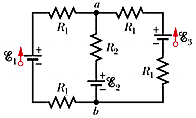
28_41.gif

Homework Statement


(a) Calculate the current through each ideal battery in Fig. 28-41.
(As a sign convention, assume the currents are "up" through each battery.)


A (I1)
A (I2)
A (I3)

Assume that R1 = 1.5 , R2 = 2.5 , ε1 = 2.0 V, and ε2 = ε3 = 3.5 V.

(b) Calculate Va - Vb


Homework Equations


V=iR


The Attempt at a Solution


I don't know how to approach this problem, use kirchhoffs law?
 
Physics news on Phys.org


Yes, Kirchhoff's laws or techniques based upon them are the way to go.


ok so i set up 3 loops and after simplifying i get:

Loop 1(the square on the left):-.6+1.2(i1)= i2
Loop 2(right square): 2.5(i2)=1.5(i3)
loop 3(the whole rectangle): 1.5=-3(i1+i2)

and that i1 = i2+i3


lodovico said:
ok so i set up 3 loops and after simplifying i get:

Loop 1(the square on the left):-.6+1.2(i1)= i2
Loop 2(right square): 2.5(i2)=1.5(i3)
loop 3(the whole rectangle): 1.5=-3(i1+i2)

and that i1 = i2+i3

Check the signs in your Loop 1 equation.

The coefficient of the i3 term in your Loop 2 equation doesn't look right.

Check the signs of the terms in your Loop 3 equation.


ok i just redid my loops I am not sure what is going wrong

1) 2-1.5(i1)-2.5(i2)-3.5-1.5(i1)=0
2) 3.5-2.5(i2)-1.5(i3)-3.5-1.5(i3)=0
3) 2-1.5(i1)-1.5(i3)-3.5-1.5(i3)-1.5(i1)=0

1) -.6-1.2(i1)=i2
2)-.833(i2)=i3
3)-.5-i3=i1


lodovico said:
ok i just redid my loops I am not sure what is going wrong

1) 2-1.5(i1)-2.5(i2)-3.5-1.5(i1)=0
2) 3.5-2.5(i2)-1.5(i3)-3.5-1.5(i3)=0
3) 2-1.5(i1)-1.5(i3)-3.5-1.5(i3)-1.5(i1)=0

1) -.6-1.2(i1)=i2
2)-.833(i2)=i3
3)-.5-i3=i1

Let's gather together the resistors in the branches and redraw the circuit showing the currents (blue) and the potential drops across the resistors (red) caused by those currents. This should make it easier to keep the signs of things straight when you do your "KVL walk" around a loop.
attachment.php?attachmentid=56105&stc=1&d=1361834650.gif


See if you can spot any sign issues in your equations.
 

Attachments

  • Fig2.gif
    Fig2.gif
    1.9 KB · Views: 906


1) -1.5-3(i1)-2.5(i2)=0
2) -2.5(i2)-3(i3)=0
3) -1.5-3(i1)-3(i3)=0

1) 1.5=-3(i1)-2.5(i2)
2)-2.5(i2)=3(i3)
3)1.5=-3(i1)-3(i3)


lodovico said:
1) -1.5-3(i1)-2.5(i2)=0
2) -2.5(i2)-3(i3)=0
3) -1.5-3(i1)-3(i3)=0

1) 1.5=-3(i1)-2.5(i2)
2)-2.5(i2)=3(i3)
3)1.5=-3(i1)-3(i3)

Did you pay attention to the directions of the potential changes on the resistors as you passed over them during your "walks" around the loops? I question the sign you've attributed to the 2.5(i2) term in your first loop equation, and to the 3(i3) terms in equations 2 and 3.

Remember, the polarities of the potential changes on the resistors are fixed by the assumed directions of the currents. You record those potential changes according to the direction you pass through the components as you proceed around the loop.
 

Similar threads

  • · Replies 1 ·
Replies
1
Views
2K
Replies
22
Views
4K
Replies
5
Views
3K
  • · Replies 2 ·
Replies
2
Views
2K
  • · Replies 1 ·
Replies
1
Views
4K
  • · Replies 3 ·
Replies
3
Views
4K
  • · Replies 62 ·
3
Replies
62
Views
6K
  • · Replies 4 ·
Replies
4
Views
4K
  • · Replies 6 ·
Replies
6
Views
2K
  • · Replies 3 ·
Replies
3
Views
4K