Circuit that is both parallel and in series

Click For Summary

Homework Help Overview

The discussion revolves around determining the power dissipated in a 9 ohm resistor within a circuit that includes both series and parallel components, specifically with resistances of 4.0 ohms and 9.0 ohms, and a voltage of 9V applied.

Discussion Character

  • Mixed

Approaches and Questions Raised

  • Participants explore various methods to calculate the total resistance and current in the circuit, with some attempting to simplify the circuit by treating certain resistors as series or parallel combinations. Questions arise regarding the correct application of series and parallel rules, and participants express uncertainty about their calculations.

Discussion Status

Multiple participants have shared their calculations and reasoning, with some arriving at different power values for the 9 ohm resistor. There is an ongoing exploration of the correct approach to find the equivalent resistance and current, with no clear consensus yet on the correct power dissipation.

Contextual Notes

Some participants mention potential miscalculations and the need for visual aids, indicating that the circuit diagram is crucial for accurate analysis. There is also a reference to homework rules that may limit the types of assistance provided.

tigerguy
Messages
32
Reaction score
0
Determine the power dissipated in the 9 ohm resistor in the circuit shown in the drawing. (R1=4.0 Ohms, R2=9.0 Ohms, and V1=9V).
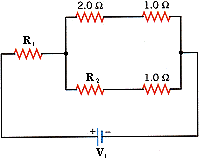
20_67alt.gif


When trying to solve this problem, I tired to add the resistance of the bottom two as if they were in series, and then add that to R1 to get the total resistance. I then found the current using the given voltage, and then tried to multiply that to the voltage to get an answer of 9 watts. But that is wrong, and I am not sure where I went wrong.

I'd appreciate any help. Thank you.
 
Physics news on Phys.org
tigerguy said:
Determine the power dissipated in the 9 ohm resistor in the circuit shown in the drawing. (R1=4.0 Ohms, R2=9.0 Ohms, and V1=9V).

View attachment 7384


When trying to solve this problem, I tired to add the resistance of the bottom two as if they were in series, and then add that to R1 to get the total resistance. I then found the current using the given voltage, and then tried to multiply that to the voltage to get an answer of 9 watts. But that is wrong, and I am not sure where I went wrong.
I can't see your drawing yet but I expect that it consists of two branches, one of which has a single 9 ohm resistor and the other with two series resistors of 4 + 9 = 13 ohms.

For parallel connected resistors, the voltages are the same and the currents add up. In series the currents are the same and the voltages add up (to the total V).

So the total current is the current in both branches of the parallel circuit and the current in each is V/R.

If the applied voltage is 9 volts you will get a current of 9/9 + 9/13 amps. The power in the 9 ohm resistor is its current x voltage = 9 * 9/9 = 9 w.

AM
 
you must take all the resistor together to make 1 substitutional resistane using the following rules:

1. serial placed resistance: [tex]R_{subst.} = \Sigma R[/tex] and U is divided over the resistors.

2. parallel circuit: [tex]\frac {1} {R_{subst.}} = \Sigma \frac {1} {R}[/tex] and I is divided over the resistors.
 
Last edited:
I got 9 watts as my answer, and that was incorrect. Maybe the picture that's now uploaded can help someone help me with this question? Thanks again everybody.
 
what do we nee d for the power: U and I

Now let's take the serial 1 ohm and 9 ohm and the serial 2 ihm and 1 ohm resistors together and we get a simplified circuit with a new R of 10 ohm and 3 ohm parallel to each other.

Now we must take the parallel 10 ohm and 3 ohm toegether. this yields:

[tex]\frac {1} {\frac {1} {10} \cdot \frac {1} {3} } = 2.31 \Omega[/tex]

Then add these 2 resistors together to get 1 single resistor of 6.31 ohm.

Now the source has a voltage of 9.0 V so the I through the singel resistor is [itex]I = \frac {9} {6.31} = 1.43 A[/itex]

Thus thorugh the 2.31 resistor earlier has a current of 1.43 A with a voltage of [itex]U = 1.43 \cdot 2.31 = 3.3033 V[/itex]. (As a control you can calculate U of the 4 ohm resistor.

Now 1 step back U is 3,3033 V over the 10 ohm resistor and 3 ohm resistor and I is divided. Over the 10 ohm resistor I is [itex]\frac {3.3033} {10} = 0.330033 A[/itex]

Then at the original situation the current in the 9 ohm resistor is 0,33033 A and the voltage is [itex]0.330033 \cdot 9 = 2.97 V[/itex]

Then the power is [itex]P = 2.97 \cdot 0.33033 = 0.98 W[/itex]

(I may have made a miscalculation --> i did not use paper)
 
I have juste made the calculations and I arrived at 0.98 watt ≈ 1 watt.
So the result of sdekivit seems ok
 
I have juste made the calculations and I arrived at 0.98 watt ? 1 watt.
So the result of sdekivit seems ok
 
Also, remember the following rules:

[tex]R_{series} = R_1 + R_2[/tex]
[tex]R_{parallel} = \frac{R_1 \, R_2}{R_1 +R_2}[/tex]

Then you can use some nice short hand when you are trying to find an equivalent resistance. In this case the equivalent resistance of those resistor combinations would be:
[tex]R_{eq} = R_1 + ((2 + 1) || (R_2 + 1))[/tex]

Notice that [itex]R_a|| R_b[/itex] would mean:
[tex]R_a|| R_b = \frac{R_a \, R_b}{R_a + R_b}[/tex]
 

Similar threads

  • · Replies 14 ·
Replies
14
Views
2K
  • · Replies 3 ·
Replies
3
Views
2K
  • · Replies 3 ·
Replies
3
Views
933
  • · Replies 6 ·
Replies
6
Views
2K
  • · Replies 11 ·
Replies
11
Views
2K
  • · Replies 13 ·
Replies
13
Views
2K
Replies
5
Views
2K
  • · Replies 7 ·
Replies
7
Views
2K
Replies
3
Views
2K
  • · Replies 10 ·
Replies
10
Views
3K