Clarification about Mutual Inductance

Click For Summary
SUMMARY

The discussion clarifies the concept of mutual inductance between two coils, specifically when one coil is rotated 90 degrees relative to the other. The equations provided, emf = -N2 (dφB2/dt) and M21 = (N2φB2)/i1, are central to understanding the relationship between the coils. The consensus is that when coil 2 is perpendicular to coil 1, the flux through coil 2 is effectively zero, although a negligible amount may still pass due to the coil's physical characteristics. The confusion regarding the area of the coil arises from its open-loop nature, which is clarified by visualizing the flux and area interaction.

PREREQUISITES
  • Understanding of electromagnetic induction principles
  • Familiarity with mutual inductance concepts
  • Knowledge of flux calculations and their mathematical representations
  • Basic grasp of coil configurations and their physical properties
NEXT STEPS
  • Study the mathematical derivation of mutual inductance between coils
  • Learn about the effects of coil orientation on induced emf
  • Explore the concept of magnetic flux and its calculation in different configurations
  • Investigate the physical characteristics of coils, including thickness and winding
USEFUL FOR

Students and professionals in electrical engineering, physicists studying electromagnetic theory, and educators teaching concepts of mutual inductance and electromagnetic induction.

Physicslearner500039
Messages
124
Reaction score
6
Homework Statement
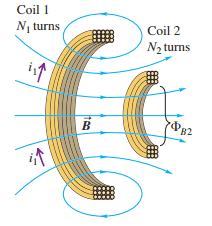
In if coil 2 is turned so that its axis is vertical, does the mutual inductance increase or decrease? Explain.
Relevant Equations
emf = ##\frac {-N_{2} {d\phi}_{B2}} {dt}## ## M_{21} = \frac {{N_2}{\phi}_{B2}} {i_1}##
emf = ##\frac {-N_{2} {d\phi}_{B2}} {dt}## ## M_{21} = \frac {{N_2}{\phi}_{B2}} {i_1}## are the equations
1599881309992.png

This is the original position, now the coil 2 is moved so the axis is perpendicular. The flux ##{\phi}_{B2}## due to i1 is the amount of flux cutting the coil 2 due to change in current i1. My answer is 0, since no flux cuts the Coil 2 in 90 degrees position. Is it correct? My main confusion is with respect to the area of the coil. How to consider it? i do not see the coil 2 as closed circuit it is open loop. So, what will be the area. Please advise.

Note: One another problem is i cannot preview the Homework statement and the Relevant Equations section. I have a workaround for the equations section, but still not sure if latex symbols work for the Homework statement. Please advise.
 
Physics news on Phys.org
Physicslearner500039 said:
My answer is 0, since no flux cuts the Coil 2 in 90 degrees position. Is it correct?
Hi. You are correct. There is (almost) zero flux through rotated coil-2. I say 'almost' because the coil has finite thickness and is spiral-wound which means a *very* small amount of flux cuts the coil - we can usually treat it as zero.
My main confusion is with respect to the area of the coil. How to consider it? i do not see the coil 2 as closed circuit it is open loop. So, what will be the area.
I'm not sure I understand the question. But see if this helps.

Visualise the flux and area as you have done here. You can then 'see' if flux passes through the coil, rather than being parallel to the coil's plane.

Mathematically, you multiply the *component* of flux perpendicular to the area (i.e. parallel to the area's normal) by the area.

For example, for area A with its normal at angle θ to uniform field B, the flux through the area is Φ = ABcosθ (which is zero if θ = 90º).
not sure if latex symbols work for the Homework statement.
Sorry, can't help with that.
 
  • Like
Likes   Reactions: TSny
1599913421775.png
When rotated 90 Degrees
1599914127235.png

Is my understanding correct? Please advise.
 
Physicslearner500039 said:
My main confusion is with respect to the area of the coil. How to consider it? i do not see the coil 2 as closed circuit it is open loop. So, what will be the area.
I'm not sure, but I'm wondering if the figure is misleading you. The figure does not show the entire coils. The figure is a "cutaway" figure. The coils are complete circular coils.
 
I agree with TSNy (#4). The coils are meant to be omplete circular ones (or they cannot be called 'coils'!). The diagram is simply a cut-away schematic.

If they were actual open half-coils as shown, there could be no current through either and the question wouldn't make sense.
 
I interpret this as 2 neighboring coils with axes parallel, then one is rotated 90 deg. so that now the axes are mutually perpendicular.

In which case, what is mutual inductance in terms of the two coils' fluxes?
 

Similar threads

  • · Replies 1 ·
Replies
1
Views
1K
  • · Replies 2 ·
Replies
2
Views
1K
  • · Replies 10 ·
Replies
10
Views
3K
  • · Replies 16 ·
Replies
16
Views
4K
  • · Replies 10 ·
Replies
10
Views
2K
  • · Replies 1 ·
Replies
1
Views
1K
  • · Replies 6 ·
Replies
6
Views
4K
  • · Replies 3 ·
Replies
3
Views
2K
  • · Replies 2 ·
Replies
2
Views
9K
  • · Replies 1 ·
Replies
1
Views
1K