Allenman
- 58
- 0
This isn't actually a homework problem. I just had a question about the solution they provided.
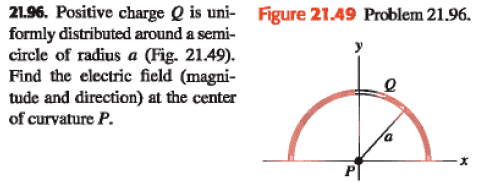
2. Solution given in solutions manual
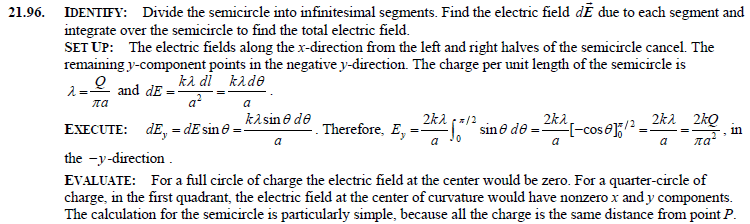
3. My question
When they convert dE into cylindrical coordinates why does the radius "a" lose its exponent?
dE = [itex]\frac{\kappa\lambda\delta l}{a^{2}}[/itex] = [itex]\frac{\kappa\lambda\delta\theta}{a}[/itex]
I have to be missing something simple, I just know it...
Homework Statement
2. Solution given in solutions manual
3. My question
When they convert dE into cylindrical coordinates why does the radius "a" lose its exponent?
dE = [itex]\frac{\kappa\lambda\delta l}{a^{2}}[/itex] = [itex]\frac{\kappa\lambda\delta\theta}{a}[/itex]
I have to be missing something simple, I just know it...