Clarification on an electric fields solution

Click For Summary

Homework Help Overview

The discussion revolves around the conversion of electric field components into cylindrical coordinates, specifically questioning the treatment of the radius "a" in the context of an electric field expression.

Discussion Character

  • Conceptual clarification, Mathematical reasoning

Approaches and Questions Raised

  • The original poster questions why the radius "a" loses its exponent during the conversion to cylindrical coordinates, indicating a potential misunderstanding of the underlying mathematics.
  • Some participants explore the relationship between the differential length element and the angle in cylindrical coordinates.

Discussion Status

Participants are engaged in clarifying the mathematical reasoning behind the conversion process. A connection to the arc length formula has been acknowledged, suggesting a productive direction in the discussion.

Contextual Notes

The original poster emphasizes that this inquiry is not part of a homework problem, but rather a question about a solution provided in a solutions manual.

Allenman
Messages
58
Reaction score
0
This isn't actually a homework problem. I just had a question about the solution they provided.
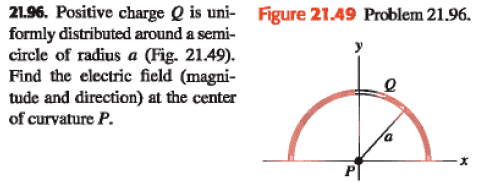
Homework Statement


physprob96.png


2. Solution given in solutions manual
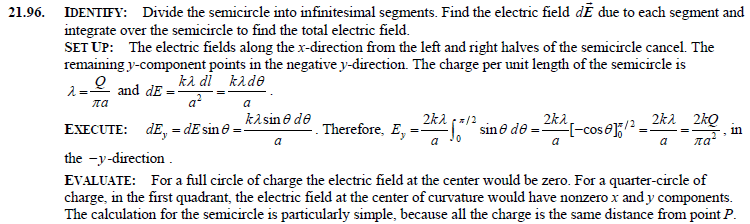
physsol96.png


3. My question

When they convert dE into cylindrical coordinates why does the radius "a" lose its exponent?

dE = [itex]\frac{\kappa\lambda\delta l}{a^{2}}[/itex] = [itex]\frac{\kappa\lambda\delta\theta}{a}[/itex]

I have to be missing something simple, I just know it...
 
Physics news on Phys.org
Allenman said:
This isn't actually a homework problem. I just had a question about the solution they provided.

Homework Statement


physprob96.png


2. Solution given in solutions manual
physsol96.png


3. My question

When they convert dE into cylindrical coordinates why does the radius "a" lose its exponent?

dE = [itex]\frac{\kappa\lambda\delta l}{a^{2}}[/itex] = [itex]\frac{\kappa\lambda\delta\theta}{a}[/itex]

I have to be missing something simple, I just know it...
It's because [itex]d\ell=a\cdot d\theta\,.[/itex]
 
Does that come from the arc length formula?

Thank you
 
Yes it does.
 

Similar threads

Replies
1
Views
2K
  • · Replies 6 ·
Replies
6
Views
2K
Replies
6
Views
4K
  • · Replies 1 ·
Replies
1
Views
1K
  • · Replies 11 ·
Replies
11
Views
3K
Replies
8
Views
2K
Replies
3
Views
1K
  • · Replies 9 ·
Replies
9
Views
2K
Replies
8
Views
2K