Classifications of basis vectors

Click For Summary
The discussion centers on the classification of basis vectors in the context of differential geometry and tensor analysis. Three types of bases are identified: general (non-holonomic), coordinate (holonomic), and orthonormal (non-holonomic). A general basis consists of any set of linearly independent vectors in an n-dimensional space, while a coordinate basis is specifically tied to a smooth coordinate system, requiring that all Lie brackets between basis vectors vanish. In curved spaces, a basis cannot simultaneously be both coordinate and orthonormal, as the conditions for each type impose different restrictions. The conversation highlights the complexities of these classifications and their implications in manifold theory.
mikeeey
Messages
57
Reaction score
0
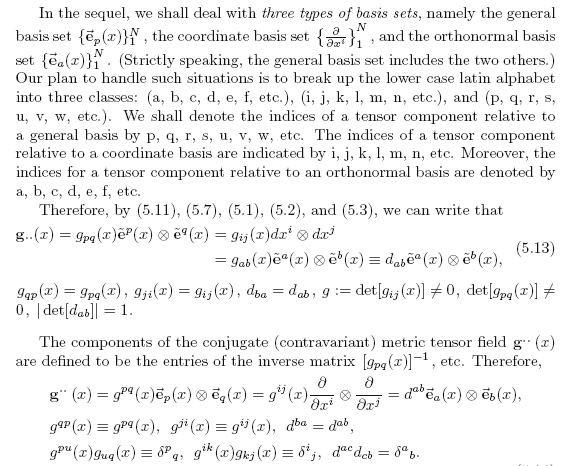
Hello every one , in this pic i just printed ( Tensors_The Mathematics of Relativity Theory and Continuum Mechanics by Anadijiban Das ) here the author classifies the basis into 3 types 1- is the general basis (non-holomonic ) , 2- coordinate basis ( holomonic ),3- orthonormal basis ( non- holomonic)
I know that the coordinate basis represent the natural basis like cartesian , spherical(orthogonal) or any general system(non-orthogonal) coordinate basis, and I know that the orthonormal basis represent the normalized basis from the coordinate basis ( i.e. unit vector )
My question , What do the general basis represent ?!
upload_2014-12-4_18-57-45.png
 
Physics news on Phys.org
A set of vector fields is a basis if it is basis at each point in its domain for the tangent space at each point. If these vector fields are a coordinate basis then your book calls them holonomic. If there is an inner product then a basis that is orthonormal at each point your book calls an orthonormal basis.

But your question confuses me because this is what your book says.
 
Last edited:
It is perhaps easier to think of this at one point first, and just consider a single tangent space. A set of n-linearly independent vectors in an n-dimensional vector space defines a basis. This is a "generalized basis". The only property you require of a basis is that it is linearly independent and it spans the space (so n vectors for an n-dimensional space). A coordinate basis is a subset of such, arising from a coordinate system. This means that not only does a coordinate basis need to span the space, and be linearly independent, it needs to be associated with a smooth coordinate system, i.e. it must be ##\partial_\mu## for some system of coordinates ##x^\mu##. As it turns out, the necessary and sufficient condition to guarantee this is that all the Lie brackets between the different basis vectors must vanish. In other words, we must have ##[e_i,e_j]=0~\forall i,j##. This is an additional condition that we impose, and it limits the potential bases to a small subset. An orthonormal basis is a set of n linearly independent vector which is also orthogonal to each other, and normalized to length 1, these are the bases for which ##g_{ab}(e_i)^a(e_j)^b=\delta_{ij}##. This is a wholly different condition that we impose on our basis vectors, and it limits the potential bases to a different small subset.

On a flat manifold, it is possible for a basis to be both a coordinate basis and orthonormal (i.e. the Cartesian basis). But in a curved space, it is not possible to be both at once. So it is technically incorrect to associate "orthonormal basis" as "non-holonomic basis". Any basis which is NOT a coordinate basis is "non-holonomic". That includes, in a curved manifold, all the orthonormal bases and more.
 
THANK YOU ALL , but who does say that the orthonormal basis need to be orthogonal coordinate system ? i think that the orthonormal basis is a unit basis vector of the coordinate basis vector and the determinant of the orthonormal metric is ONE , so is the general basis derived also from the coordinate basis with the determinant of the metric does not equal to ONE,
EXAMPLE on 2D non-orthogonal coordinate system , the transformation equations from the cartesian system to the non-orthogonal system are
X=\frac{u} {v} ,
Y=uv
this system of basis can be normalized and still non-orthogonal system with unit vector , then what is the general basis ?
 
I'm having a hard time understanding your question. A general basis is ANY set of n-linearly independent vectors in an n-dimensional vector-space. In a 2-D manifold, then, choose ANY set of 2 vector fields who are linearly independent at every point. That is a general basis.
 
mikeeey said:
here the author classifies the basis into 3 types 1- is the general basis (non-holomonic ) , 2- coordinate basis ( holomonic ),3- orthonormal basis ( non- holomonic)
I know that the coordinate basis represent the natural basis like cartesian , spherical(orthogonal) or any general system(non-orthogonal) coordinate basis, and I know that the orthonormal basis represent the normalized basis from the coordinate basis ( i.e. unit vector )
My question , What do the general basis represent ?!
A coordinate basis for the tagent space ##T_pM## at a point ##p## of an ##n##-dimensional manifold ##M##, is a basis of the form
$$\bigg\{\frac{\partial}{\partial x^1}\bigg|_p,\dots,\frac{\partial}{\partial x^n}\bigg|_p\bigg\},$$ where ##x## is a coordinate system. A "general" basis is just a basis whose elements may not be equal to the partial derivative functionals associated with a coordinate system.

If you normalize a coordinate basis, the result won't be an orthonormal basis unless the coordinate basis you started with was orthogonal.
 
Last edited:
Matterwave said:
On a flat manifold, it is possible for a basis to be both a coordinate basis and orthonormal (i.e. the Cartesian basis). But in a curved space, it is not possible to be both at once.
Sure it is. Perhaps you're thinking of the problem of finding a coordinate system that covers the entire manifold?
 
Fredrik said:
Sure it is. Perhaps you're thinking of the problem of finding a coordinate system that covers the entire manifold?

If on a curved manifold you have a set of coordinates whose basis vectors are always orthonormal, then haven't you just found a global transformation to a Minkowski metric?

What I mean is, if you then use the coordinate basis expressions for the Riemann tensor, you will find that it is 0, since in this orthonormal coordinate system you can use the Minkowski metric instead of the general metric tensor.

EDIT: I think I understand where the confusion is coming from. I guess I should have been more clear. A tetrad field can't be also a coordinate basis field in curved manifolds. Sorry for the confusion.
 
Last edited:

Similar threads

  • · Replies 3 ·
Replies
3
Views
2K
  • · Replies 9 ·
Replies
9
Views
3K
  • · Replies 11 ·
Replies
11
Views
5K
  • · Replies 9 ·
Replies
9
Views
4K
  • · Replies 12 ·
Replies
12
Views
4K
  • · Replies 6 ·
Replies
6
Views
831
  • · Replies 12 ·
Replies
12
Views
2K
  • · Replies 1 ·
Replies
1
Views
2K
  • · Replies 24 ·
Replies
24
Views
4K
  • · Replies 2 ·
Replies
2
Views
4K