CO2 and the correlation with rising atmospheric temperatures

Click For Summary
The discussion centers on the correlation between rising CO2 levels and increasing atmospheric temperatures, acknowledging CO2 as a greenhouse gas. While there is a general scientific consensus that rising CO2 contributes significantly to global warming, the exact degree of its influence remains debated. The IPCC reports are recommended as key resources for understanding climate models and their projections regarding temperature changes. Participants note that while CO2 is a primary contributor, other factors like methane and agricultural practices also play a role in climate change. Overall, the conversation highlights the complexity of climate science and the ongoing need for research and policy discussions.
  • #31
Hello @Charlie Cheap:
The role of greenhouse gases and the lead role of CO2 in the warming we have seen over the past 50 years is well established and described in the first section of the IPCC report I cited earlier:
https://www.ipcc.ch/site/assets/uploads/2018/02/SYR_AR5_FINAL_full.pdf
The gas that contributes the most to the greenhouse effect is water vapor. But changes in water vapor occur over days - so there is no long-term cumulative effect. CO2, the number two contributor to the affect, on the other hand, can last many years. So CO2 can accumulate and produce long lasting changes.
Other contributors to the green house effect are N2O, methane, and cloud cover.

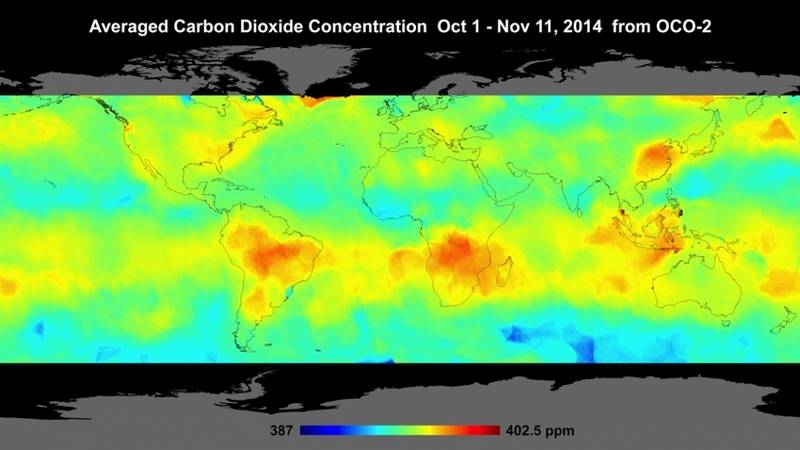
We now have a satellite up there (OCO-2) that can measure CO2 concentrations. Here's what it looks like:
12_18_14_Brian_OCO2Image1_1050_591_s_c1_c_c.jpg


Notice a few things here:
1) The range is 387-402.5. Not very wide. It's that base number (387 ppm) that is continuing to rise.
2) The areas of highest concentration is not the Pacific ring (volcanoes). But it does include all major industrial areas.
3) There definitely seem to be other sources - so I wouldn't let those cows off the hook right away.
4) This is from 2014, when OCO-2 was first operational. Those large CO2 generators in the southern hemisphere are not there every year.

That graphic comes from an article which also includes a chlorophyll map (from that same satellite).
Here is a link: http://www.climatecentral.org/news/nasa-satellite-most-detailed-view-co2-18459

For more clues about those areas in Africa and South America that seem to be such large contributors, see this article:
https://www.nasa.gov/press-release/...of-earth-s-recent-record-carbon-dioxide-spike
 

Attachments

  • 12_18_14_Brian_OCO2Image1_1050_591_s_c1_c_c.jpg
    12_18_14_Brian_OCO2Image1_1050_591_s_c1_c_c.jpg
    38.3 KB · Views: 845
Last edited:
  • Like
Likes Genava
Earth sciences news on Phys.org
  • #32
Bandersnatch said:
What I wanted to convey, is that while there are other contributors to climate change, they're either feedbacks (e.g. water vapour concentration, ice-related albedo changes), outright negative forcings (solar), or not comparable in magnitude to CO2 emissions (other greenhouse gases).
Hi Bandersnatch:

I think you are forgetting a period of approximately 10-20 years near the end of the 20th century. This was a period in which the largest changes in average annual temperature increases occurred since about 1950 (when human releases of CO2 became the dominant factor), and these increases were primarily the result of fluorocarbons emitted which destroyed a lot of ozone before international policy (almost entirely) ended this practice. I do not have the time now to post references, but I will try to add some later today.

The reason ozone reduction was so significant, although its fraction of human gases released were quite small, is the average of each photon of UV radiation reaching the Earth was much much greater than that of the average energy of the green house gas photons.

ADDED
The following cites a 2010 article: "Twenty Questions and answers about the ozone Layer: 2010 update".
Q18 (pp 55-59) and Q19 (pp 60-63) are about effects of warming. Page Q.61 has four charts. The bottom right chart shows the changes in UV radiative forcing of climate between 1960 extrapolated to 2020. In 1960 the forcing value was 0.02 watts per square meter (WPSM) It peaks at about 0.35 WPSM about 1995. Since 1995 it has declined slowly to about 0.32 WPSM.

This should be compared with the increase in average world temperature - the hockey-stick effect.

I remember reading some other articles but I am having trouble now finding them again. I will do some more searching tomorrow.

Regards,
Buzz
 
Last edited:
  • #33
Charlie Cheap said:
.Scott, my real problem with so-called science on climate change is the reference to "consensus" among scientists. Science is the ability to perform a repeatable test in order to prove or disprove something. Supposedly, science is set-in-stone once the studies/tests are complete, and no guess-work is involved once that work is done.

Maybe you should try to apply the idea of a consensus on a different subject, less political. It is true that there is no absolute certitude in science, but I am sure you see everyday that our policy, our economy and our public funds rely on scientific principles and subsidize some organizations for these reasons. And we need to rely on these scientific principles and to consider them as truths to live. Like for example geological exploration and resources mining which rely a lot on plate-tectonics (which is a more recent theory than human induced climate change). Surprisingly there have been contrarians on this theory, like Arthur A. Meyerhoff until his death in the 1990s. But having some contrarians does not mean that the we should refuse the principle of a consensus or that we should refuse to rely on these scientific principles for our economy.

What I want to highlight with my analogy is that we accept all the time most of the consensus from the scientific community and it is a good thing. The problem with the acceptance of climate science does not come from a problem in science but in politics.
 
  • Like
Likes Buzz Bloom
  • #34
@Charlie Cheap
Strictly speaking, the physical sciences don't "prove" things. The results from scientific experiments can support of refute one or more scientific hypothesis. With enough data collected, the likelihood of a misinterpretation can become very low - this is expressed as a standard deviation (sigma confidence) value.

For example, CERN does not declare a new particle until is has accumulated evidence to reach the five sigma level. This is far from "proof". We should expect that should 1 of every 3.5 million of these announcements are mistakes. So if anyone "sets them in stone", they should expect to have to break one stone out of every 3.5 million.

A lot of the climate change measurements, experiments, and projections do not come close to five sigma confidence. In the IPCC AR5 report, confidence is expressed in these terms:
The likelihood, or probability, of some well-defined outcome having occurred or occurring in the future can be described quantitatively through the following terms: virtually certain, 99–100% probability; extremely likely, 95–100%; very likely, 90–100%; likely, 66–100%; more likely than not, >50–100%; about as likely as not, 33–66%; unlikely, 0–33%; very unlikely, 0–10%; extremely unlikely, 0–5%; and exceptionally unlikely, 0–1%.
So even "virtually certain" means that you would have to break as many as one stone in 100.

This is why I have said that science is not about "consensus". It is about experiments and measurements; assessing how confident one can be based on the results of those experiments; and looking for new ways to explain the results of the experiments.
There's a lot of stuff that is "set in stone", like how much infrared CO2 absorbs. That's the kind of experiment or measurement that can be repeated over and over - with confidence far, far exceeding 5 sigma. Or this:
Anthropogenic greenhouse gas emissions have increased since the pre-industrial era, driven largely by economic and population growth, and are now higher than ever. This has led to atmospheric concentrations of carbon dioxide, methane and nitrous oxide that are unprecedented in at least the last 800,000 years. Their effects, together with those of other anthropogenic drivers, have been detected throughout the climate system and are extremely likely to have been the dominant cause of the observed warming since the mid-20th century.
That "extremely like" puts it at 99+% at least 2.5 sigma. But the only "consensus you can expect is that it is "very like" as defined in the report, not that it is "true".

Here's another statement from the IPCC:
It is likely that the frequency of heat waves has increased in large parts of Europe, Asia and Australia.
So there is as much as a 10% change that those heat waves are just a coincidence - unrelated to global warming. But it's still a scientifically-based statement and it is also potentially useful information to policy-makers.From US Energy Information Administration:

Here US household gasoline consumption (from https://www.eia.gov/todayinenergy/detail.php?id=33232)
chart2.png
But the number of households has increased and the products we use need oil during manufacturing and shipping, so...
Here is US total energy consumption (from https://www.eia.gov/todayinenergy/detail.php?id=9210)
consumption.png

I don't think that this supports your statement that the US has "dropped its [C]O2 levels dramatically over the past 4 decades". Perhaps we've trimmed them.
But the affects of CO2 are cumulative, so even if we stay at this level of CO2 output, things will continue to warm up.And have fun with those cars!
 

Attachments

  • chart2.png
    chart2.png
    6.6 KB · Views: 755
  • consumption.png
    consumption.png
    9 KB · Views: 711
  • Like
Likes Genava
  • #35
@Charlie Cheap :
You listed a litany of ideas that were popularly considered "scientific" and were not correct. That's the type of history that motivates scientists to strictly stick to the scientific method.

In science, the facts are the experiments and the experimental results. Fortunately, that seems to be what you are asking for.

The chart below shows three sets of measurements (black, blue, and tan) for global temperatures. The chart is adjusted so that zero is the average planetary temperature from 1986 to 2005.
IPCC_AR5_SPM_Figure1.1a.jpg


Greenhouse gas concentrations:

Global-averaged-atmospheric-concentrations-of-the-greenhouse-gases-carbon-dioxide-CO-2.png

AR5_SYR_Figure_1.5.png
 

Attachments

  • IPCC_AR5_SPM_Figure1.1a.jpg
    IPCC_AR5_SPM_Figure1.1a.jpg
    28.6 KB · Views: 868
  • Global-averaged-atmospheric-concentrations-of-the-greenhouse-gases-carbon-dioxide-CO-2.png
    Global-averaged-atmospheric-concentrations-of-the-greenhouse-gases-carbon-dioxide-CO-2.png
    66.5 KB · Views: 778
  • AR5_SYR_Figure_1.5.png
    AR5_SYR_Figure_1.5.png
    11.3 KB · Views: 865
  • Like
Likes BillTre and Bandersnatch
  • #36
Charlie Cheap said:
I want provable facts using known information that reaches actual conclusions, that everyone knows is FACT!
This is an unobtainable goal in the modern world, especially when there are so many people with a variety of reasons to contest any particular fact that conflicts with something of import to them.
Example: flat earthers do not accept the Earth being round is a fact.
Alternatively, one could also hypothesize that you are not a human but some computer program posting here, thus disputing the "fact" that you are a human rather than a machine.
These kinds not serious kinds of arguments are pretty bogus.

Charlie Cheap said:
Evolution is provable science fact, but evolving from one species to another is not. Yet some teach Darwin as if it was fact. The Japanese were considerably shorter than Americans in WWII, but after changing to our Western diet, they began growing taller...evolving. To jump from that fact to monkeys changing to human is a serious stretch.
This is wrong in many ways:
How is it that species are not evolving into different species if evolution is a provable fact?
How is it that evolution is a provable fact if Darwin was not right (on most things)?
Perhaps this is some form of sarcasm on your part (I can't tell, if so my apologies).
Any changes in the height of a Japanese population does not have to be attributed to evolution rather than perhaps better nutrition or some other non-genetic, non-evolutionary cause.
 
  • #37
Charlie Cheap said:
.Scott, my real problem with so-called science on climate change is the reference to "consensus" among scientists. Science is the ability to perform a repeatable test in order to prove or disprove something. Supposedly, science is set-in-stone once the studies/tests are complete, and no guess-work is involved once that work is done.
Ok, so this is a broader problem than climate change itself, it's a misunderstanding of what science is/how it works. There is no such thing as set-in-stone in science. There is only a spectrum of confidence level in a theory.
More fuel with cooler denser air at a 14.7:1 ratio, makes for better combustion. That is science fact.
Correct, but this is data, not theory. Data is the facts of what happened, theory is the explanation. Data informs theory, but theory generally does not become data.

And even data isn't 100%. Data always has error associated with the measurement. This is a particular problem with climate change, where the data is noisy - it varies a lot on its own and the trend we're looking for is small.

That said, my understanding of the current state of the science is that the following are very solid:
  • The data is has become clear that the climate is warming, and at a historic rate.
  • The data is clear the CO2 (and other gases) are greennhouse gases because they block IR radiation.
  • The data is clear that the concentration of CO2 (and other greenhouse gases) is rising and that measured human releases are most of it.
  • Therefore, the theory that humans are causing global warming is very strongly accepted.
The reason you can't say this theory is as strong as, for example, Special Relativity, is that the data is noisy...not that it prevents crackpots from disbelief of Relativity. But you're unlikely to find a scientist in a relevant discipline anywhere who doesn't accept SR and only a very small handful who do not accept that humans are causing global warming.

Extending:
  • The prediction based on that theory is something like 0.3C per decade for the next few decades.
Because the data is noisy and weather/climate is chaotic (there are a lot of variables), the confidence level in this prediction is high but not really high. And predictions of secondary and tertiary effects such as damage or cost are very low confidence (and many not even scientific anyway).
 
  • Like
Likes BillTre
  • #38
russ_watters said:
The data is has become clear that the climate is warming, and at a historic rate.

I think the confidence in "the climate is warming" is high, but I don't think the confidence in "at a historic rate" (by which I think you mean "at a rate that is larger than what has been seen before in human history") is as high.

russ_watters said:
Therefore, the theory that humans are causing global warming is very strongly accepted.

There is a missing piece in the chain of reasoning here, though: how confident are we that there are no other drivers of climate change that are significant? The argument that there aren't, i.e., that CO2 is the only significant driver (and therefore human CO2 emissions are the only significant driver), depends on climate models, and climate model predictions based on CO2 being the only significant driver only match observed warming rates well in the latter half of the 20th century. Climate models under-predict warming for the early 20th century (because there wasn't much CO2 rise then, but there was significant warming) and over-predict warming for the early 21st century (because there has been signficant CO2 rise, but little to no warming). So our confidence in "humans are causing global warming" should not be as high as our confidence in "humans are causing most of the rise in CO2 levels"; or, to put it another way, the variance between model predictions and observations in the early 20th century and early 21st century should raise the significant possibility that there are other drivers of climate change that the models are not capturing, and we need to understand what those are.
 
  • Like
Likes NTL2009, jim hardy and russ_watters
  • #39
PeterDonis said:
There is a missing piece in the chain of reasoning here, though: how confident are we that there are no other drivers of climate change that are significant? The argument that there aren't, i.e., that CO2 is the only significant driver (and therefore human CO2 emissions are the only significant driver), depends on climate models, and climate model predictions based on CO2 being the only significant driver only match observed warming rates well in the latter half of the 20th century. Climate models under-predict warming for the early 20th century (because there wasn't much CO2 rise then, but there was significant warming) and over-predict warming for the early 21st century (because there has been signficant CO2 rise, but little to no warming). So our confidence in "humans are causing global warming" should not be as high as our confidence in "humans are causing most of the rise in CO2 levels"; or, to put it another way, the variance between model predictions and observations in the early 20th century and early 21st century should raise the significant possibility that there are other drivers of climate change that the models are not capturing, and we need to understand what those are.

I agree. It is why there is a lot of work around energy budget/balance of the Earth. And it is why I put these two publications in the first place:
Genava said:
Today, we have satellite data supporting that theory:
https://journals.ametsoc.org/doi/10.1175/2008BAMS2634.1

And direct measurement of the greenhouse effect in the atmosphere:
https://www.nature.com/articles/nature14240

Measuring the climate forcing parameters is one of the key topic to improve the models and the predictions. But is it to explain most of the warming? I don't think so. The uncertainties and variability in the models depend more on:
- Policy scenarios
- Heat redistribution on the Earth's surface
- Water-CO2 feedback
- Vegetation productivity feedback (related with the water cycle as well)
etc.

It is not really about possible unknown sources. It is about knowing how the system reacts with an increase of thermal energy. A warming of the air temperature is only one expression of this increase.
 
  • #40
Charlie Cheap said:
My issue is not with the facts but with how they are acquired.

First you told us you are looking for facts and now you are looking for something else... something else which is related to your distrust of a part of the scientific community based on ..? It is not science clearly.
 
  • #41
Charlie Cheap said:
To evolve simply means change over time, and the Japanese grew taller only after switching to a more Western diet.
So, now you are using "evolve" (in a scientific forum where commonly understood meanings of words is important) to mean the same thing as "change"?
Why not use change, a simpler and more direct word? Change is used a lot in the scientific world using the meaning you explained.

So now you are denying evolution of life by natural selection based on a hoax no one believes and a bunch of not knowing about modern biology and human evolution.

Please educate yourself or stick to your primary issue here.
 
  • Like
Likes russ_watters
  • #42
Charlie Cheap said:
Genava, I am not looking for something else and I have faith in science...just not some who want more $$$ for their projects. However, I am skeptical about the numbers used, as are many in this debate. When I put numbers into a formula for say RPM at a given MPH, I must make sure "all" factors are included and correct. Final gear ratio, tire diameter, where (RPM) does the engine make max torque, am I using a true drag number for friction on the ground and air-drag, is my frontal area number right, and on it goes. And that is just for a motor vehicle speed/rpm relation. ANY of those number changes can drastically alter RPM or MPH or both. Those of us over 60 can remember the lies, yes lies, we were told in the 70's about America freezing by the year 2000. That did instill a degree of skepticism. Water boils at 212f and freezes at 32f...FACT, unless one injects gasses or anti-freeze, or some other outside influence. That is the kind of certainty I am looking to see. I TRUST science, but not scientists. I am here because I have watched this site for some time and trust the people. If I sometimes sound distrusting, it is not aimed at people here.

Ok. Then for example there are several introductory articles about climate change on the webpage of the American Chemical Society, what do you think of them?
https://www.acs.org/content/acs/en/climatescience/climatesciencenarratives.html
 
  • Like
Likes BillTre
  • #43
.Scott said:
I don't think that this supports your statement that the US has "dropped its [C]O2 levels dramatically over the past 4 decades". Perhaps we've trimmed them.
This thread is moving fast so I may have missed the clearing-up of this one, but it is probably a reference to per capita carbon emissions, which have in fact been dropping for 45 years:
https://www.google.com/search?ei=Ff...4j2...0...1..gws-wiz...0i71j0i131.5uiuU4glwsg
[not sure how to embed this google chart, sorry]

This follows the peaking of per capita energy use, aka "energy intensity".
 
  • #44
russ_watters said:
not sure how to embed this google chart, sorry

Screen shot ?

upload_2019-1-10_20-5-48.png


.
 

Attachments

  • upload_2019-1-10_20-5-48.png
    upload_2019-1-10_20-5-48.png
    12.3 KB · Views: 829
  • Like
Likes russ_watters
  • #45
Thread closed pending moderation.
 
  • #46
After a long Mentor discussion, the thread will remain closed.
 

Similar threads

Replies
6
Views
6K
  • · Replies 1 ·
Replies
1
Views
3K
  • · Replies 42 ·
2
Replies
42
Views
19K
  • · Replies 11 ·
Replies
11
Views
5K
Replies
10
Views
6K
  • · Replies 8 ·
Replies
8
Views
8K
Replies
17
Views
7K
Replies
63
Views
26K
Replies
1
Views
5K
  • · Replies 33 ·
2
Replies
33
Views
24K