Collimating Sunlight: Can It Be Done?

  • Context: Undergrad 
  • Thread starter Thread starter Bastian74
  • Start date Start date
  • Tags Tags
    Sunlight
Click For Summary
SUMMARY

The discussion centers on the challenges of collimating sunlight using lenses. Participants explore the feasibility of focusing sunlight into a pinpoint and maintaining that size with a concave lens. Key points include the difficulty of achieving a narrow beam due to beam divergence and the limitations of non-coherent light sources like sunlight. The consensus indicates that while collimating coherent light sources is straightforward, sunlight presents unique challenges that complicate this process.

PREREQUISITES
  • Understanding of optical principles, specifically beam divergence and collimation.
  • Familiarity with lens types, including concave and convex lenses.
  • Knowledge of coherent versus non-coherent light sources.
  • Basic concepts of spatial filtering and its application in optics.
NEXT STEPS
  • Research the principles of beam divergence in optics.
  • Learn about the use of spatial filters in collimating light.
  • Explore the differences between coherent and non-coherent light sources.
  • Investigate advanced optical systems that utilize holographic film for light manipulation.
USEFUL FOR

Optical engineers, physicists, and hobbyists interested in advanced light manipulation techniques and the practical applications of lens systems in focusing sunlight.

Bastian74
Messages
5
Reaction score
0
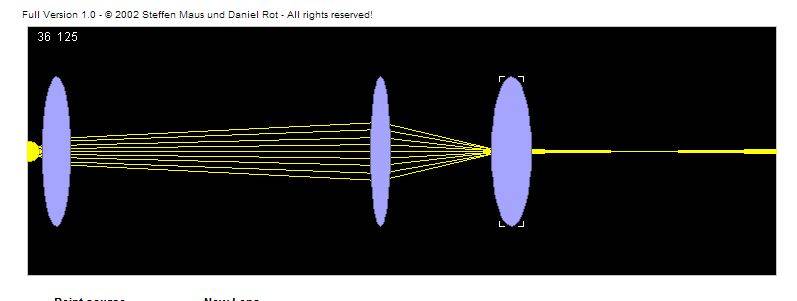
It seems like it should be easy to use two lenses to 1: focus light into a small point then 2: use a stronger lens past the focal point to keep the beams fairly parallel. Experimentally, I have not been able to achieve these results.

I have an LED flashlight which can project a fairly tight beam with high culmination. (shadows from objects in the beam are crisp at a considerable distance.

I place a lens in front of it with a focal length of 10cm and then another lens with a focal length of 1cm, 1cm behind the pinpoint of light. I would expect to be able to keep the beam of light fairly culminated but in a much tighter compressed beam. However my results are very diffuse, and when adjusted to project an actual image, the image size is larger than the original.

I'm just curious if it is possible to compress sunlight into a pinpoint, and then keep it pinpoint size by using a concave lens to focus the beam at infinity. I know sunlight isn't perfectly parallel, but it seems fairly parallel as shadows preserve their crispness for many meters.

I would think you could make a psuedo-laser "deathray" capable of igniting things for at least 30 feet?
6SAEUpY.jpg
 
Science news on Phys.org
I can't answer your question, but you mean collimating, not culminating.
 
My thought was that it may be difficult to collimate a non-coherent light source

collimating a coherent light source such as a laser is easy with lenses

await other comments :)

Dave
 
Obviously the sun is not coherent, but the rays are fairly parallel. I would think you can Compress them into a similarly parallel beam with a smaller radius.

Of course that beam could be directed with a mirror to aim it.

What I'm not clear on is how long you could effectively keep the beam narrow..
 
Bastian74 said:
Obviously the sun is not coherent, but the rays are fairly parallel. I would think you can Compress them into a similarly parallel beam with a smaller radius.

Of course that beam could be directed with a mirror to aim it.

What I'm not clear on is how long you could effectively keep the beam narrow..

The issue is that the Sun is far from a "point source". Instead of having a narrow beam, you'll have a number of collimated beams that spread out from each other. Actually, this is exactly what an eyepiece does. When focused correctly an eyepiece will cause exiting beams of light to be collimated in preparation for being focused by your eye.
 
Bastian74 said:
It seems like it should be easy to use two lenses to 1: focus light into a small point then 2: use a stronger lens past the focal point to keep the beams fairly parallel. Experimentally, I have not been able to achieve these results.

In actuality, focusing the beam actually makes it harder to focus it further, because you've introduced more beam divergence. (The more a beam is focused the more the beam diverges).

Bastian74 said:
I have an LED flashlight which can project a fairly tight beam with high culmination. (shadows from objects in the beam are crisp at a considerable distance.

I place a lens in front of it with a focal length of 10cm and then another lens with a focal length of 1cm, 1cm behind the pinpoint of light. I would expect to be able to keep the beam of light fairly culminated but in a much tighter compressed beam. However my results are very diffuse, and when adjusted to project an actual image, the image size is larger than the original.

The problem is probably that your flashlight is not collimated. For a collimated source, this ought to be quite easy.

Bastian74 said:
I'm just curious if it is possible to compress sunlight into a pinpoint, and then keep it pinpoint size by using a concave lens to focus the beam at infinity. I know sunlight isn't perfectly parallel, but it seems fairly parallel as shadows preserve their crispness for many meters.

Well, define "pinpoint". The size of an actual pin is cake for a good optical system. But if you mean "arbitrarily small", you have have problems because there the ray-optic approximation ceases to apply. You have to apply a wave-optic approximation instead, which always has some extraneous beam divergence by virtue of wave diffraction.

Bastian74 said:
I would think could make a psuedo-laser "deathray" capable of igniting things for at least 30 feet?

No death rays, which is probably for the best.

Claude.
 
Could you at least focus the sunlight into a pinpoint and capture it in a fiber optic cable?
At the exit end of the cable, would it be closer to a point source?
 
Bastian74 said:
It seems like it should be easy to use two lenses to 1: focus light into a small point then 2: use a stronger lens past the focal point to keep the beams fairly parallel. Experimentally, I have not been able to achieve these results.

I have an LED flashlight which can project a fairly tight beam with high culmination. (shadows from objects in the beam are crisp at a considerable distance.

I place a lens in front of it with a focal length of 10cm and then another lens with a focal length of 1cm, 1cm behind the pinpoint of light. I would expect to be able to keep the beam of light fairly culminated but in a much tighter compressed beam. However my results are very diffuse, and when adjusted to project an actual image, the image size is larger than the original.

I'm just curious if it is possible to compress sunlight into a pinpoint, and then keep it pinpoint size by using a concave lens to focus the beam at infinity. I know sunlight isn't perfectly parallel, but it seems fairly parallel as shadows preserve their crispness for many meters.

I would think you could make a psuedo-laser "deathray" capable of igniting things for at least 30 feet?
6SAEUpY.jpg

Have you tried that setup outside in the sun? I wonder. How large of a lens would you need for the sun to boil rock?
 
I'm starting to understand the problem with that approach using non point-source light, but I'm curious if there is a way to turn sunlight into an effective point-source?

I'm also curious if holographic film could be used to "straighten" the light passing through it...
 
  • #10
Bastian74 said:
I'm starting to understand the problem with that approach using non point-source light, but I'm curious if there is a way to turn sunlight into an effective point-source?

I'm also curious if holographic film could be used to "straighten" the light passing through it...

Use a spatial filter- focus the light onto a (small) pinhole. The pinhole, if small enough (10 microns or so), acts as a point source.
 
  • #11
The general principle that makes your death ray impossible is that the area-solid angle product of an optical system cannot increase in a passive system. With sunlight you get almost collimated rays of the same area as your input aperture. Your flashlight is probably configured so the output is similar. To focus these down you increase the solid angle. To do this you have 'traded' a small spread in angle for a small spread in space. Entendue is a commonly used term for this.

As Andy Resnick says a pinhole will allow superior collimating but will cost you light.
 

Similar threads

  • · Replies 9 ·
Replies
9
Views
3K
  • · Replies 2 ·
Replies
2
Views
1K
  • · Replies 10 ·
Replies
10
Views
2K
  • · Replies 7 ·
Replies
7
Views
2K
  • · Replies 1 ·
Replies
1
Views
2K
  • · Replies 10 ·
Replies
10
Views
3K
  • · Replies 58 ·
2
Replies
58
Views
8K
  • · Replies 9 ·
Replies
9
Views
4K
  • · Replies 2 ·
Replies
2
Views
2K
  • · Replies 2 ·
Replies
2
Views
5K