Complex Circuit Analysis Simplification

Click For Summary

Discussion Overview

The discussion revolves around the analysis and simplification of a complex circuit, specifically focusing on deriving equations for voltages U1 and U2. Participants explore methods to substitute one equation into another and seek assistance in achieving a form that matches their circuit simulator's output.

Discussion Character

  • Technical explanation
  • Mathematical reasoning
  • Homework-related

Main Points Raised

  • One participant presents an equation for U2 and seeks help to substitute it into the equation for U1, expressing difficulty in achieving the expected result from their circuit simulator.
  • Another participant suggests using Thevenin's equivalent circuit for R1, R2, and E2, providing equations for Eth and Rth, as well as expressions for V3 and I.
  • A later reply indicates that the suggestion was tried but did not lead to a successful derivation of U1, with the participant expressing frustration over their inability to simplify the equations.
  • One participant corrects a previous statement, clarifying that U1 should be used instead of V3 in their calculations.
  • Another participant shares the output from their simulator, which does not match their derived equations, and provides the name of the simulation program used.
  • A final post reveals that the original poster successfully derived the equation after considering the Thevenin equivalent, expressing relief and gratitude for the assistance received.

Areas of Agreement / Disagreement

Participants generally agree on the utility of Thevenin's equivalent circuit in simplifying the analysis, but there remains uncertainty regarding the specific derivations and the matching of results with the simulator's output. The discussion reflects a mix of attempted solutions and ongoing challenges without a definitive resolution.

Contextual Notes

Limitations include the potential for errors in the derivations, dependence on the definitions of circuit components, and unresolved steps in the mathematical simplifications. The specific conditions under which the equations hold may also be unclear.

jonlg_uk
Messages
141
Reaction score
0
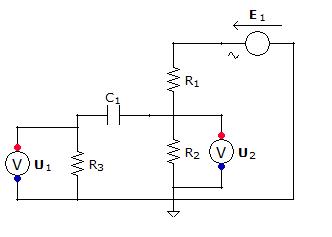
I have the following circuit...
circuit22.jpg


I have managed to derive an equation for U2:
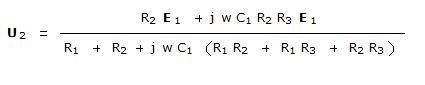
u22.jpg


Now I want to substitute U2 into U1, in order to derive equation for U1

I have defined U1 as:
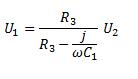
u11.jpg


Now I substitute U2 into the above equation. This is how far I get...I am stuck...


My circuit simulator is saying that U1 is equal to:
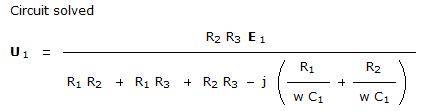

u11sol.jpg


However I cannot simplify to get this equation. Can someone please help I have spent hours trying to get U1 to look like the U1 that the simulator produces.


I thank you in advance.
 
Physics news on Phys.org
Have you try to replace R1, R2 and E2 with his Thevenine equivalent circuit ?
Eth = R2/ ( R1 + R2 ) * E1 and Rth = R1||R2

attachment.php?attachmentid=43692&stc=1&d=1328795691.jpg


V3 = I * R3

[tex]I = \frac{Eth}{\sqrt{(Rth + R3)^2 + Xc^2)}} = \frac{E1*\frac{R2}{R1+R2}}{\sqrt{(R1||R2 + R3)^2 + Xc^2)}}[/tex]

And

[tex]V3 = \frac{E1*R2*R3}{(R1+R2)\sqrt{(R1||R2 + R3)^2 + Xc^2)}}[/tex]
 

Attachments

  • circuit22.jpg
    circuit22.jpg
    4.8 KB · Views: 558
Last edited:
Jony130 said:
Have you try to replace R1, R2 and E2 with his Thevenine equivalent circuit ?
Eth = R2/ ( R1 + R2 ) * E1 and Rth = R1||R2

attachment.php?attachmentid=43692&stc=1&d=1328795691.jpg


V3 = I * R3

[tex]I = \frac{Eth}{\sqrt{(Rth + R3)^2 + Xc^2)}} = \frac{E1*\frac{R2}{R1+R2}}{\sqrt{(R1||R2 + R3)^2 + Xc^2)}}[/tex]

And

[tex]V3 = \frac{E1*R2*R3}{(R1+R2)\sqrt{(R1||R2 + R3)^2 + Xc^2)}}[/tex]

No I haven't tried this before, but I did just try it and I still can't derive U1. Perhaps I am being stupid...
 
A made a small error instead of V3 I should write U1

jonlg_uk said:
IMy circuit simulator is saying that U1 is equal to:
u11sol.jpg
What is the name of your simulation program?
 
Thanks for your help Jony, the simulator is giving me this equation:

u11sol.jpg


I haven't derived that myself^. When I expand out the equation you derived:


[tex]V3 = \frac{E1*R2*R3}{(R1+R2)\sqrt{(R1||R2 + R3)^2 + Xc^2)}}[/tex]

I still not can get a the equation looking like the simulator one.


BTW the simulator is called Solve Elec, you can download it for free.

[URL="http://www.physicsbox.com/indexsolveelec2en.html[/URL]
 
Last edited by a moderator:
Ah done it! you are right I was being stupid. I am upset with myself that I never thought to do a thevin equivalent :( thanks a lot for your help. I can sleep peacefully tonight.
 

Similar threads

  • · Replies 5 ·
Replies
5
Views
2K
  • · Replies 9 ·
Replies
9
Views
4K
  • · Replies 1 ·
Replies
1
Views
2K
  • · Replies 6 ·
Replies
6
Views
5K
  • · Replies 2 ·
Replies
2
Views
2K
  • · Replies 16 ·
Replies
16
Views
2K
  • · Replies 6 ·
Replies
6
Views
3K
  • · Replies 1 ·
Replies
1
Views
2K
  • · Replies 2 ·
Replies
2
Views
2K
  • · Replies 4 ·
Replies
4
Views
2K