Complex Fourier series of sin (t)

Click For Summary

Discussion Overview

The discussion revolves around the calculation of the complex Fourier series coefficients for the function sin(t). Participants are examining the derivation of the coefficients, specifically Cn, and addressing discrepancies in their results.

Discussion Character

  • Technical explanation
  • Debate/contested
  • Mathematical reasoning

Main Points Raised

  • One participant reports arriving at a different answer for Cn, citing an extra factor of (1/i) that appeared during the integration process.
  • Another participant suggests that the original source may have intentionally omitted the factor, questioning the completeness of the provided information.
  • Some participants assert that f(t) = sin(t) is its own Fourier series, indicating that the coefficient c1 should include a factor of 1/i.
  • One participant requests further details on the derivation to clarify the disagreement.
  • A later reply acknowledges a mistake in their earlier reasoning, but does not resolve the overall disagreement.

Areas of Agreement / Disagreement

Participants express differing views on the correct form of the Fourier series coefficients, particularly regarding the inclusion of the factor (1/i). The discussion remains unresolved with multiple competing interpretations of the derivation.

Contextual Notes

There are indications of missing assumptions in the derivations, and the discussion highlights the dependence on specific definitions of the Fourier coefficients. Unresolved mathematical steps contribute to the ongoing debate.

unscientific
Messages
1,728
Reaction score
13
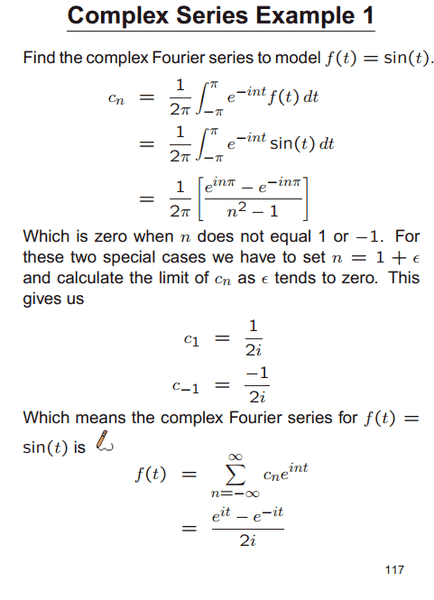
In finding Cn, I arrived at a different answer. I got an extra factor of (1/i) instead, which came when you do the integral of each exponential with respect to t; so you get a factor of 1/i(1-n) and 1/i(1+n) respectively..

Did they intentionally leave that out?
x1mz9j.png
 
Last edited:
Physics news on Phys.org
http://www.math24.net/complex-form-of-fourier-series.html

The above may help.

This should be in one of the math forums.
 
Last edited:
Addition thought. f(t) = sint is its own Fourier series. exp(it) = cost + isint. Therefore c1 needs a coefficient 1/i. I can't see what your disagreement is about. Perhaps you can give the details of your derivation.
 
mathman said:
Addition thought. f(t) = sint is its own Fourier series. exp(it) = cost + isint. Therefore c1 needs a coefficient 1/i. I can't see what your disagreement is about. Perhaps you can give the details of your derivation.

Sorry, I spotted my mistake!
 

Similar threads

  • · Replies 1 ·
Replies
1
Views
2K
  • · Replies 3 ·
Replies
3
Views
2K
  • · Replies 2 ·
Replies
2
Views
1K
Replies
3
Views
2K
Replies
3
Views
2K
  • · Replies 1 ·
Replies
1
Views
2K
  • · Replies 4 ·
Replies
4
Views
4K
  • · Replies 1 ·
Replies
1
Views
2K
  • · Replies 1 ·
Replies
1
Views
3K
  • · Replies 16 ·
Replies
16
Views
2K